

There’s probably no one in the world who wants the Fed to raise rates more than Japanese Finance Minister Taro Aso.
Earlier this month, Aso threatened to intervene in the FX market if the yen continued to trade in a “disorderly, one-sided, speculative” manner. For those who haven’t followed the story, this is a big deal.
The yen serves as a kind of barometer for the extent to which central banks are losing credibility. The Bank of Japan has pushed the limits of accommodative monetary policy perhaps more than any other developed market central bank. Haruhiko Kuroda is monetizing the entirety of gross JGB issuance and he’s also effectively cornered the Japanese ETF market. Incredibly, the BoJ is a top-10 holder in 90% of the Nikkei. As a reminder, Japan needs a weak yen in order to escape the iron grip of deflation and to ensure that the country’s exporters remain competitive amid the protracted global currency wars. Here’s a handy summary of the BoJ’s unprecedented accommodation via Barclays:
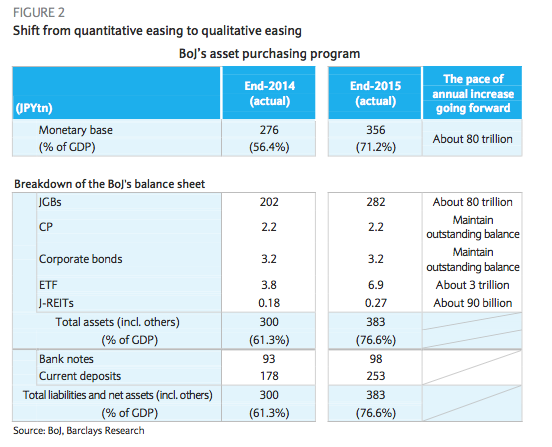
(Table: Barclays)
The problem for Japan is that the yen has a tendency to absorb safe haven flows and that effectively puts a floor under the currency. That’s complicated by the fact that the market is beginning to smell blood when it comes to the BoJ’s ability to drive currency depreciation by adopting an ever easier monetary policy.
The wheels started to come off in earnest after Kuroda’s surprise move to take rates negative in late January. The market interpreted the NIRP lean as an act of sheer desperation. Instead of driving the yen lower, Kuroda accidentally triggered a rally.
Subsequently, it was determined that the world needs a stronger dollar like it needs a hole in the head and so, much to the chagrin of the ECB and the BoJ, the Fed stood pat in March. At that point it was clear that the decision had been made at the G20 in February to sacrifice the euro and the yen (i.e. to allow them to strengthen) in the short-term in order to i) drive dollar weakness, ii) push up crude prices, and iii) give risk a bid. And it worked.
But after the BoJ refrained from easing further last month triggering a sharp rally in the yen, Aso had seen enough. Japan, he said, would intervene directly if the “one-way” move continued.
That didn’t please Treasury secretary Jack Lew and although last week’s hawkish Fed speak went some ways toward alleviating appreciation pressure on the yen, the tension was palpable over the weekend at the G7 meeting in Sendai. “It’s a pretty high bar to have disorderly FX conditions,” Lew said, in a jab at Aso’s characterization of the prevailing market dynamic. "It's important that the G7 has an agreement not only to refrain from competitive devaluations, but to communicate so that we don't surprise each other,” Lew added.
For his part, Aso told the media there was “no heated debate.” "I told Lew that recent currency moves were one-sided and speculative," he said. Here’s Morgan Stanley’s take, for what it’s worth:
“The question is, what is the definition of "excessive”? Japan’s Finance Minister Aso said recently: "If the yen was gaining 5 yen in two days, it might gain 10 yen in four days. That would be too excessive and if such trend continued, it would be the kind of excessive currency volatility that G20 nations agreed was undesirable". Other countries such as many EMs in Asia intervene in the FX markets but there isn’t a level described or any particular measure of volatility they would deem as “excessive”. We think the probability of FX intervention in Japan is very low. Excessive moves would require the currency to continuously appreciate by more than say 10% within 4-5 days. Global FX volatility is high on a historical basis but still within similar levels seen in the early 2000s when the BoJ was intervening the most aggressively. The main change today, which makes us even more convinced that the probability of FX interventions is low, is that the bid-offer spread is very low relative to times of stress (say the 2008 financial crisis). Global central banks may become concerned if this measure starts to rise rapidly:"
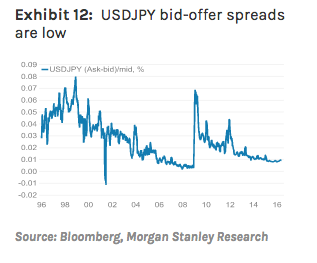
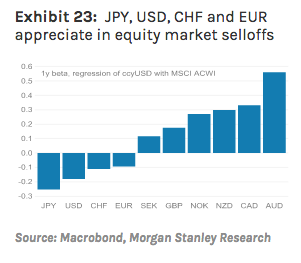
Be that as it may, there are a number of reasons to think the yen will appreciate from here. For instance, if we get a selloff in risk, you can expect inflows. As Morgan Stanley goes on to note, “the JPY appreciates more than the USD in times of a global equities sell off, followed by the CHF and the EUR.”
Unfortunately for the Japanese, even a Fed hike could end up driving the yen higher because of the knock-on effect it would have on risk assets and, more specifically, on China. Consider the following from FT:
“Jane Foley, G10 FX strategist at Rabobank, said the haven status of the yen could return as a favoured trade if concerns about China resurfaced.
“‘This would likely throw any uptrend in dollar-yen well off course and could thus rekindle the conflict between the US Treasury and the MoF about the circumstances that would justify FX intervention,’ Ms Foley said.”
On Monday, the yen was resurgent following reports of a larger than expected trade surplus for Japan. “There is a shared perception in the markets that the yen has little room for further decline given the present cheapness in the currency ,” Barclays wrote, earlier this month.
It certainly appears as though there’s about to be a rather epic FX battle between the market and the Japanese Ministry of Finance. Pick your side.