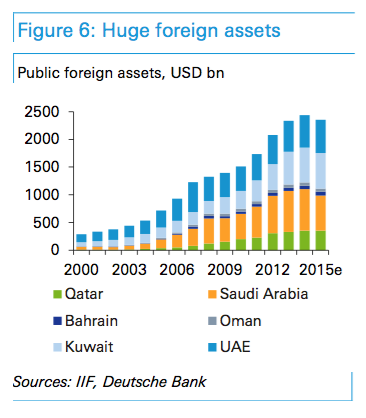

I’ve thought (and written) quite a bit about what Deutsche Bank called “quantitative tightening” last autumn.
The concept, like many complicated-sounding ideas, is actually simple: countries hold reserves to guard against economic turmoil and when they sell those reserves in times of stress it amounts to the opposite of QE because those reserves are primarily denominated in USD.
If I’m a commodities exporter and I’m not completely obtuse, I learned a lesson from what I saw in the Asian Financial Crisis and I’ve stockpiled dollar assets that I can sell when things go bad. Of course what I’m selling is exactly what the Fed was buying (i.e. Treasurys) so in a way, my actions offset what the FOMC has been doing for the better part of eight years. To the extent countries hold euro and yen assets, the dynamic is the same.
Of course this trade wasn’t as much of a no-brainer as it seemed. China was liquidating its reserves at an absurd pace last August and the likes of Saudi Arabia were drawing down their rainy day funds as well. The one-way trade should have been short US paper. Think about it. If markets are simple and amenable to unidimensional analysis, Treasury yields should have spiked. Here’s what Citi said last year:
“On the short-term impact, one recent paper estimates that if foreign official inflows into U.S. Treasuries were to decrease in a given month by $100 billion, 5- year Treasury rates would rise by about 40–60 basis points in the short run.”
That kind of happened and kind of didn’t. You did get a pretty pronounced move up from the October lows (yield-wise) but it quickly reversed with risk-off sentiment in January and cause and effect was almost impossible to determine.
Then, this month, we got a shocker: Bloomberg reported that Saudi Arabia only owns $117 billion in US debt. That figure came courtesy of an FOIA request and it frankly makes no sense. If Saudi Arabia’s reserves sit at something like $600 billion, how is it possible that less than a fifth of that is denominated in dollars? What else does Riyadh hold in terms of reserve assets?
And not only does it make no sense, it has real implications for where USTs (not to mention the dollar) are headed going forward. Here you have a Federal Reserve that’s suddenly hell-bent on raising rates, China which will need to sell more USD assets to keep a lid on yuan depreciation should the market get spooked again, and still depressed commodity prices that effectively force exporters to sell reserves to protect their currencies and their economies.
As I’ve documented exhaustively, Saudi Arabia will ultimately be forced to draw down their entire reserve stash. Quite simply, they are going broke. If you assume any kind of reasonable estimate for what they hold in US Treasurys, you should see something like 150 bps of upward pressure on 5-year yields. If you throw in a Fed hike, you’re talking about 163 bps (give or take) and then there’s China selling. It should be a veritable bloodbath. You could make a fortune being bearish on USTs.
That’s probably why Washington wants to obscure how much in USTs the Saudis actually own. There are already enough reasons to be bearish on US paper. Washington wasn’t keen on providing Bloomberg with another.
This isn’t some conspiracy theory. The Washington Post’s Daniel Drezner is out Wednesday with his own take on the issue and he, like me, is incredulous. Here are some excerpts:
“Devoted readers of Spoiler Alerts might remember an item last month in which Saudi Arabia threatened to dump its holdings of U.S. debt if a bill passed Congress that would permit the Saudi government to be liable for the Sept. 11, 2001, terrorist attacks. While there were decent substantive reasons to oppose the bill, I blogged that Saudi Arabia’s leverage was not that great at all. What was interesting was the degree to which everyone else in Washington agreed.
“The extent of Saudi Arabia’s holdings of dollar-denominated debt has been a subject of considerable hand-wringing over the years, right up to this year. But the truth is that $116 billion is not a lot of holdings. At all. It’s a lot less than the $750 billion the Saudis threatened to dump on the markets when the kerfuffle with Congress was brewing. It would certainly make any Saudi threats about financial statecraft ring even more hollow.”
“And the Treasury Department’s release of the information certainly tarnishes the image of the kingdom as a financial powerhouse.”
Yes, it does. And as Drezner points out, it’s flat out strange:
“$116 billion is a super-low number. It’s just weird.”
It sure is. And it’s entirely possible that, like China, the Saudis have a substantial amount of their UST exposure in custodial accounts.
And really, we should all hope that’s the case. Because it’s not as though they’re holding the majority of their reserves in a currency other than the dollar.
So if they’re not holding USTs, but they’re holding USD assets, the question is this: are they holding stocks? And if so, what happens when they sell?
And further, as I mentioned last week, what happens when all of the beleaguered producers sell?