

Something important happened today.
The ubiquitous “people familiar with the matter” confirmed that Saudi Arabia is set to tap international capital markets for the first time in a bond sale worth as much as $15 billion.
Although the Gulf’s budget crunch began making front page financial news (finally) late last year and has been a hot topic for the last several months, I can say with some degree of confidence that quite a few market participants still don’t fully grasp how big of a deal this is.
Let me start at the conceptual level. This marks an epochal shift in the way the world thinks about capital flows. For years, oil producers recycled their surplus petrodollars (i.e. USD denominated crude proceeds) back into international capital markets and primarily into USD assets like Treasurys. That is, they were net exporters of capital.
All of that changed in late 2014. When the Saudis drove prices into the ground, the dynamic began to shift and in fairly short order, producing states became net importers of capital. Graphically, the swing looks like this:
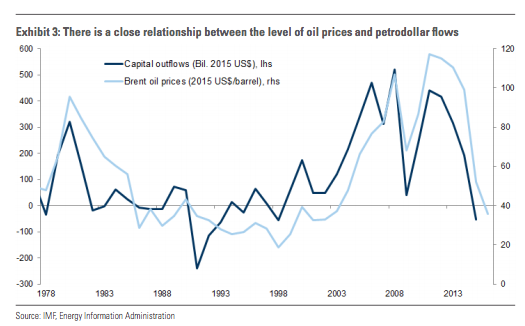
(Chart: Goldman)
I have detailed the petrodollar reversal on a number of occasions (see here for example) so I won’t rehash the entire story here, but suffice to say that this shift will serve to suck around $300 billion in liquidity from the global financial system each year - and that’s excluding Norway.
So that’s the big picture. At the country level, the Saudis have taken it on the chin from the protracted slump in crude. This is also something I’ve written quite a bit about (see here for the full treatment), so for the sake of brevity I will make this is a simple to understand as possible.
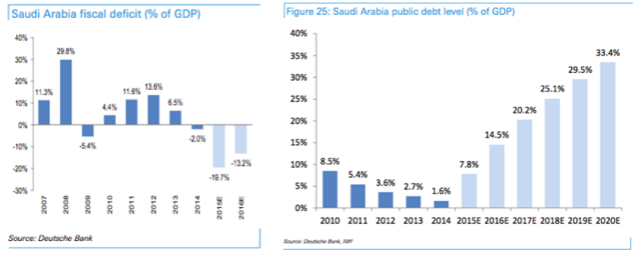
The Saudis came into the oil slump with a fiscal surplus of 6.5% of GDP and a debt-to-GDP ratio of basically zero. By the end of last year, the fiscal situation had swung to a massive deficit worth 15% of output and projections for the debt-to-GDP ratio were alarming (if not for the actual percentage, at least for the rate of growth):
But the kingdom’s situation is unique. They also provide generous (and thereby expensive) subsidies to the public. It’s a kind of “let us keep living in gold palaces and we’ll give you stuff that’s basically free and provide jobs” type of arrangement. Those subsidies were sharply curtailed last year as part of Riyadh’s plan to get the budget under control.
The kingdom must also preserve its currency’s peg to the USD. Without getting into the mechanics, just know that when the market smells blood, defending that peg becomes expensive.
The Saudis also came into the crude downturn with reserves totaling some $700 billion. That’s helped them weather the storm (a storm of their own making, mind you). But those reserves have dwindled. In April, the country’s foreign assets fell more than 1% and now sit at around $570 billion, give or take.
This is the backdrop against which deputy crown prince Mohammed bin Salman has embarked on an ambitious plan to get the kingdom back on a sustainable path before either the people revolt after deeper subsidy cuts, the riyal peg falls, or Riyadh goes broke. Or perhaps all of the above.
There’s only one problem with the plan (well, actually there are all kinds of problems with it, but let’s just leave those aside for now): Mohammed bin Salman wants to have his cake and eat it too. He wants to keep oil prices low in order to pressure regional rival Iran and drive US shale out of business, but he wants to get the fiscal house back in order. Guess what: that’s probably not possible.
And so, the Saudis are going to test the waters on an international bond sale. As Bloomberg notes, they let their fellow Gulf monarchies take a stab at it first:
“The country may replicate Qatar’s $9 billion sale by issuing bonds with five-, 10- and 30- year maturities, the people said, asking not to be identified as the talks are private. It’s weighing a sale of $10 billion to $15 billion after the end of Ramadan in July.
“Governments in the six-nation Gulf Cooperation Council, which includes the two-biggest Arab economies of Saudi Arabia and the United Arab Emirates, are turning to public markets to raise funds after a plunge in oil prices led to higher budget deficits. Qatar last week attracted $23 billion in orders for its $9 billion sale, the biggest-ever bond issue from the Middle East.”
I’ll have much more on this as the story develops, and will provide more granular detail on the kingdom’s finances in the coming days, but for now, it’s important that every investor understand the 30,000 foot view here.
Oh by the way, there is (as always) a punchline: the Saudis will benefit from the very same historically low borrowing costs that allowed their competition in the US shale space to stay in business even as nearly the entire sector is and always was, cash flow negative.