
If the leaders of the world’s advanced economies are very concerned about global growth, then Japanese Prime Minister Shinzo Abe is very, very, very concerned (so that’s three “verys” for Abe versus one “very” for everyone else).
To be sure, part of the reason Abe seems to be on the verge of a meltdown when it comes to hand-wringing about the prospects for the global economy is that Japan looks like it may just end up mired in a kind of never-ending recession where deflation lasts forever and the demographics get perpetually worse. That’s why Abe essentially tried to incite a panic at this week’s G7 meeting by going the nuclear route: he invoked Lehman.
That invocation was met with mixed reviews by the Prime Minister’s counterparts partly because it was seen as an excuse for delaying a planned sales tax hike and partly because it was set against the backdrop of Finance Minister Taro Aso’s threat to intervene in the FX market to dampen yen strength, a suggestion the US Treasury was none too pleased with.
When the meeting was said and done, we got a 32-page, rambling declaration full of largely amorphous promises like these:
"Global growth remains moderate and below potential, while risks of weak growth persist. Global growth is our urgent priority.” (full statement)
Compare that to Abe’s alarmist rhetoric:
“There is a risk of the global economy falling into crisis if appropriate policy responses are not made."
The bottom line is that Japan is about to go the “helicopter money” route and Abe would like for everyone else to come along for the ride.
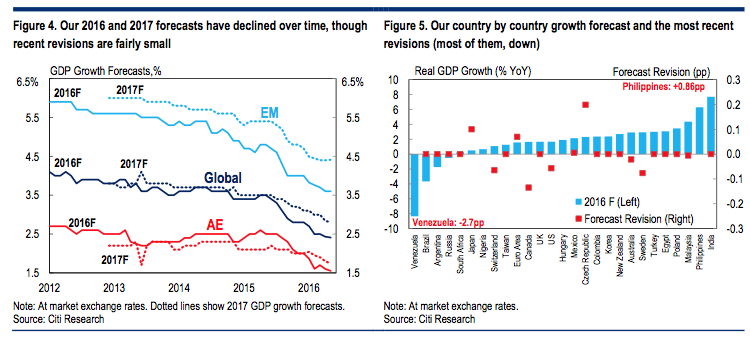
But world leader pontificating aside, it is important to recognize that in fact, global growth and trade is subdued. That’s obviously been parroted any number of times by analysts, bloggers, and pundits alike, but what we’re coming to realize is that this time may really be different.
It feels like we may have entered a new era in the post-crisis world. Sluggish global growth and trade seem to have become structural and endemic rather than cyclical and transient.
That’s bad news.
One of my favorite quotes (in a kind of morbid way) comes from WTO chief economist Robert Koopman who said last autumn that “it’s almost like the timing belt on the global growth engine is a bit off or the cylinders are not firing as they should.”
That came as WSJ noted that “for the third year in a row, the rate of growth in global trade is set to trail the already sluggish expansion of the world economy.”
Prior to 2010, the last time that happened was 1985.
For a more granular take on the collapse of trade (and this is something I find particularly interesting) take a few minutes and research the collapse of Class 8 truck orders in the US. Those are the big boys that form the veritable backbone of overland freight in America. Here’s an excerpt from a Transport Topics piece that ran earlier this month:
“Class 8 truck orders tumbled 39% year-over-year in April, reaching a seven-year low for the month, in the midst of a weak freight environment, slumping used-truck prices and overstocked dealer lots, two consulting firms reported.
“‘Class 8 orders were once again below expectations with the downshift in order activity continuing,” Don Ake, vice president of commercial vehicles at FTR, said in a statement. “This order volume is surprisingly low. Fleets have right-sized for the current freight volumes and do not need additional units. They are being very cautious to not overextend, until business improves some. Inventories remain bloated. The OEMs will not be able to maintain current build rates under these order conditions. It appears more production cuts are on the way.”
Part of the problem is of course overcapacity and rampant supply gluts across the globe. Part of the problem is also a dearth of demand across markets. As it turns out, DM central banks have been unable to boost aggregate demand using the current preferred method: pumping money into the system using primary dealer intermediaries. That’s why they’re toying with the idea of cutting out the intermediary and simply sending out checks in the mail.
As the US enters the holiday weekend, I’ll leave you with the following thoughts from Citi on what is quickly becoming the most important macro topic in the minds of markets:
“One of the reasons for the continued sluggishness of global growth may have been the persistence of uncertainty about individual events in recent years (such as Grexit, the US fiscal cliff, or the Chinese currency regime) and global growth prospects more generally. Uncertainty implies that there will in general be an option value of waiting, often dampening the willingness to invest and perhaps induce precautionary savings. Uncertainty about economic and other policies may be among the most relevant sources of drag for the world economy. Currently, some of the open issues include: who will be the next US President? Will the Fed re-start its normalization process in June/July? Will China continue with broad and aggressive stimulus? Will the UK remain a member of the EU? Is policy in Brazil likely to get a fresh start? Will Japan be the first advanced economy to attempt helicopter money? Naturally, at any point in time, there are many different sources of uncertainty. The possible policy responses and their potential effectiveness under current economic circumstances is what, in our view, aggravates the toll on confidence and investment in the real economy as well as financial markets.”