

There are two reasons why oil prices will have a difficult time sustaining a rally above $50/bbl.
One reason is heightened tensions between Saudi Arabia and Iran. We’ve discussed this dynamic here before. Essentially, Iran is angling to ramp production to 4 million b/d. The (former) pariah state has already brought output back up to pre-sanction levels:
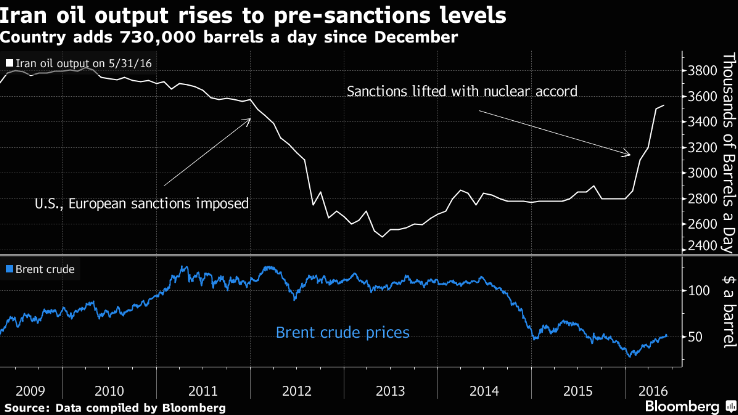
(Chart: Bloomberg)
But getting to 4 million is going to be a stretch considering the political ambiguities that still cloud opportunities for foreign investment. As Antoine Halff, a senior fellow at the Center on Global Energy Policy at Columbia University in New York told Bloomberg last week, “to exceed pre-sanctions levels would require investment and technology and that’s a much longer-term proposition.”
The second reason crude prices seem to have found a ceiling at $50/bbl is that “creative destruction” (so to speak) has been destroyed by the Fed’s insistence on keeping interest rates essentially glued to zero. What that does is drive investors into riskier assets in search of yield and that behavior, in turn, creates demand for HY debt. Debt like that issued by struggling US energy producers.
Historically, these companies have relied on capital markets to plug their funding gaps (as a group, they’re cash flow negative). As long as capital markets remain open, they can stay in business. As it turns out, $50/bbl is the magic number for some of these producers. That is, it’s the price at which the market gets more confident in their ability to survive and thus more willing to take on credit risk by loaning them more money, and the price at which the companies themselves start producing again.
The problem, of course, is that they are effectively digging themselves a hole (no pun intended) by resuming production. The world doesn’t need any more oil and by adding to the supply glut, US producers are simply ensuring that the very same oversupplied market that brought them to the brink of bankruptcy stays oversupplied. The Fed encourages this by keeping the cost of capital low. The market can’t purge misallocated capital. The balance can’t be restored.
This has been readily apparent for quite some time, but oil’s recent recovery has brought the issue to the fore.
One important consideration being debated by analysts this month is “drilled but uncompleted” wells or, DUCs. These may be the key to capping oil at $50. Citi has discussed this at length over the course of several notes and FT is out on Tuesday with a useful overview. Here are some excerpts:
“As oil trades at about $50 a barrel, everyone in the US industry is looking at DUCs.
“Wells that are Drilled but Uncompleted are holes in rock waiting for the steel tubing and hydraulic fracturing needed to bring them into production.
“From early in oil’s two-year downturn they have been seen as a readily available source of supply that will start producing as the market tightens.
“In recent weeks there have been signs that is happening. Several shale producers — including Continental Resources, EOG Resources and Oasis Petroleum — have started to complete some of their DUCs. Others, including Whiting Petroleum, have said they can follow suit if oil stays near $50.
“Some believe this ‘fracklog’ of uncompleted wells could put a ceiling on oil prices, which have already rallied almost 80 per cent from their January lows. On Tuesday, West Texas Intermediate, the US oil benchmark, was down 0.9 per cent at $50.18.
“Citigroup reckons DUCs could add up to 1m barrels per day to the market in the second half of the year, “putting the brakes on oil’s march higher.’”
In other words, by working through the so-called “fracklog,” US producers are effectively putting a lid on prices. Here’s Citi’s take:
“DUCs represent the low hanging fruit for US oil producers as well completion is ~55% of the total cost and oil production can be brought to market quicker. Citi’s DUC costs curve shows that most are actually economical at $50/bbl, and completions are already occurring, with Continental communicating this clearly to the market.
“Under Citi’s current price forecast (see Commodities), our model estimates US crude production at 8.4-m b/d by Dec-16, but DUC completions starting from May-16 could add ~1-m b/d in a high-case scenario, putting the brakes on oil’s march higher. This would be if the DUCs had an initial production of ~1-k b/d, but even a strong draw-down at an initial production rate of 600-b/d could yield ~600-k b/d of additional output in a 6-month timeframe.”
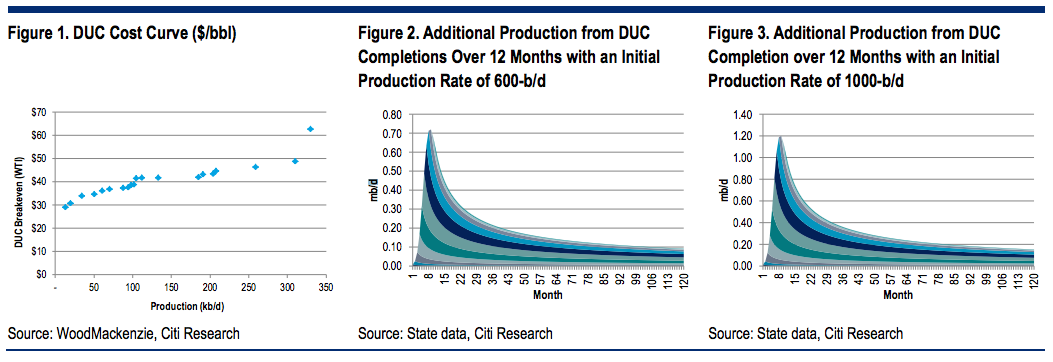
(Charts: Citi)
Now obviously, US producers are in a tough spot. If they start ramping up production, they’ll drive prices lower which could very well put them right back in the same place they were before. If they sit on their hands, they won’t be able to service their debt or stay in business.
So what should they do, just give up? Probably. Because no matter what you might have heard, reports of OPEC’s demise are premature. The Saudis may be on the fast track to bleeding their cash reserves dry, but between their ample room to borrow (the kingdom came into 2015 with a debt-to-GDP ratio of less than 2%) and their determination to keep the Iranians from taking in any more money than they already are from Tehran’s post-sanctions effort to get production to 4 million b/d, the deck is stacked against a sustained price recovery.
Throw in the fact that any type of black swan event (e.g. Brexit) would invariably drive the dollar higher (and thus oil lower) and you’re facing a decidedly difficult environment if you’re a US producer.
On the bright side, as long as the Fed delays the tightening cycle, they’ll probably be some bid for junk bonds and secondaries. So they may yet live to frack another day.