

This is it folks, last call for Brexit analysis and commentary. Or at least we hope so, although one certainly imagines that if the vote is close, whichever side loses will demand a do-over.
To be sure, markets are trading as though “remain” is a done deal. Have a look, for instance, at (in order) German stocks, UK stocks, crude, and the pound versus the Japanese yen:
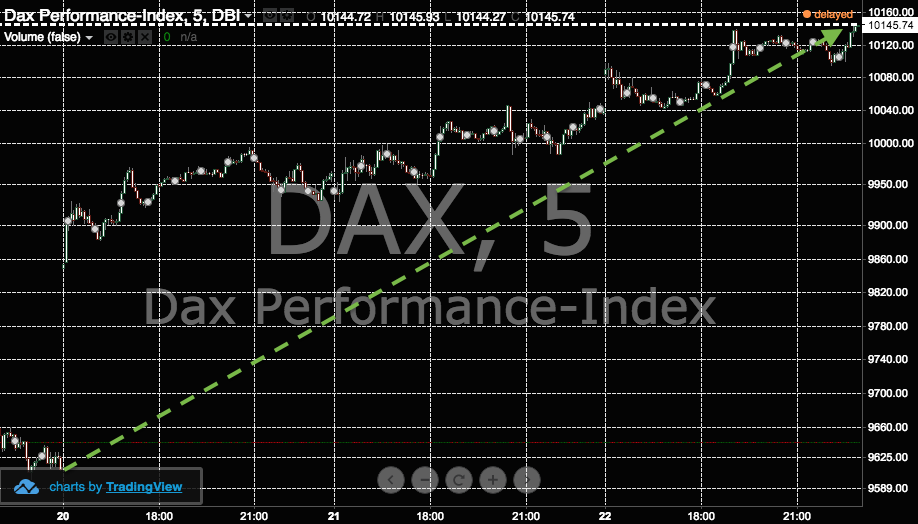
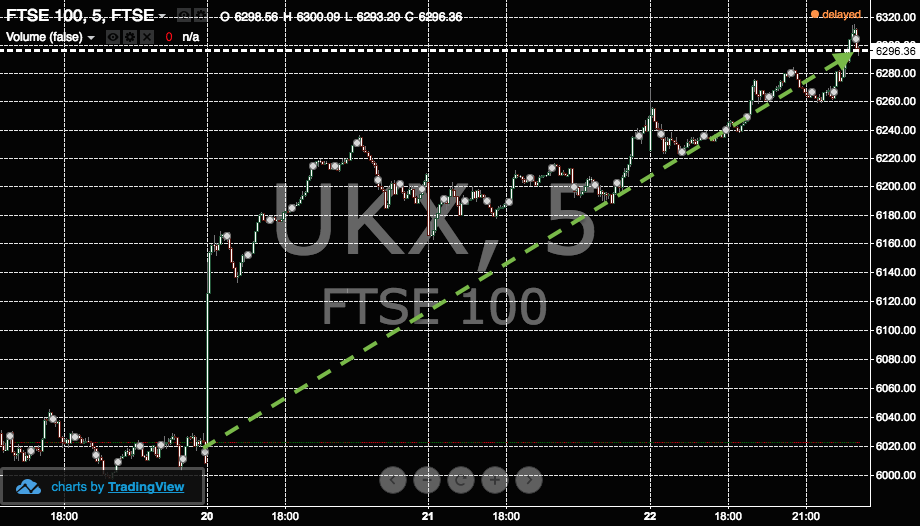
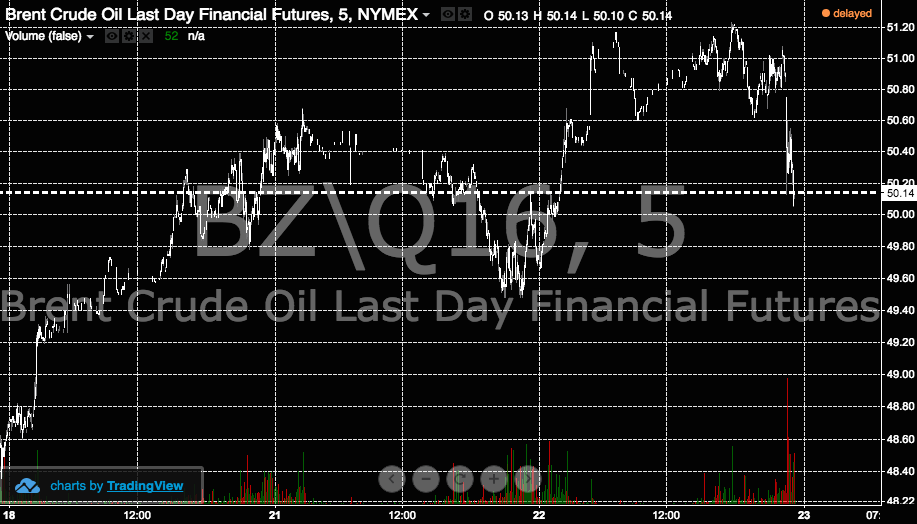
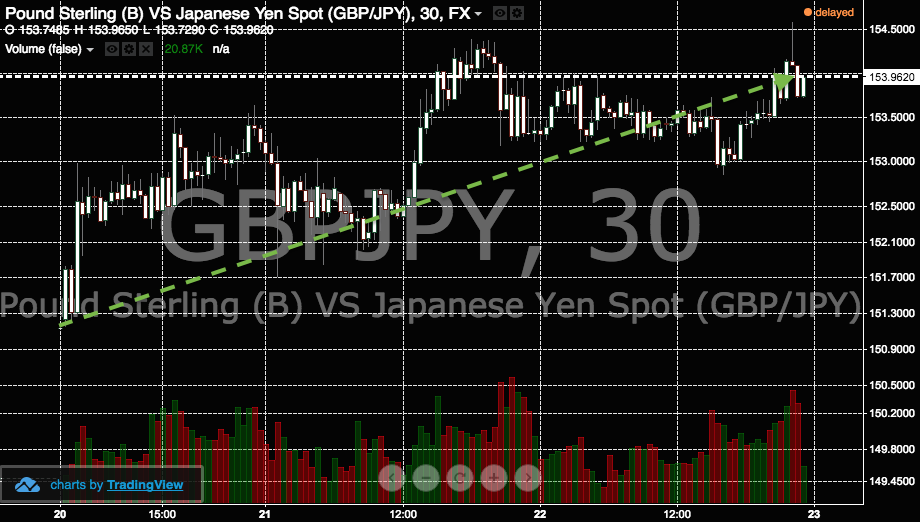
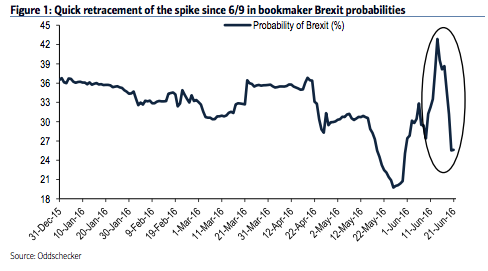
You’d think they’d already voted. Here’s a look at the swing in bookmaker odds:
(Chart: BofAML)
And all of this euphoria is predicated on a lawmaker getting shot. The media will tell you it’s because the poll numbers have shifted in favor of the “remain” side, but when you look at the numbers, it looks too close to call.
Given that, this seems like a problematic setup. That is, you don’t really want to head into a binary event where the outcome is about as far away from certain as it could possibly be with everyone crowding into one side of the trade. That sets the stage for a violent reversal, which in this case would mean a sharp sell-off for stocks, a gap down for crude, and a monumental rally for the yen.
And don’t forget the headline-scanning algos which will exacerbate an already volatile FX situation. “Traders are seeing prices for 50 pounds on bank platforms from one U.K. clearer up to 15 pips wide; relatively large vs the typical spread between 2-3 pips wide,” Bloomberg wrote overnight, citing traders. “There is no depth at all in the GBP queue,” one London trader said, adding that “market liquidity only an ‘impression’ that dries up as soon as real trades are placed.”
Incidentally, that sounds like every market across every asset class in the post-crisis world.
Anyway, on Monday we assessed the outlook for bonds, stocks, and commodities courtesy of Credit Suisse, FactSet, and Citi, respectively. Now, with the clock ticking, let’s take one last look at where equities might trade in the event of what Credit Suisse calls a “full Brexit scenario.”
First, let’s define “full Brexit.” Here’s Credit Suisse:
“This would involve invoking Article 50 almost immediately (within a few months). In this scenario, we see: i) UK GDP falling sharply (a contraction of 1% in 2017) and trend growth up to 2020 falling by around a third; ii) the Bank of England potentially restarting QE and the gilt yield potentially falling below 100bps; iii) euro area growth initially hit by c.0.2% in 2016 and c.1.0% in 2017 (to 1.5% and 1.0% GDP growth, respectively).”
Ok, so that’s bad. Got it. But what we care about is the potential impact on stocks. What say you Credit Suisse?
“Into a full Brexit scenario, the impact of a stronger dollar (including the implications on both commodities and the RMB) and disruption to the European growth cycle would be cause for us to revise down our S&P 500 year-end target to 2,000 from 2,150.”
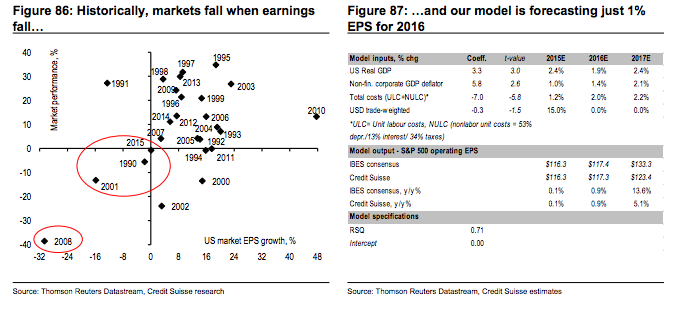
“Our key concerns with regard to equities are: i) equities are overall priced at fair value; ii) we forecast almost no US earnings growth; and iii) there is unusually high political, economic and business model risk at a time when governments are trying to redress the imbalance between owners of capital and labour.”
Here’s points one and two summed up visually:
(Charts: Credit Suisse)
The point here is simply this: risk looks stretched both from the perspective of how markets have traded this week, and from the perspective of fundamentals which suggest that US stocks might be fully priced, especially when one considers that a non-trivial amount of EPS “growth” has been engineered by resorting to buybacks.
On the bright side, we’ll get to see how all of these assets and currency pairs hold up when faced with a potential tail event. A dress rehearsal for November 8 perhaps?