

Heavy is the head that wears the crown.
It’s good to be king.
Asked to choose which of those old adages best describes how it feels to control the fate of the world’s reserve currency (“king dollar”) in a time of intractable currency wars and peak global debt, I imagine Janet Yellen would likely choose the former.
The Fed is in something of a tough spot. February’s so-called “Shanghai Accord” - in which the G-20 tacitly agreed to work towards a weaker dollar regime in the short to mid-term in order to support oil prices and risk assets following a harrowing January for markets - led directly to a dovish reversal by the FOMC in March, and two “checks” (to use a poker term) by the ECB and the BoJ, respectively, in April.
Put simply: central bankers were concerned that a March hike by the Fed could potentially reignite the global deflationary impulse, exacerbate EM outflows, play havoc with the CNY, and generally lead to risk-off sentiment across markets.
But a weak dollar policy isn’t necessarily palatable for the likes of Europe and Japan, who are desperately trying to devalue.
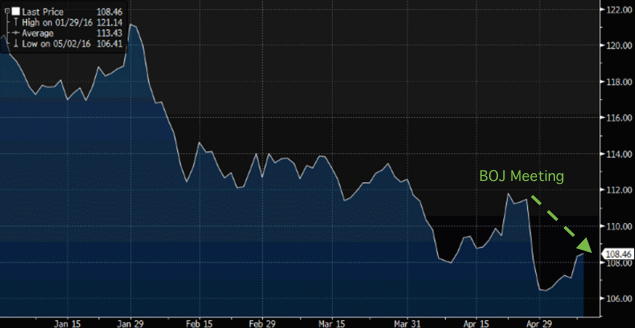
Earlier this week, Japanese FinMin Taro Aso made waves when he used the “I” word (intervention) twice in two days on the way to warning the market that excessive yen strength could not, and would not, be tolerated.
"Japan obviously will intervene if one-sided moves persist," he said. “It’s been quite rapid [and] we're determined to prevent such one-sided moves from accelerating.” Here’s what Aso means by “quite rapid”:
(Chart: Bloomberg)
The BoJ and the ECB, should they continue to play along with the weak USD game by keeping monetary policy on hold, will be shooting themselves in the foot for the sake of global stability. Here’s Goldman:
“But, in a way, the Fed has been something of a sideshow for the Dollar recently. After all, it was the decision by the BoJ not to take action last month that set in motion that last round of Dollar weakening. The market saw the BoJ’s move to negative interest rates in January as validating concerns that there are limits to aggressive QQE and interpreted the lack of action in April as further evidence in that regard. The Yen and the Euro strengthened sharply, giving rise to the latest round of Dollar weakening.”
In other words, the yen strength you see in the chart above on January 29 is the market saying “you are desperate” and the yen strength you see on April 28 is the market saying “you have given up.”
What’s interesting is that it isn’t clear the BoJ could do much - even if it wanted to. Haruhiko Kuroda is already monetizing the entirety of gross JGB issuance, he’s already taken rates negative, and the central bank’s ETF holdings are so large as to be laughable. One could make the same argument for the ECB, where Mario Draghi has taken the plunge into corporate credit. For their part, Goldman sees further scope for BoJ easing, but not so much for the ECB:
“Our view is that there is ample space for the BoJ to pursue aggressive balance sheet expansion. We still have faith that the BoJ is willing to surprise markets in a dovish way, which is the cornerstone of monetary policy at the zero lower bound. The ECB has now disappointed markets twice. We see the inability of the ECB to ease in an effective manner as signalling more fundamental disagreement over the path of policy within the institution.”
Translation: the USD can rally against the yen, but EUR weakness may not be in the cards. Or so says Goldman.
Despite the misgivings of the ECB and the BoJ, whose easing efforts are for all intents and purposes failing, the Fed seems to be far more concerned about the effect excessive hawkishness (and in today’s world “excessive” would be two hikes worth a paltry 50bps by the end of 2016) would have in an increasingly interconnected world laboring under a mountain of USD denominated debt.
On that point, Reuters is out today with an interesting piece that ties together a Morgan Stanley note on debt with a speech by the BIS’s Claudio Borio (who, as an aside, has a peculiar and rather amusing penchant for criticizing the very same list of central bankers that make up the BIS board).
“Aggregate world debt is now far higher than it was before the 2007-08 crash,” Reuters writes, which, incidentally, reminds us that Ray Dalio’s “beautiful deleveraging” is actually a myth.
"The saga of debt is far from over," Reuters continues, quoting Morgan Stanley. Here’s more from the piece:
“But the role of the U.S. dollar as the world's main reserve currency denominating large chunks of that debt pile is showing up as complicating factor that's added to risk of instability.
“The Bank for International Settlements estimates that while U.S. dollar dominance means it accounts for almost 90 percent of all foreign exchange transactions and some 60 percent of hard currency reserves. But crucially it also accounts for about 60 percent of all debts and assets outside the United States.
“And if the rest of the world goes into shock because of the higher cost of servicing and paying back those dollar debts, the boomerang effect on U.S. exporters, commodity firms and the wider economy just ends up tying the Fed's hands in ways made crystal clear this year already.”
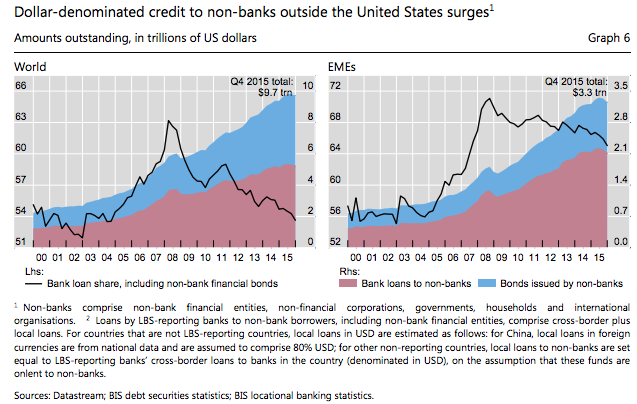
And here’s a visual from the transcript of Borio’s comments at the SNB-IMF conference in Zurich held this week:
The Fed then, is roped into a perpetually loose monetary policy regime. That, in turn, spreads to the rest of the world. This is how Borio ties all of the above together:
“Domestic monetary policy regimes pay little attention to the build-up of financial imbalances: their main focus is inflation but, as has become abundantly clear, the imbalances can grow even if inflation is low and stable. This easing bias then spreads from the core economies to rest of the world, regardless of their domestic conditions. The bias spreads directly, through the extensive reach of international currencies, mainly the dollar, beyond national borders. Hence the huge post-crisis expansion of US dollar credit to non-residents – a key indicator of global liquidity. Between 2009 and end-2015 this key indicator of global liquidity was up by some 50% to $9.7 trillion to non-banks and it doubled, to $3.3 trillion, to those non-banks resident in EMEs alone, marginally down from its historical mid-year peak.
“And it spreads indirectly, through policymakers’ resistance to exchange rate appreciation out of macroeconomic, financial stability or possibly competitiveness concerns. Central banks in the rest of the world keep interest rates lower than otherwise and/or intervene in the FX market, further pushing down bond yields in the source countries.
“As a result, easing begets easing. Thus, according to typical benchmarks, monetary policy has been exceptionally easy for exceptionally long at the global level. Importantly, in this story the increase in reserves is not so much precautionary, but the by-product of other policies.”
For the FOMC, juggling all of these concerns is becoming more and more difficult. The problem - as suggested by Borio - is that the further the Fed pushes out the normalization process, the greater the problem becomes. We saw this last year when the FOMC was forced to abandon the September hike.
Now, it appears they may have missed their window to embark on a sustained tightening cycle. December’s “liftoff” was followed by a January meltdown and, as Reuters puts it, “the subsequent recovery only came about once the Federal Reserve hastily made clear it was pressing the pause button precisely because of seismic events in world finance.”
Now, the market is pricing just a 4% chance of a June hike.
We close exactly as we opened: heavy is the head...