

Going into this week, some traders assumed things couldn’t get any worse for LendingClub.
Shares in the beleaguered marketplace lender tumbled last week following an internal investigation into falsified loans sold to Jefferies and after it was revealed that CEO Renaud Laplanche failed to tell the board about a stake he had in a fund LendingClub was considering investing in.
Naturally, the retail crowd was tempted to catch the falling knife. LendingClub is a story stock and there are some who believe the story still makes sense. The rationale goes something like this: P2P lenders will continue to be disruptive and will ultimately take market share from traditional lenders on the way to supplanting the old model. Who needs loan officers when you’ve got algorithms?
For those who might not be familiar with this space, there are two problems with the P2P or “marketplace” model.
First, the algorithms haven’t been tested over a full credit cycle. Marketplace lenders have been able to wrench business away from traditional banks by touting their ability to speedily process loans. But speed isn’t necessarily something that’s desirable when it comes to underwriting. Earlier this year for example, LC Advisors (a vehicle owned by LendingClub that buys the company’s loans) said write-offs for 5-year loans originated by LendingClub were considerably higher than forecast.
Second, the model depends upon the ability to offload credit risk. These companies lean on the same “originate to sell” dynamic that drove the housing market right off a cliff in 2008. Marketplace lenders make loans based on algorithms and then sell those loans to the likes of Jefferies and Goldman Sachs. Propser - another popular marketplace lender - sells its loans to banks which then package them into ABS. If marketplace lenders were forced to retain credit risk on their own books, they could end up without sufficient capital to make new loans. Just this week, Fitch weighed in on the impact the LendingClub debacle has had on demand for P2P-backed paper:
“Investor confidence in US marketplace lending ABS tumbled last week on events surrounding the industry's largest player, Fitch Ratings says. The latest news adds to other significant challenges facing the sector, including limited history, management of rapid growth, the recently volatile capital markets, and growing legal and regulatory risks. Fitch rates two marketplace ABS deals backed by loans originated through Prosper. Their performance, to date, has been within expectations and we do not expect recent events to affect the ratings of these deals. However, last week's events will result in heightened scrutiny from investors and regulators, as they involve Lending Club. This comes at a critical stage in the development of the burgeoning marketplace lending ABS market. Building and maintaining investor confidence is vital if marketplace lenders are going to have access to long-term, stable funding sources.”
Right. In other words: if demand for these companies’ loans dries up, it’s game over. Throw in heightened regulatory scrutiny and you have a decisively precarious scenario.
On Tuesday, LendingClub got still more bad news in the form of a subpoena from the Justice Department. Here’s an excerpt from the SEC filing:
“On May 9, 2016, following the announcement of the board review described elsewhere in this filing, the Company received a grand jury subpoena from the U.S. Department of Justice (DOJ). The Company also contacted the SEC. The Company intends to cooperate with the DOJ and the SEC. The DOJ and the SEC may have additional requests, and no assurance can be given as to the timing or outcome of these matters.”
Nothing good about that. But the filing contained other disturbing language. Like this:
“Historically, the Company's overall business model has not been premised on using its balance sheet and assuming credit risk for loans facilitated by our marketplace.
“As a result of the circumstances relating to our internal board review into certain private loan sales to a single institutional investor in contravention of its requirements and other matters, and the resignation of our former CEO, a number of investors that account for, in the aggregate, a significant amount of investment capital on the platform, have paused their investments in loans through the platform in the last five business days. It is possible that these investors may not resume investing through our platform. As a result, we may use a greater amount of our own capital, compared to past experience, to invest in loans.
“In order to obtain additional investor capital to our platform, we may need to enter into various arrangements with new or existing investors and we are actively exploring several possibilities. These arrangements may have a number of different structures and terms, including equity or debt transactions, alternative fee arrangements or other inducements including equity. These structures may enable us or third-parties to purchase loans through the platform. Such actions may have a material impact on our business and results of operations and may be costly or dilutive to existing stockholders.”
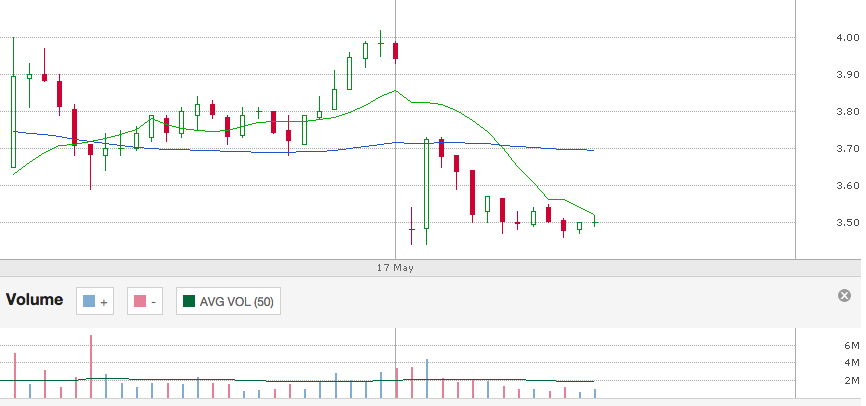
Needless to say, the shares are down sharply on Tuesday:
On Deck Capital is sliding hard in sympathy.
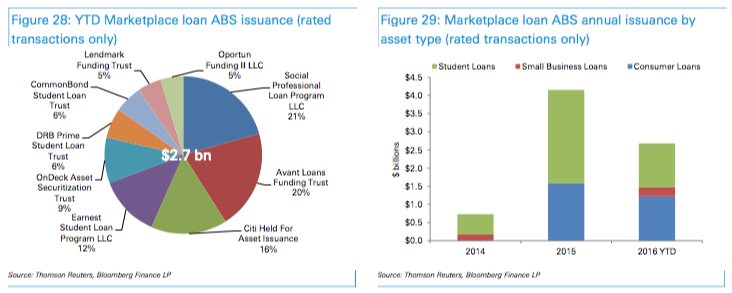
So far this year, around $2.7 billion in rated marketplace-backed paper has come to market. But Deutsche Bank thinks it may be more difficult to push the deals through going forward. Here’s an excerpt from the bank’s weekly ABS monitor:
“Despite the fact that none of Lending Club’s loans have been included in a rated securitization to date, the circumstances surrounding these loan sales have resulted in increased headline risk for this still-developing ABS subsector, and will cause investors to look more closely at reps and warrantees in these transactions, as well as lenders’ internal controls.
“Away from Lending Club, OnDeck and Prosper have also been in the news recently. Prosper announced last week that it would lay off 28% of its workforce and shut down an office in Utah, as a result of tighter conditions in the capital markets. In OnDeck’s earnings call last week, management lowered origination guidance to 30-35% year over year from 45-50%, and said they expected marketplace funding to account for 15-25% of origination volume through year end, compared with previous expectations of 35-40%.
“Given current market conditions we could see issuance volume slow.”
The writing is on the wall here.
It seems exceedingly possible that these names could go to zero if they are forced to retain credit risk on their balance sheets. Long story short: this may not be the best time to “buy the dip.”