

Does The Disaster At LendingClub Foretell The Demise Of Marketplace Lending?
Monday was one horrendous session for P2P powerhouse LendingClub.
Shares fell by more than a third to close at just $4.62 following revelations that CEO Renaud Laplanche - who WSJ reminds us is the “telegenic French entrepreneur who argued that the Internet would upend finance by allowing borrowers to connect directly with investors [and later became] the face of the online-lending industry” - failed to tell the board everything he knew about the falsification of documents tied to some $22 million in near-prime loans sold to an investor.
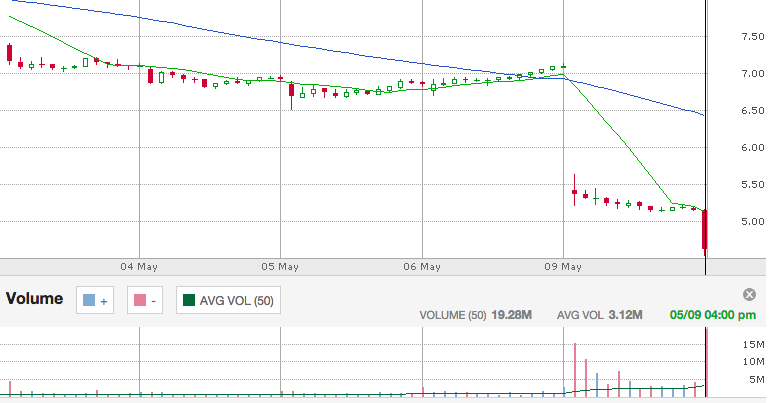
Apparently, that investor was Jefferies and the loans were sold “in contravention of the [bank’s] expressed instructions as to a non-credit and non-pricing element,” according to the company’s conference call. LendingClub later bought them back at par.
Board member Hans Morris - who, as Bloomberg amusingly pointed out this morning had to explain to investors and analysts who he was and why he was on the call - provided a bit more color as follows:
“I led a sub-committee of the Board with the assistance of an independent outside law firm and other advisors and we reviewed among other things, certain non-conforming loans that were made to a single accredited institutional investor, totaling $22 million of near-prime loans, that was $15 million in March and $7 million in April. We also discovered during the investigation that a Senior Managers of LendingClub made a change in the application dates of approximately $3 million of these loans and that was also internally discovered and promptly remediated.”
Ok. So, is that it? As it turns out, no.
Just before a painful Q&A with the analysts on the call, CFO Carrie Dolan slipped this in:
“In the first quarter of 2016, we identified two events that resulted in material weaknesses in our internal controls over financial reporting and the ineffectiveness of our disclosure controls and procedures. [The] second, [was] a failure to inform the Board’s Risk Committee of personal investments held in a third-party fund, while the Company was contemplating an investment in that same funds.”
Laplanche apparently has a 2% stake in Cirrix Capital, an outfit managed by Andrew Hallowell’s Arcadia Funds which invests in P2P (or, as they’re more commonly referred to these days, “marketplace”) loans. The problem: Laplanche didn’t tell anyone about that stake when he went to the LendingClub board and “presented the idea of having LendingClub invest in the venture to the risk committee” - to quote Bloomberg.
So in short, Laplanche pushed the board to invest $10 million for a 15% stake in a fund he already had a 2% stake in and that same fund invests in LendingClub loans.
The reaction from previously exuberant analysts was not pretty:
LendingClub cut to Hold from Buy at Stifel
LendingClub cut to underperform from Neutral at Sterne Agee
LendingClub cut to Hold at Canaccord
LendingClub cut to Street-low $4 from $6 at Compass Point
LendingClub cut to Underperform at Keefe Bruyette
LendingClub cut to Neutral by Guggenheim Partners
LendingClub cut to Sector Weight from Overweight at Pacific Crest
And on, and on. “LendingClub improper loan sale, other internal control failures will ‘surely spook’ bank purchasers who’ve become an increasing part of LC’s funding base, further frustrate investment community, ultimately result in stricter federal, state regulator scrutiny, even as violations were self-identified, remediation swift,” Compass Point wrote in a note.
The incident most certainly will result in “stricter federal and state regulator scrutiny”. In fact, just hours after the story broke, the ubiquitous “people familiar with the matter” said the SEC is reviewing the company’s disclosures.
Of course you could have read most of the above anywhere. The point here is that investors should have known this type of thing was coming. You didn’t need to be a CFA to see that the funding model was becoming circular and the conflicts of interest were mounting.
It was just two months ago when SoFi (another prominent marketplace lender) was starting its own hedge fund just so it could buy up its own loans. If that seems absurd to you that’s because it is. The idea is, to quote Bloomberg again, to “attract more money from wealthy individuals, funds of hedge funds and other institutional investors that may not want to buy whole loans directly from the company or securities backed by the debt.”
Why is that necessary, you ask? Because some suspect the ABS market for securitized marketplace loans may soon dry up as charge-offs rise. Charge-offs at places like LendingClub, for instance, where things are going sour for lower quality loans:
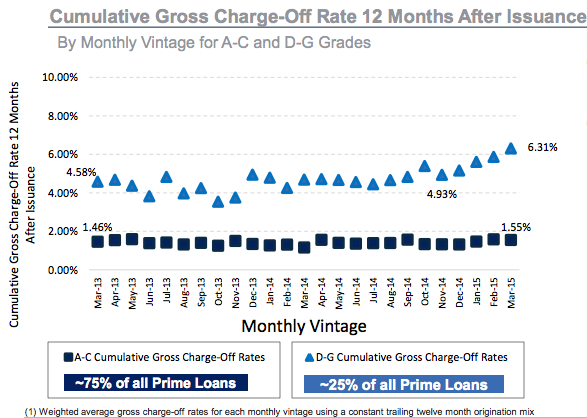
That of course has led the firm to raise rates on all buckets save the highest quality credits. “Interest rates are trending higher for lower grades. From December to March, average rates for A loans fell 30 bps to 6.51%; all other loan grades rose: B: +6bps to 9.98%; C: +40bps to 13.52%; D: +110bps to 17.83%; E: +189bps to 21.08%; F: +98bps to 24.52%; G: +63bps to 28.17%,” Compass Point notes, adding that LendingClub “raised rates by weighted avg. 220bps from Dec. to April to account for higher Fed Funds rate and weaker credit performance.”
Yes, “weaker credit performance,” which is to be expected when you are running the infamous “originate to sell” model that tanked the housing market in 2007 (and which will likely soon do the same to US subprime auto), and when you are using untested algos to assess credit risk.
Put simply: when you are packaging the loans and selling them to investors, it doesn’t matter how they perform because they are off your balance sheet. Well, it doesn’t matter until it does. And when it does is precisely when poor performance and ratings agency downgrades kill demand for your ABS. At that point, the model no longer works and you have to find more “creative” ways to get the bad loans off your books so you can continue to lend.
More “creative” ways like starting a hedge fund to buy your own loans from yourself like SoFi has done (incidentally, LendingClub has one of these vehicles too called LC Advisors, but they don’t call it a hedge fund). Or like pressing the board to take a stake in a fund that, i) you have a stake in, and that ii) buys your loans.
Coming full circle, it’s worth noting that even from the start this business was a risky proposition. These online intermediaries are comparatively inexperienced when it comes to underwriting - no matter who’s on the board or on the management team. That is, given their size versus the size of large traditional lenders, and given the untested nature of online lenders’ algorithms, it was always unlikely that they’d be able to model risk as effectively. That’s not to say that Wall Street has a good track record when it comes to effectively modeling risk (see subprime housing ca. 2007), it’s simply to say that mistakes here were inevitable and given constraints on funding for marketplace loans, it was something of a foregone conclusion that there would one day be a confluence of rising charge-offs and possibly shady end-arounds to secure more money to keep the businesses going. That’s exactly what happened to LendingClub.
For those who might have missed the story, the quintessential example of marketplace lenders’ inability to properly assess risk came last year, when Prosper lent $27,000 to the San Bernardino shooters. Needless to say, they won’t be paying that loan back.