

We woke up Monday morning and everything was fixed.
Actually, it started last night when the British pound suddenly spiked above 1.46. Liquidity was thin, according to traders who also told Bloomberg that market-makers in some global banks have been told to cease quoting short-dated GBP options until further notice.
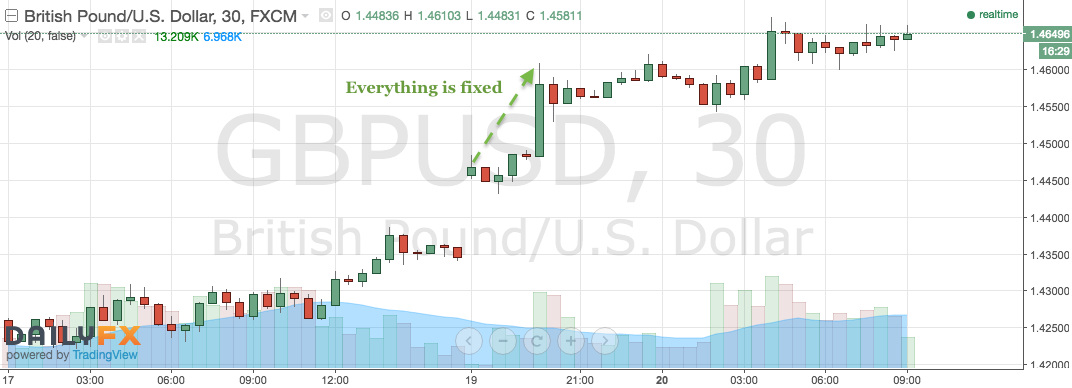
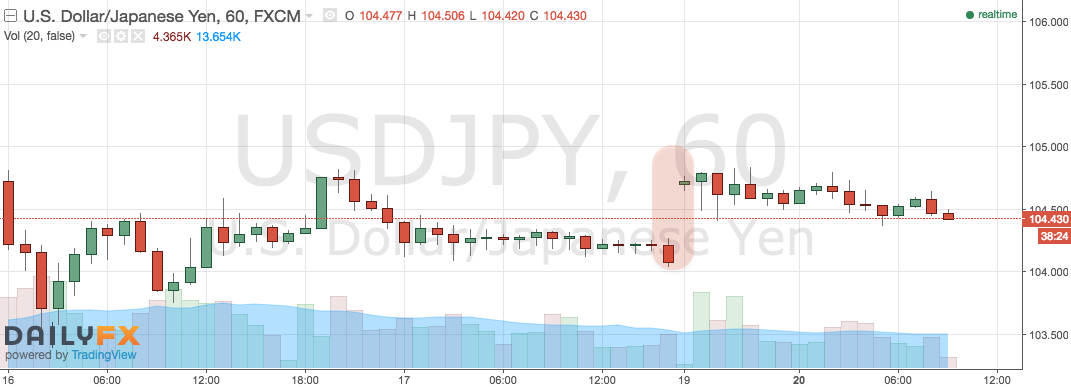
The GBP rally set the tone, and in fairly short order, all of the risk-on pieces fell into place. The yen fell…
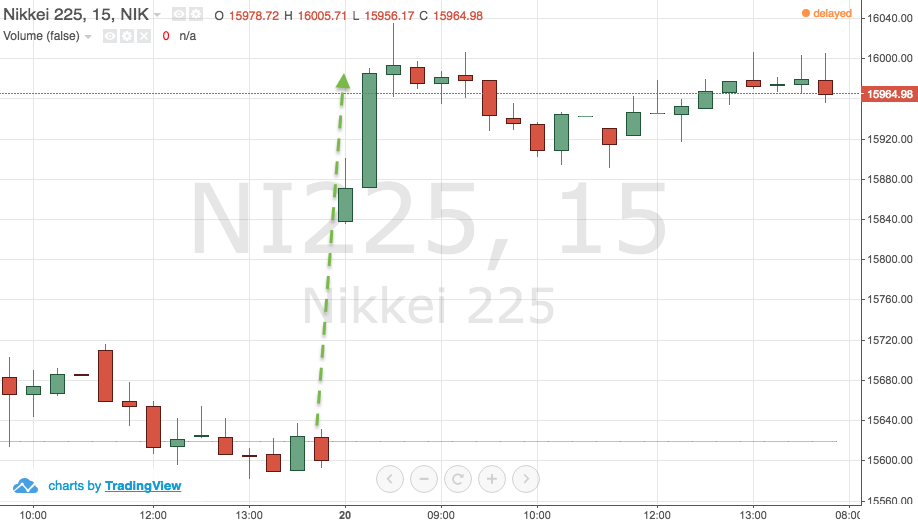
… the Nikkei soared…
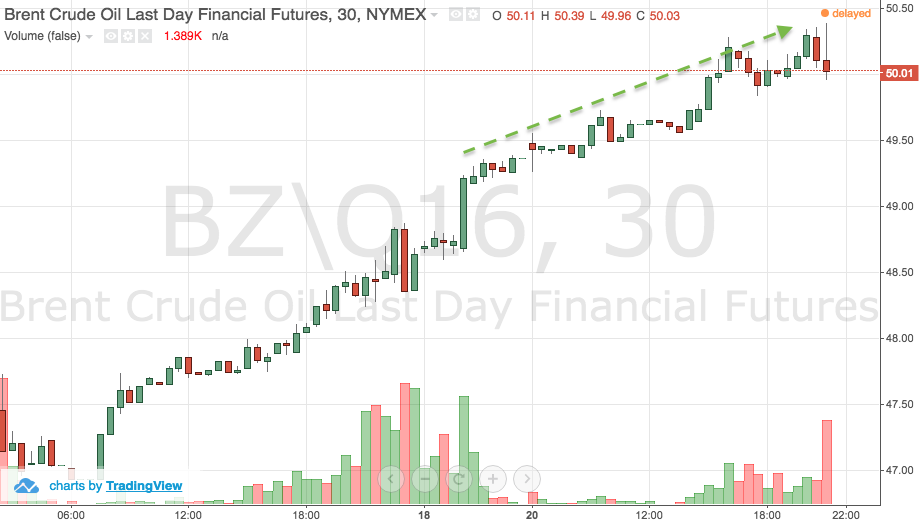
...crude rallied…
...and finally, European bourses surged. The DAX was up nearly 3.5%...
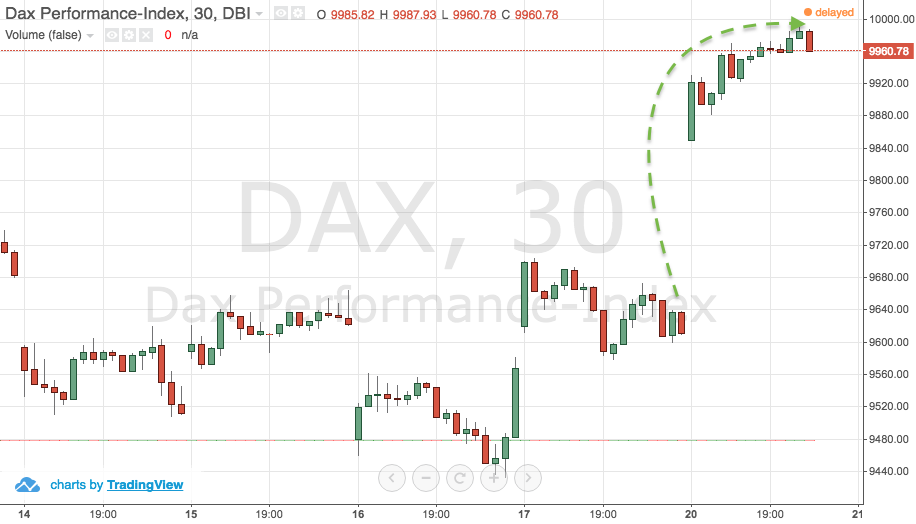
The euphoria carried over to Wall Street as US equities climbed at the opening bell.
So what was the catalyst? Brexit. Or, more appropriately, a perceived lack thereof.
Oddschecker’s probability of the UK voting to leave the EU plunged to around 27%, down from 40% last week. As Bloomberg notes, “a poll over the weekend showed 45% of voters backed the ‘Remain’ camp, while 42 percent were in favor of leaving.”
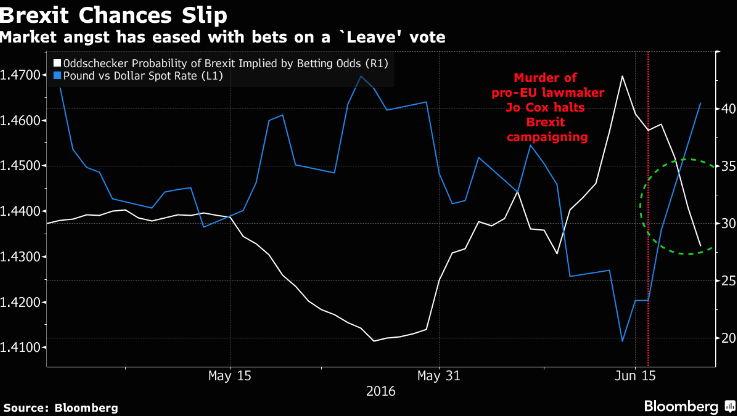
(Chart: Bloomberg)
Clearly, the market is taking this as a sign that the murder of MP Jo Cox has indeed turned the tide in favor of the “remain” camp.
For US investors, this is good news. According to BofAML’s Savita Subramanian, a UK “leave” vote would send European stocks crashing ~10%, which, if history is any guide, would mean a 6%-7% drop for the S&P 500. A “stay” vote would mean a 3-4% rally on Wall Street, a weaker USD, and of course, higher crude prices. You can assume a weaker yen and a sell-off in US Treasurys in that scenario as well.
Needless to say, there’s quite a bit of uncertainty around what exactly the fallout would be from a “leave” vote. “If Brexit goes through, we’ll be in a real potential [financial] crisis,” John Gieve, former Bank of England policy maker, told Bloomberg TV. “I’m sure [the BoE) has prepared various liquidity measures to reassure the markets that the British banking system can fund itself and is soundly based.”
Contrast that with Spanish Economy Minister Luis de Guindos who said on Monday that the fallout from a Brexit would be mostly political. “It would provide further momentum for populism across the continent,” he said. The economic effects would be more severe for the UK than for the EU, he continued. Incidentally, don’t forget that there’s a new Spanish election in six days. That’s another potential geopolitical landmine.
For his part, Wilbur Ross told Bloomberg TV that a Brexit would be “the most expensive divorce ever.” Capital would flow out of the country and thanks to leverage, a 10% decline in home prices could destroy 50% of the elderly’s net worth, he continued.
Meanwhile, FT reported that some US banks had included Brexit in their stress tests.
Frankly, no one has any idea what’s going to happen as the following rather convoluted flow chart from Credit Suisse makes abundantly clear:
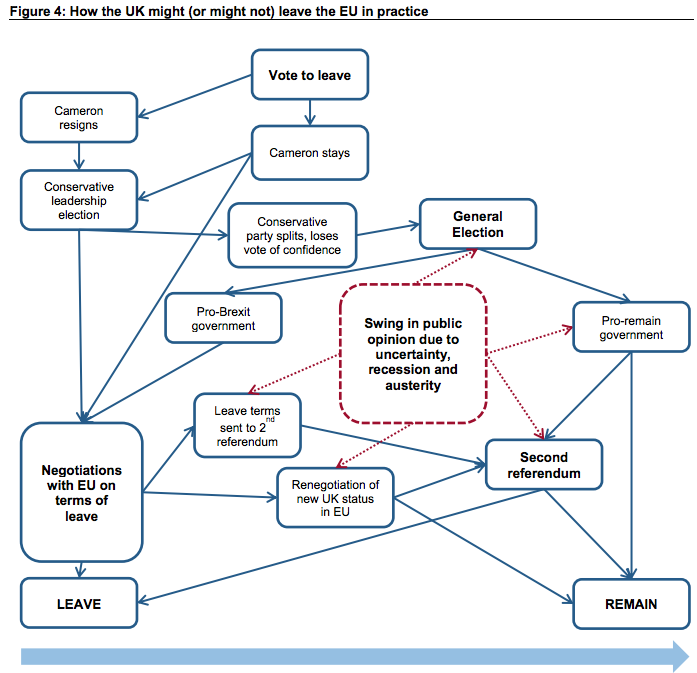
(Chart: Credit Suisse)
So be cautious with these risk-on days. It could be a good idea to take profits.
As Triple T Consulting’s Sean Keane writes in note sent out to Credit Suisse clients, “increasingly frequent” polls will lead to “tape bombs that will [in turn] diminish liquidity [and] ensure that risk appetite will remain a function of the politics.”
“The sooner Thursday comes around the better,” Keane adds.