

On Tuesday we brought you a full preview of this week’s ECB meeting after which Mario Draghi is generally expected to talk a lot about how the bank remains prepared to do all sorts of accommodative things in the event the economic outlook in Europe gets even cloudier following the UK’s decision to leave the European Union.
We’ll likely also hear about how “splendidly” the corporate bond buying program is going. Allow us to show you what “splendidly” means in this context (via Bloomberg):
-
131 of the 458 bonds purchased under CSPP are currently negative yielding, and the lowest five are all German industrials
-
Deutsche Bahn 4.75% 3/2018 -0.24%
-
Siemens 5.625% 6/2018 -0.23%
-
Robert Bosch 1.625% 5/2021 -0.22%
-
Linde 1.75% 6/2019 -0.20%
-
Deutsche Bahn 4.875% 3/2019 -0.20%
That’s right folks, it’s come to this. Developed market central banks are buying negative yielding bonds not only from the government, but now from corporations. Don’t gloss over that - let it sink in. Siemens is now getting paid to borrow money. Conversely, if you want to loan Siemens some money, you’ll have to pay them a fee for the privilege. Here’s a rather surreal graphic:
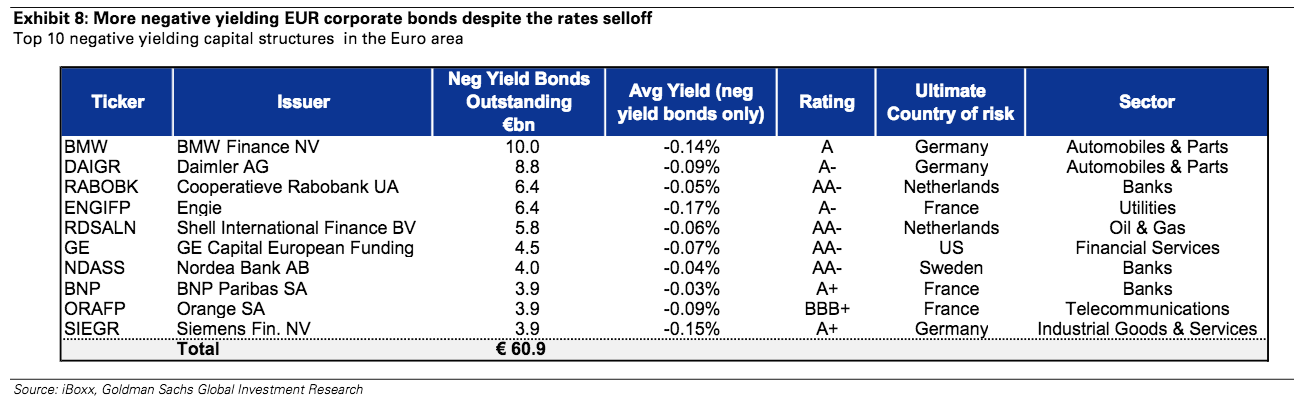
(Table: Goldman)
Consider that for a moment, then have a look at the following screengrab from NADA:

(Source NADA)
So if you want to loan BMW money, you will have to pay interest (negative rates). But if you want to finance an actual BMW, you won’t. Welcome to the Twilight Zone.
Even if, as Goldman wrote last week, “new EUR issue volume slows in reaction to heightened uncertainty and reduced risk appetite,” central banks are clearly incentivizing companies to borrow. Here’s a look at supply (issuance) in Europe:
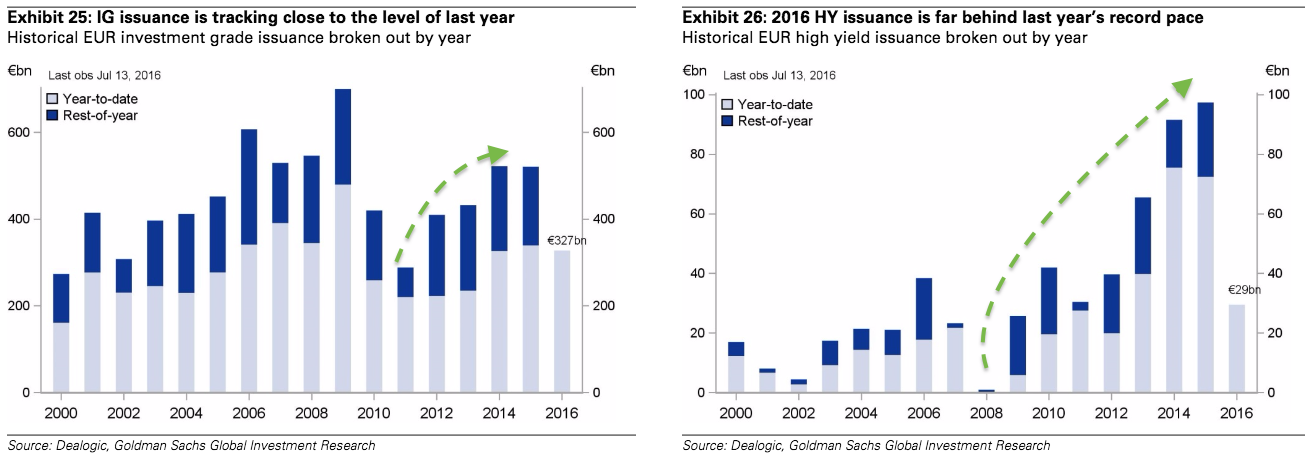
(Charts: Goldman)
And have a look at reverse Yankee action: 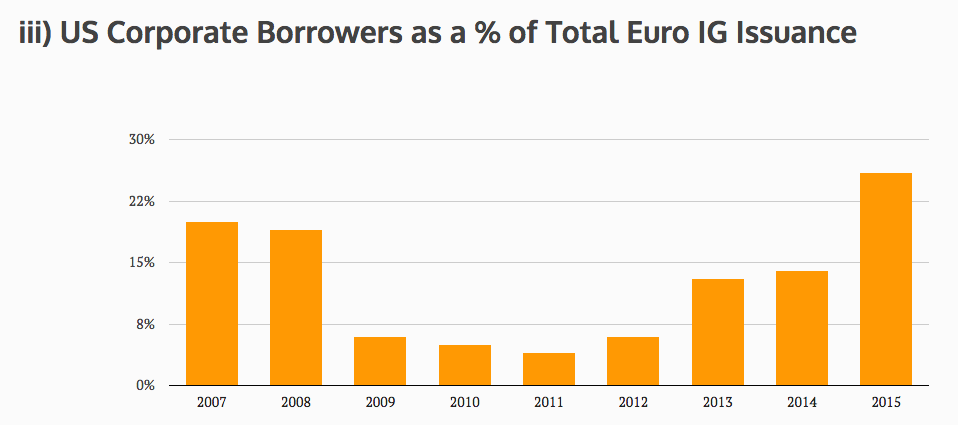
(Chart: Creditmarketdaily)
That’s a record and what it shows is just how attractive the ECB has made the environment for corporate borrowers. US corporations would rather borrow in euros and swap back into dollars because borrowing costs are so low in Europe.
If all of the above sounds dangerous to you, you’d be right and on Wednesday, S&P was out warning of an “inevitable” correction in credit markets. Here are some excerpts from what is a truly downbeat report:
"Central banks remain in thrall to the idea that credit-fueled growth is healthy for the global economy. In fact, our research highlights that monetary policy easing has thus far contributed to increased financial risk, with the growth of corporate borrowing far outpacing that of the global economy."
"Favorable financing conditions, such as abundant debt funding and low interest rates, have elevated prices for financial assets as investors searched for yield. This creates conditions for greater market volatility over the next few years due to lower secondary-market liquidity, with credit spreads for riskier credits and longer duration assets being most exposed."
"A worst-case scenario would be a series of major negative surprises sparking a crisis of confidence around the globe. These unforeseen events could quickly destabilize the market, pushing investors and lenders to exit riskier positions ('Crexit' scenario). If mishandled, this could result in credit growth collapsing as it did during the global financial crisis."
And just like that, “Crexit” enters the increasingly silly global financial lexicon.
It’s difficult to overstate the risks inherent in credit markets these days. It’s a much more precarious situation than the S&P trading at 20 times forward earnings. Stocks correct, people lose money, life goes on. It’s a bit different with credit. This is an enormous systemic risk. There’s something like $50 trillion in corporate debt floating around out there and money has poured into the market amid the ongoing rally:
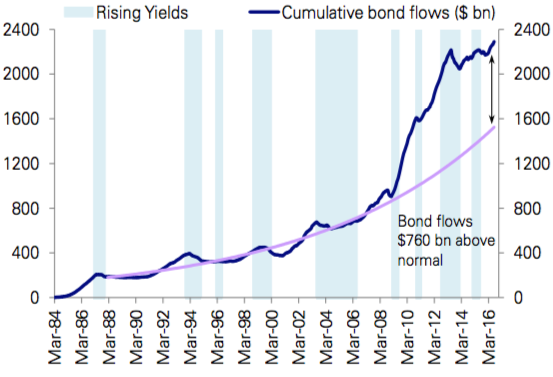
(Chart: Deutsche Bank)
Can you imagine what happens when this finally starts to correct?
Neither can we. But a snapping rubber band comes to mind.