

Since it’s all about central banks these days, we might as well look ahead to Thursday’s ECB decision.
This an important meeting, as it’s the first Draghi and friends powwow since the Brexit vote. Remember, the committee plunged even further down the policy rabbit hole in March when Draghi announced he would add corporate bonds to the list of paper the bank monetizes in its increasingly frantic attempt to ward off deflation. Here’s a complete flows summary broken down by asset class:
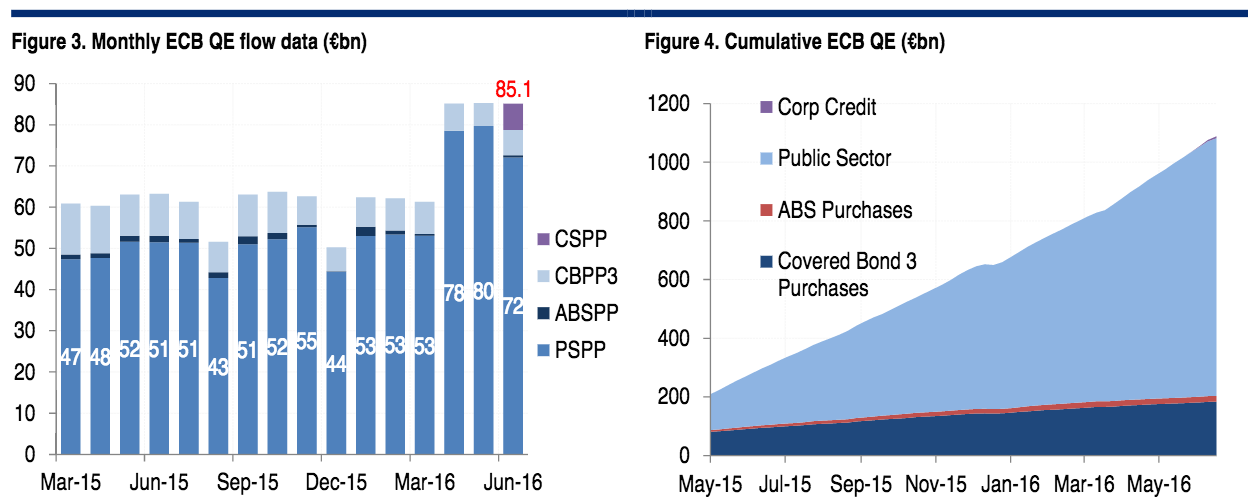
(Charts: Citi)
How’s the corporate bond buying effort going, you ask? Well, swimmingly if “swimmingly” means buying a lot of stuff. Here’s a bit of color from BofAML:
“Since June 8th the ECB has bought 440 corporate bonds, which is around 35% of our estimated universe. By issuer, we find that the ECB has bought bonds from 158 different corporates. The most popular bonds appear to be Deutsche Bahn (12 bonds bought), Telefonica (11 bonds bought), BMW (10 bonds bought), Daimler (9 bonds bought), ENI (9 bonds bought), Orange (9 bonds bought), Air Liquide (8 bonds bought), Engie (8 bonds bought), Iberdrola (8 bonds bought), Total (7 bonds bought) and Enel (7 bonds bought).”
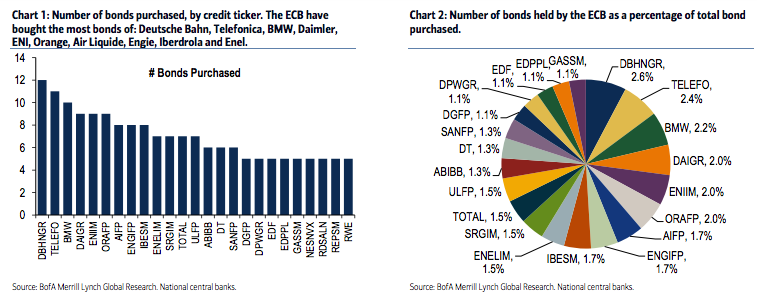
(Charts: BofAML)
As a reminder, Deutsche Bahn recently priced a €350 million 5-year to yield -0.006%, the first negative-yielding non-fin EUR sale. Clearly, the ECB is getting the job done when it comes to artificially suppressing rates. And they’re buying debt from foreign issuers too, meaning this is really “QE for the world,” as BofA puts it:
“Foreign issuers have been bought due to their issuing entities being Dutch, for instance. For us, this underscores the point that we made a few months ago that CSPP is really ‘QE for the world’. Plenty of Swiss credits have been bought (such as Nestle, Novartis and Adecco) as have UK credits (Unilever) and US credits (Schlumberger and Bunge).”
That’s right folks, the ECB is buying bonds issued by a US oilfield services company. That’s not exactly what comes to mind when you think about ultra “safe” investments - even if Schlumberger is a behemoth in the industry.
Anyway, the question now is whether the Brexit vote has changed the ECB’s outlook. Don’t forget, the Bank of Japan is up to bat next week, and then we’ll almost certainly get more easing from the BoE the week after that, so one wonders if Draghi might surprise the market to try and get in a few preemptive easing jabs. According Citi, the answer is “no.” Here’s some commentary:
“Citi’s baseline is no change on rates or the APP, but a dovish enough press conference and potentially setting up September. The focus should be on Draghi’s language – and if similarities can be drawn to December 2015 or January 2016. We expect a 0.80% move lower in EUR over the event. An explicit signal for September would open further downside.”
See how ridiculous this has become? We’re now left to parse the press conference for signs it resembles other press conferences that preceded easing. Here’s a bit more trader chatter from Citi:
“Short-rates: We expect nothing from Draghi. We believe that it will be a relatively uninteresting meeting, with the common refrain of ‘we can act if necessary’ and waiting for more data to see if they need to. XCCY: Looking at the week ahead, the ECB meeting is the main event, although we do not think this will trigger significant volatility in the cross-currency basis markets. Spot: The market will be very interested in any talk of expanding QE, either by capital key changes, increasing individual bond ceilings or extending the end date of the program. I will be looking for spots to establish a short position going into the meeting.”
All of that sounds pretty dry, but there are some good points in there. Have a look at EUR implied vol and cross-currency basis swaps:
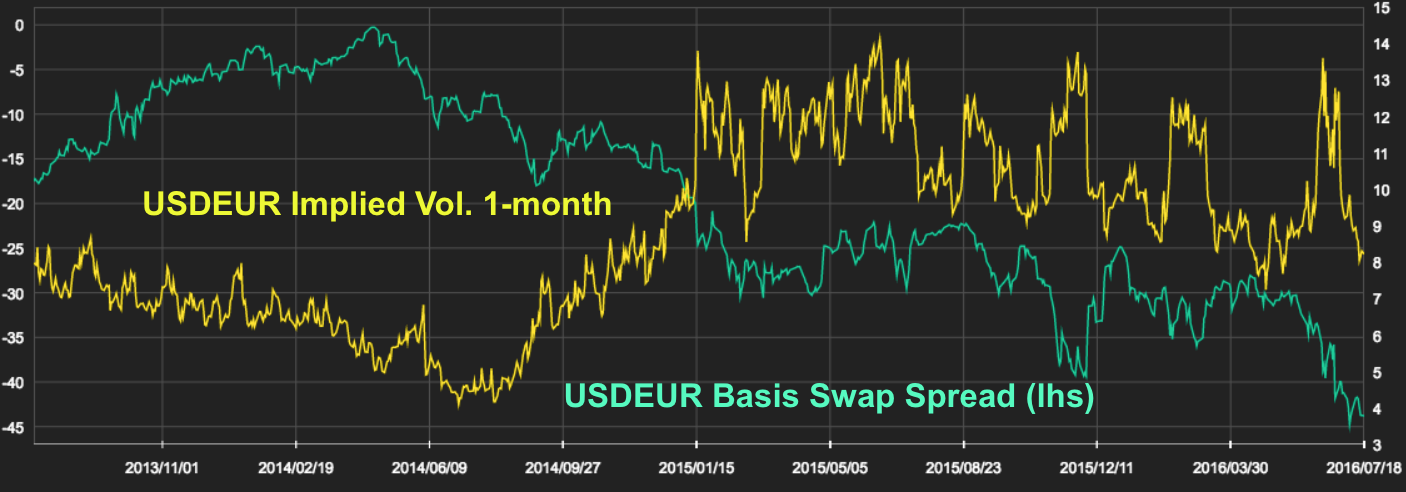
So you’ve got pretty subdued vol but the cost of procuring dollars is rising (i.e. widening swap spreads), which is a pretty interesting dynamic to keep an eye on.
For what it’s worth, this is BofAML’s take:
“Upon meeting on 21 July, resilient markets after the Brexit vote will, in our view, allow the ECB’s Governing Council to stop at simply delivering hints at an imminent additional layer of stimulus on 21 July, reserving hard announcements for September. This would coincide with the release of new inflation forecasts, which we think will continue to be inconsistent with a return to price stability within a reasonable policy horizon.”
Perhaps the most critical thing to remember about the ECB’s asset purchases is that the deposit rate floor makes this an exercise in futility. We’ve discussed this here before.
The more bonds they buy, the more they drive rates lower. The lower rates go, the more bonds fall below the deposit rate floor and thus become ineligible for purchase thus shrinking the size of the QE-eligible asset pool. That forces the ECB to consider cutting rates further, and so on and so forth while the market invariably frontruns the whole ridiculous enterprise, adding fuel to the fire.
On that note, we’ll close with a chart that demonstrates this dynamic rather poignantly:
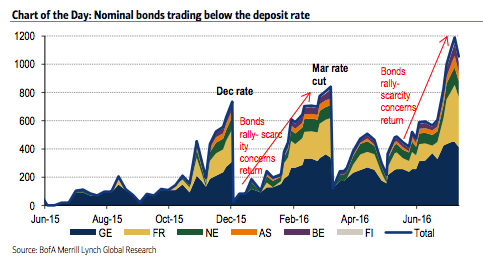
(Chart: BofAML)