

I want to talk a bit about perceived policymaker ineptitude today in the wake of the OPEC and ECB meetings, both held in Vienna.
First, let’s do the headlines: we got nothing in the way of an agreement out of OPEC and no policy change from Draghi. To be sure, both of those outcomes (or non-outcomes, as it were) were expected - a bit of last minute crude production cap speculation notwithstanding.
Cue the “OPEC is dead” and “central banks have run out of ammo” cliches.
Let me just clarify something: neither of those two contentions are true.
First, OPEC isn’t “dead.” There’s something very ironic about every pundit from New York to Shanghai trumpeting the cartel’s demise and then every financial news network subsequently devoting hours of coverage to the meeting in Vienna. In the simplest possible terms: if something is “dead,” you needn’t check in on it anymore.
The idea that a group of oil producing countries that includes the Gulf monarchies and a resurgent Iran could no longer be influential in determining oil prices if it wanted to is patently absurd. It’s not “dead,” it’s just paralyzed by geopolitics.
Second, the ECB isn’t “out of ammo” because, just like every other DM central bank in the world, they never had any in the first place. Economists can talk until they’re blue in the face about “counter cyclical” policies (I use that term myself) but if we’re all being brutally honest, the business cycle is the business cycle. It can’t be “smoothed out” or eliminated by a bunch of PhDs who may or may not have worked at Goldman in a prior life.
You can influence markets, but you can’t influence Main Street’s perception of the economy because guess what? Main Street is the economy. And if you can’t ultimately influence Main Street, you can’t very well meaningfully influence consumer spending or inflation expectations. I am convinced, at this point, that that is more fact than opinion. Just look at Europe and Japan.
That said, there’s a caveat. Central banks are constrained by bank intermediaries. The average Bank of America depositor for instance, has no idea what QE is, and thus has no idea that the bank is being pushed to lend by the powers that be in the Eccles Building. If you remove that intermediary, there are things central banks could do that would have a material effect on Main Street and thus on economic outcomes and inflation expectations. That’s where so-called “helicopter money” comes in. If the government issues perpetual bonds and the central bank monetizes them, the government can then just send checks to everyone. Now that’s something everyone on Main Street will understand. But there’s a risk. Everyone on Main Street would also realize it’s too good to be true, and if enough people come to that conclusion, inflation expectations will skyrocket. Weimar Republic, here we come.
“Ok, so what’s the point?” The point, for traders, is that you shouldn’t get lulled to sleep by all of the rhetoric that suggests policymakers no longer have the power to influence market outcomes.
They do.
Whether or not reality will reassert itself over the long haul is a separate question. In some kind of hypothetical doomsday scenario where society disintegrates, stocks, bonds, and gold are all worthless while oil and food will be invaluable.
In the meantime however, stocks can be levitated into the stratosphere if the likes of the Bank of Japan want to keep buying ETFs and bond yields can go even lower if the likes of the ECB want to keep pouring printing press money into fixed income (incidentally, Draghi announced the start date for the bank’s corporate bond buying program today).
Similarly, oil prices can theoretically go to damn near zero if Saudi Arabia decides to ramp to capacity and continues to antagonize its fellow producers with what amounts to an absurdly belligerent policy.
Consider the following two headlines that crossed this morning on the terminal:
-
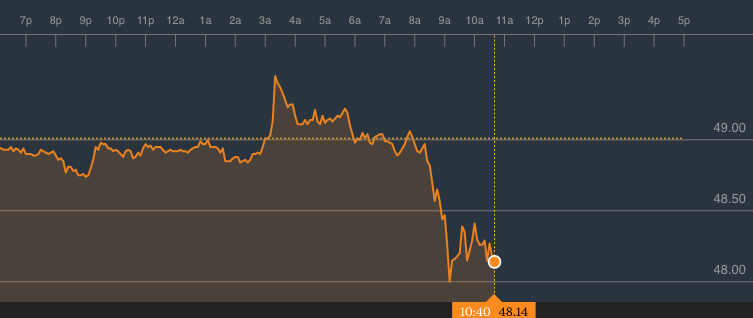
WTI CRUDE EXTENDS LOSS AS OPEC FAILS TO AGREE NEW OUTPUT TARGET
-
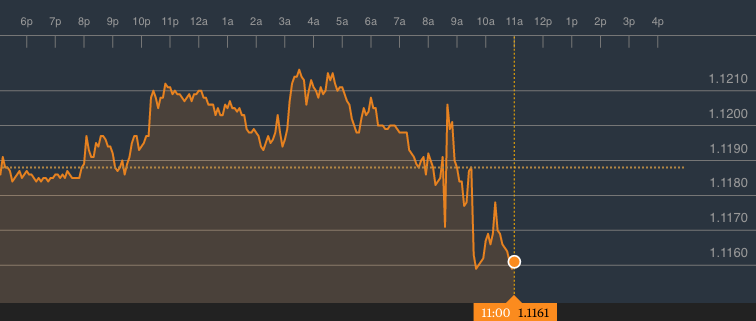
EUR NEW LOW 1.1166 DESPITE UP-REVISION TO GROWTH, INFL. FCASTS
Here’s a EUR chart…
(Bloomberg)
...and here’s WTI…
(Bloomberg)
Do I need to tell you when the ECB and OPEC headlines crossed?
And that’s after no one did anything! Nothing at all. Zip. Zero. Nada.
So don’t tell me about “dead” cartels and “inept” central bankers. These supposedly hapless policymakers managed to move markets on Thursday by doing absolutely nothing.
Note that this matters for equities traders - a lot.
A sudden move up or down in crude can and usually will influence risk appetite. That means that as an equities (or an equity options) trader, you are, to a certain extent anyway, beholden to gyrations in oil prices. I wrote about this dynamic last month in these very pages.
Similarly, FX surprises can trigger sharp reversals for US stocks as we saw yesterday with the overnight rally in the yen. If we had gotten say, some sort of extreme dovish surprise out of Draghi on Thursday morning, it might well have conspired with recent hawkish Fed rhetoric to push the dollar sharply higher and thus dent sentiment around US stocks.
All of the above is in keeping with a narrative that I’ve been keen on pushing lately. The bottom line is that in today’s markets, you can’t afford to be an equities trader that doesn’t understand FX and commodities. That’s always been the case to a certain extent, but now it’s absolutely paramount.
One last consideration: note that the effect of headlines (even indecisions and non-events) is magnified these days by the presence of HFTs.
I’m not going to feed you the doomsayer narrative that basically posits a Terminator 2 scenario wherein Skynet becomes self-aware, but what I would say is this: headline surfing algos don’t understand nuance. Vacuum tubes don’t comprehend context. Keep that in mind when thinking about policymakers and their pronouncements.