


Most traders pick a timeframe they like and apply it to everything they trade.
They scalp ETFs on a five-minute chart…
…They hold futures positions for weeks using monthly levels…They wonder why the signals keep failing…
The signals are not failing. The timeframe is wrong for the instrument.
And today, I’m going to show you how to correct that.
Monday was a perfect case study.
The S&P 500 futures gave six intraday signals off the Monkey Bars. The Euro gave even more. Gold fired trade after trade.
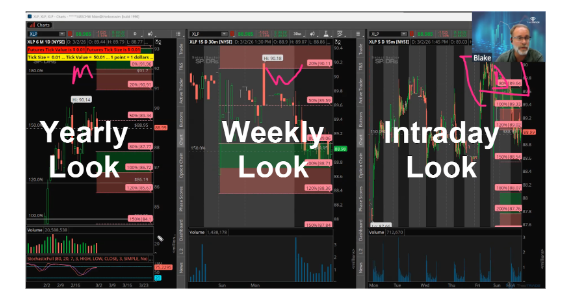
Meanwhile, XLE's intraday chart produced almost nothing. XLP offered 50 cents of upside for the entire week.
Same day. Same volatility. Completely different results depending on the instrument.
The difference had nothing to do with the market...It had everything to do with which timeframe matched which product.
The Three-Chart Grid
I trade with three charts side by side. Each one shows a different timeframe of the same Monkey Bar distribution levels. The combination changes based on what I am trading.
For futures and commodities, I use month, week, and day. The daily chart is where I scalp. The weekly is where I swing trade. The monthly gives me the broader posture.
For ETFs and individual stocks, I swap out the daily for the yearly. Now I am looking at year, month, and week. The weekly becomes my shortest actionable timeframe.
However…and this is important….
When I say daily, I mean an intraday look back over the last few days. Weekly is a look back over the past month or so, while yearly lets me see back over the past year.
The reason is simple. ETFs and most stocks do not move fast enough intraday to generate reliable scalp signals off a distribution model. Futures and high-beta commodities do.
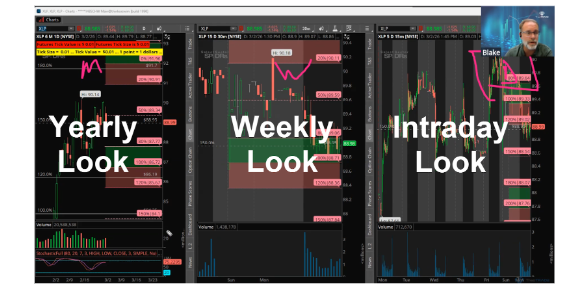
Matching Strategy to Timeframe
Each chart in the grid serves a specific purpose. The far right chart is for scalping. In and out, same day. On futures, that is the daily distribution. On stocks and ETFs, that is the weekly.
The middle chart is for swing trades. On futures, the weekly chart tells you where a move could play out over a few hours to a few days. On stocks, the monthly chart gives you the same kind of setup.
The far left chart is for position trades and premium selling. The monthly on futures or the yearly on ETFs tells you where the instrument sits in its broader distribution. If you are at fair price on the yearly and monthly, sell premium. If you are oversold on the yearly, that is a position entry.
When multiple timeframes converge at the same level, pay attention. That convergence is telling you where the instrument wants to sit.
Monday Proved the Point
S&P 500 futures gapped down on Iran news. Even with the shock, the distribution levels calculated on Friday held perfectly. The daily Monkey Bars gave a long signal off the bottom that hit its target.
Then a short signal that hit its target. Then another long, another short. One loser and multiple winners, all within a few hours.
I ended the day with about $1,200 across two accounts from scalping futures off those daily distribution levels.
XLE told a completely different story. The ETF gapped up and pulled back to the 50% level at 56.40. Then it sat there. The intraday chart gave almost no actionable buy signals for the rest of the session. It just sold back through the levels with nothing to trade.
But the longer timeframes had plenty to say. The yearly distribution showed price approaching fair value near 59 to 60. The monthly distribution agreed. Two timeframes converging at the same resistance zone. That is not a scalping opportunity. That is a premium-selling opportunity.
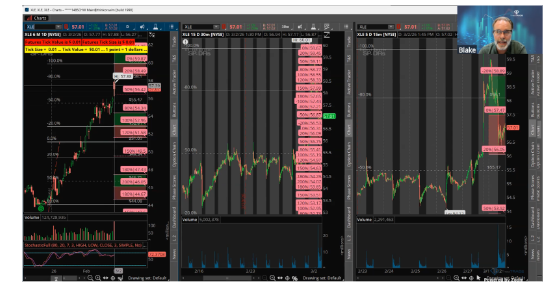
The daily chart on XLE was useless. The yearly and monthly charts gave a clear, actionable setup. If I had forced the daily timeframe onto XLE the way it works on futures, I would have sat there all day with nothing to show for it.
The market gives you the information. Your job is to look at it through the right lens.
Blake Young
Senior Market Strategist, TheoTrade