


Hey trader,
There are two types of entry signals: One fires when price hits a level. The other fires when price accelerates through a level with volume behind it.
Far too many people assume they’re interchangeable.
That assumption costs money on days when the tape shifts from momentum to chop and back again within the same hour.
They take whichever signal appears first and assume the setup will work regardless of what the market is doing.
And I want to help you understand why and when to use each one.
Wednesday's session across the S&P 500, gold, the euro, and crude oil showed exactly why the distinction matters.
The first 30 minutes produced massive directional moves driven by hot PPI data and rising geopolitical tension.
Then everything stalled at the zero line and sat there.
The tools that worked in the first phase gave nothing in the second.
Momentum Entries vs. Level Entries
You can think of momentum and level entries as breakout trading vs reversal trading, though you’ll understand why that’s not exactly the case. But, for now, it will help us with the discussion.
A momentum entry requires acceleration. Price has to be moving with force, volume has to be elevated, and directional candles have to confirm the push.
Bollinger Band breakouts are a great tool here. They capture moves that are already underway and use the speed of the tape to carry the trade to target.
A level entry requires positioning. Price has to reach a calculated distribution level where a reversal is statistically likely.
Beacon trades are the primary tool here. They do not need speed or volume. They need price to arrive at a specific spot on the map.
Both produce winners. Both produce losers. The difference is that each one only works when the tape conditions match the entry type.
A Bollinger Band breakout without acceleration behind it is just a candle touching the band. A beacon signal in the middle of a momentum flush will get run over before the reversal has time to develop.
Why the Distinction Matters
Wednesday's tape changed character twice in the same session. PPI came in at 0.7% versus the 0.3% expectation. The Iran conflict added fuel. Gold dropped from 5,008 to 4,837 in the opening push. The S&P 500 futures fell 70 points.
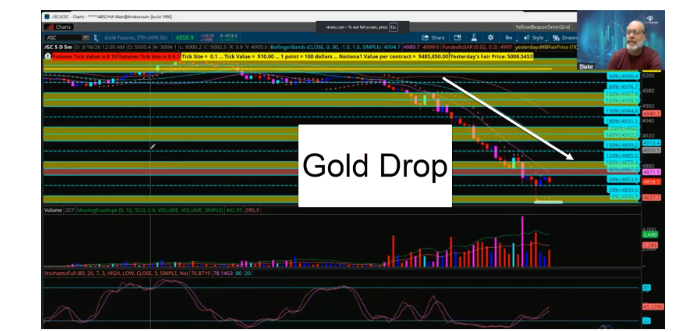
That phase was pure momentum. High volume, directional candles, acceleration on every instrument. Bollinger Band breakouts during that window hit their targets.
Then the market parked at the zero line across the board and stopped moving. No acceleration meant no momentum signals. Price sitting at the midpoint of the range meant no level signals either. The tape had gone dead.
The traders who recognized the shift waited. The traders who forced entries in the chop took coin-flip trades with no edge behind them.
How It Played Out on the S&P 500
After the extended dead zone, the S&P 500 finally broke below the zero line on a bearish candle with higher volume. A one count reversal confirmed the direction with lower highs and lower lows. Acceleration had returned.
The beacon entry existed on paper, but it was too far from the breakout point. Using it would have required a wider stop and more capital at risk for the same target.
The Bollinger Band breakout gave a tighter entry at 6,738 with a stop at 6,752. Risk was 15 points, or $75 per micro contract. The target was 6,708.
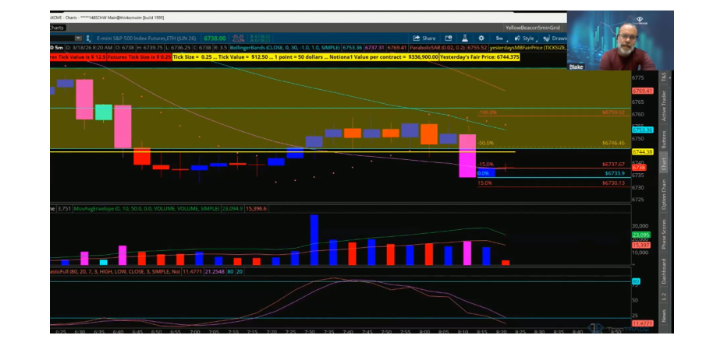
Volume was elevated. The candle closed outside the band. The one count reversal confirmed direction. The momentum tool matched the momentum tape, and the trade hit its target.
A Starting Point
Matching the right entry type to the right tape condition is one piece of the methodology. Wednesday required beacons, Bollinger Band breakouts, channel plays, balanced day setups, one count reversals, and stop management across five markets.
All of it happened in under two hours. That is a normal morning inside the 10% Club.
That is a normal morning inside the 10% Club. The concept in this article is a small window into a system that has averaged 38.5% per month since May, with a total compounded return of 628%.
The system is built around E6 futures and gold. Both markets trade 24 hours a day with deep liquidity and tight spreads. Blake scans for beacon setups the night before, giving members up to 12 hours of advance notice before a trade fires.
By the time the live session opens at 9:30 AM ET, the levels are already mapped. The stops are already calculated. The only decision left is execution.
Here is what you get when you join. A full strategy masterclass with lifetime replay access walks you through the entire beacon system step by step. A 12-week live mastermind breaks down setups and signals in real time every week.
The private trading room gives you daily access to Blake's called trades during the most active window of the session. Monthly coaching calls keep your edge sharp.
A Futures 101 class covers margin, tick sizes, and contract mechanics for anyone new to the asset class. The Gold Accelerator adds Blake's top gold signals on top of the core E6 strategy.
The full package carries over $12,000 in retail value. Annual membership is $1,995 with a 30-day money-back guarantee.
No watchlists. No headline chasing. One market, one signal system, and a clear edge that fits around your schedule.
Blake Young
Senior Market Strategist, TheoTRADE