

Terrorism and the influx of refugees fleeing the war-torn Mid-East for Western Europe have triggered a revitalization of nationalistic sentiment among the electorate, a phenomenon Donald Trump has used as a veritable springboard on the way to winning the GOP presidential nomination.
But the populist shift has also served as a drag on global trade at a time when i) the world is still trying to recover from the worst economic downturn since the Great Depression, and ii) China is finding it increasingly difficult to support the global economy as Beijing attempts a difficult transition from a smokestack-driven model to a system built on consumption and services.
In short, protectionism is back en vogue and at just the wrong time.
WSJ is out with an excellent piece outlining the problem. Here are some key excerpts:
“U.S. equity prices have been supported for the past three decades by an acceleration of global trade and a freer flow of capital. Those lifted economic growth and allowed companies to take advantage of new markets and economies of scale.”
“But now there is worry that the party is ending. ‘We believe globalization has probably reached its peak,’ said Marino Valensise, head of the multi-asset team at Barings, a member of the MassMutual Financial Group with $275 billion in assets under management. ‘The market won’t like it.’”
“Global trade this year will grow at the slowest pace since 2007, according to the World Trade Organization, just as protectionist policies are on the rise and efforts to liberalize trade have stalled. The International Monetary Fund recently warned that anti-trade trends such as increases in tariffs could cause long-term damage to the world economy.”
“Some are worried this could spill over to corporate profits.”
“Global stock-index provider MSCI estimates that if policies such as trade protectionism and government deficit spending increase significantly in the developed world in the next two years, U.S. equities would shed more than 17%, while European equity markets would fall by close to 20%.”
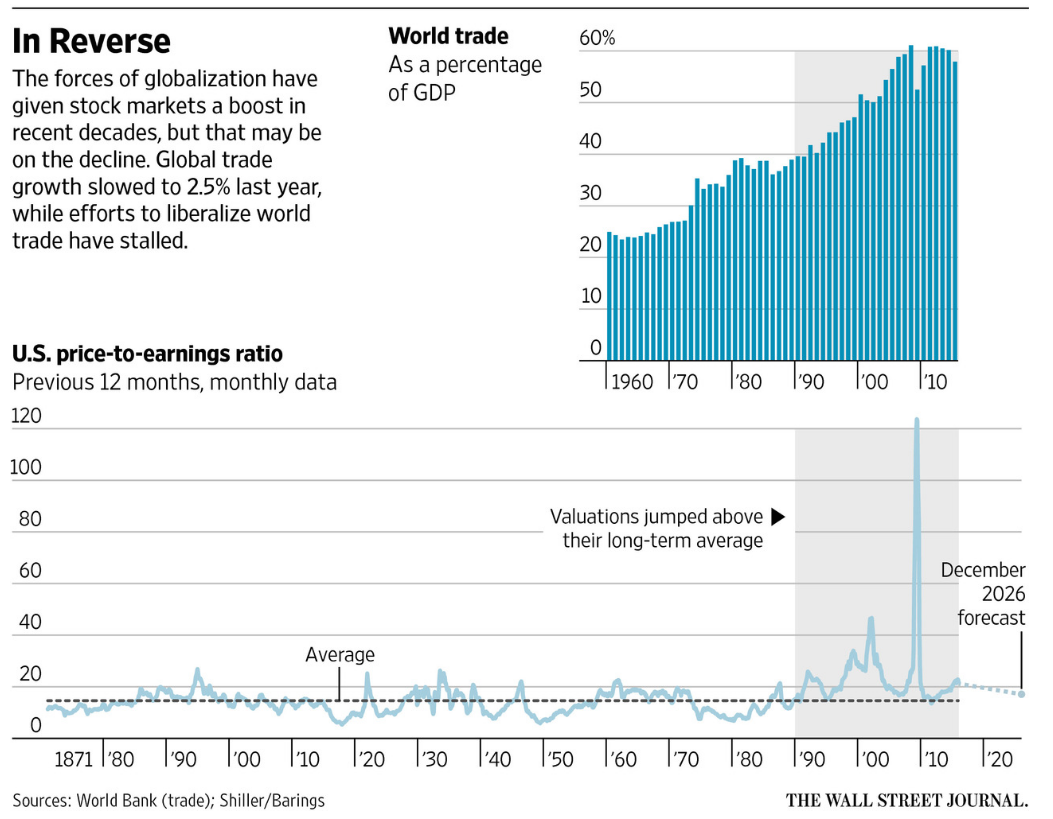
Bear in mind that this also comes at a time when profits are being artificially inflated anyway thanks to low borrowing costs that allow firms to leverage the balance sheet for EPS-inflating buybacks. If borrowing costs rise, making it less attractive to borrow for buybacks at the same time that a push towards protectionism crimps profits, you could see an even steeper decline in equities than that predicted by MSCI.
In a similar vein, Deutsche Bank is out warning about declining corporate profits. Their concern: with the economy near full employment and wage pressure likely to rise, absent a sudden upturn in productivity growth the US economy may well be in trouble:
“Economy-wide corporate operating profits as measured in the GDP accounts declined -2.4% annualized in Q2 2016 compared to the previous quarter. Compared to a year ago, corporate profits were down -4.3% in Q2, which marked the fifth consecutive year-over-year decline. In fact, corporate profits peaked in the current business cycle in Q4 2014 and have fallen -8.8% since that time. Hence, no matter how one dissects the data, corporate profits have been very weak over the last six quarters.”
And it’s not just attributable to the energy downturn:
“We find that the trend in corporate profits excluding the energy sector is broadly similar to that in overall corporate profits.”
“In point of fact, corporate profits less energy declined -2.6% annualized in Q2 2016 compared to the previous quarter. Additionally, they were down -2.0% over the four quarters ending in Q2, which was again the fifth consecutive year-over- year decline. Note that corporate profits less energy also peaked in Q4 2014 and are now down -6.1% as of the latest data for Q2. Thus, corporate profits over the last two years look extremely soft even if we exclude the energy sector from our calculation.”
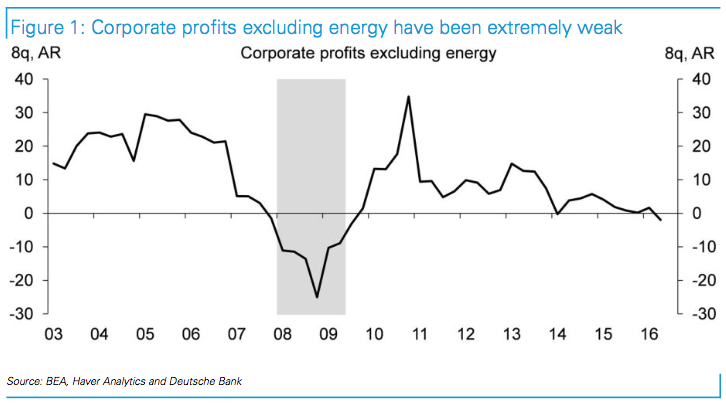
(Chart: Deutsche Bank)
To be sure, this isn’t an attempt at a political statement, and even if it were it would be party- neutral because both candidates have hinted at protectionist measures. But there’s little question that economically speaking, this is the wrong time start an experiment in deglobalization.