

A long time ago, in a market far, far away, a bloody military coup in a NATO member country seeking European Union membership would have mattered.
It would have mattered even more if analysts suspected that the siege was in fact engineered by an increasingly autocratic President intent on consolidating his grip on power. Why? Because that would mean they’ll likely be more turmoil to come as disaffected citizens become even more concerned about the prospects for democratic reform.
But today’s markets are different. Yes, the coup in Turkey failed (or succeeded depending on the extent to which you think President Erdogan staged the whole thing) but it was a stark reminder that we’re living in exceptionally uncertain times from a geopolitical perspective. By all accounts, it should have weighed on sentiment - heavily.
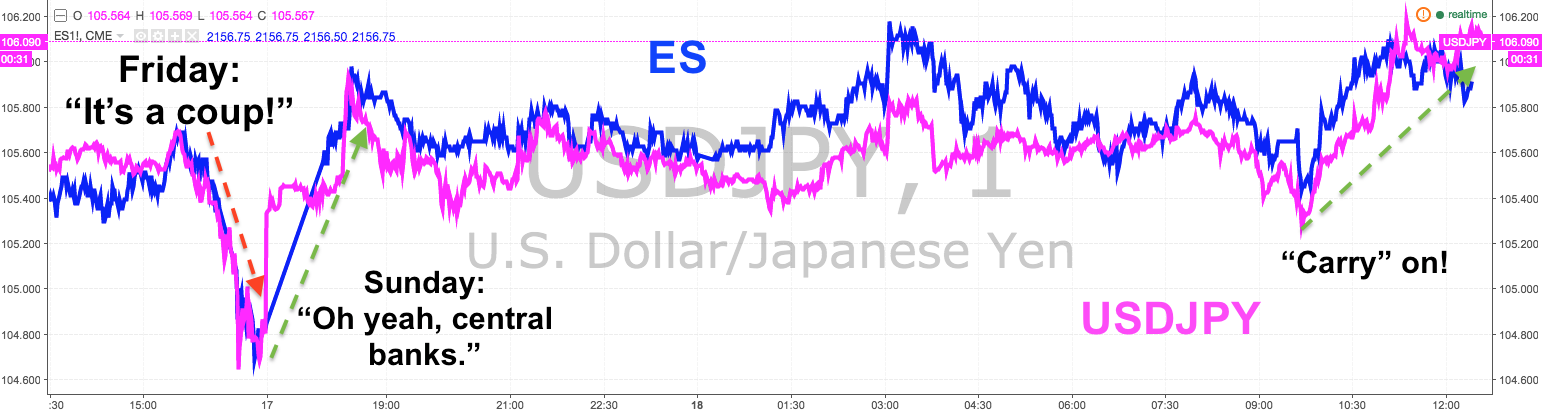
It didn’t. And you could see it right from the word “go” on Sunday evening. Futs rose, the yen fell. “Green” light. Literally.
Asian stocks didn’t generally care either and even Europe managed to close mixed despite the fact that Friday’s drama played out right on their doorstep. If Turkey descends into case, refugees won’t just be coming through the country to Europe. They’ll also be coming from the country to the EU.
So is the muted reaction rational? Well, yes and no. As we noted on Saturday, Turkey isn’t some Third World back alley of no consequence. Then again, spillover risk seems relatively benign. Here’s a helpful set of charts that shows various emerging markets’ sensitivity to rising FX turmoil and default risk in Turkey: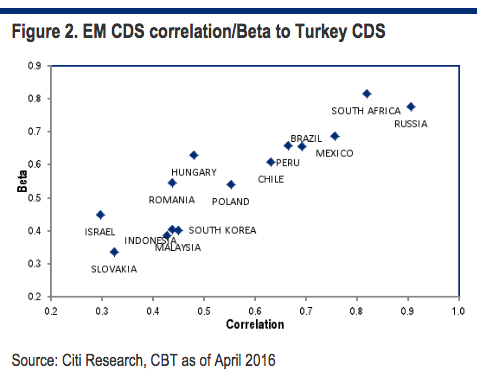
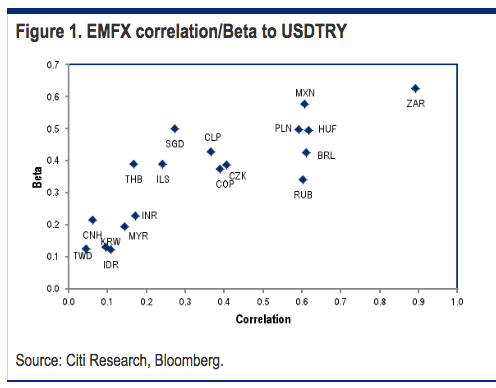
(Charts: Citi)
So is there some contagion risk for EM? Yes, but it appears manageable (unless you’re South Africa apparently, but even the rand has recovered after plunging on Friday). For what it’s worth, here’s a look at European banks’ exposure:
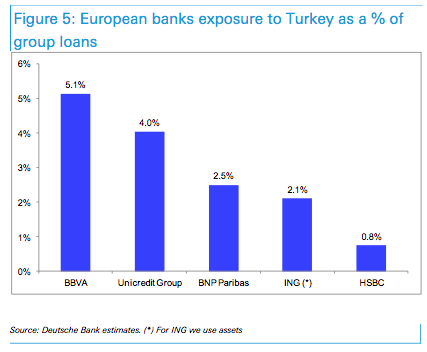
(Chart: Deutsche Bank)
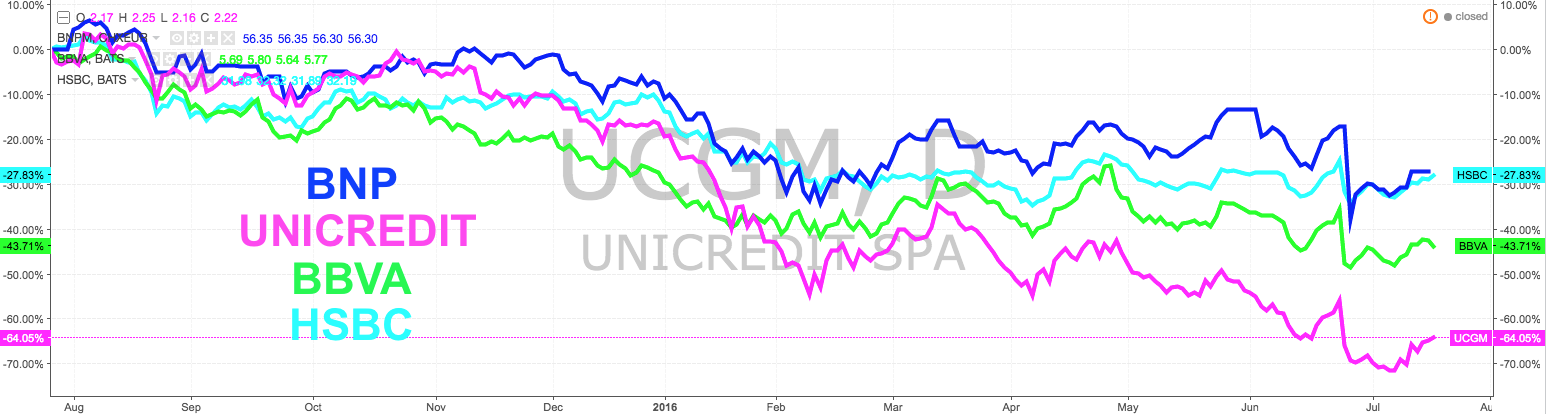
For those wondering, the reason you should care is that the European banking sector is under immense stress and scrutiny, so any and all risks need to be evaluated when it comes to the space. Here’s a 1-year chart that highlights the malaise:
And here’s a bit of color from Deutsche on the general outlook for Turkey itself:
“There has already been some immediate adjustment in FX, which is generally the shock-absorbing, liquid asset class. How much further adjustment is required is difficult to assess at this point, given the extreme tail nature of the event and lack of comparable events to form a baseline. On the negative side, risk premia should now be higher; the current account is likely to deteriorate due to further declines in tourism, while FDI and portfolio flows are also likely to decline.”
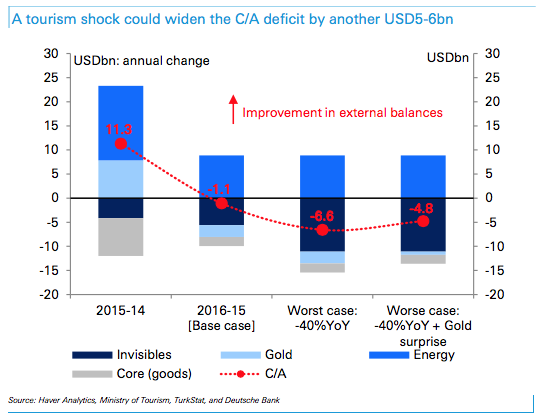
(Chart: Deutsche Bank)
As you might imagine, just about the last thing Turkey needed was yet another excuse for tourists to avoid the country. Visitors were already wary due to the propensity for things (and people) to explode in public venues.
When we were watching the Sunday night melt up in futs we wrote the following to no one in particular:
“You've got hedge funds near record long yen while mutual funds, pension funds, and all sorts of ‘slow" money are net short. That should immediately be interpreted as follows: Asset managers are betting on the traditional narrative that more easing means FX weakness; hedge funds are saying something entirely different. Who's right? Who knows, but just note that a stronger yen means carry unwind, and that means sell risk.”
Of course the opposite means “carry on” as shown in the first chart above.
And so here we are. Another day, another oblivious and apparently teflon market. Let’s close, for now, with some perspective from Citi:
“The coup attempt in Turkey comes fast on the heels of a series of events that have rattled nerves. Days before, the Bastille Day attack in Nice killed 84 people, amid intelligence warnings that France likely faces more attacks against difficult to protect soft targets, and just hours after President Hollande had lifted the state of emergency called following the Paris attacks in January. Less than 3 weeks before, the UK's vote to leave the European Union – the first country ever to do so – marked a watershed for developed market political risk and raises the spectre of an existential challenge for the European Union. At the same time, polling gains in key US swing states have prompted us to raise the probability of a Trump presidency to 35%, with the potential to go higher as Hillary Clinton's campaign remains lacklustre. Taken together, these developments point to a marked increase in political risks in systemically-significant countries.”