


The S&P just printed another all-time high. Six months straight of relentless buying. Every dip defended within hours. Retail traders rushing into calls every morning like clockwork.
You're expending massive energy. Watching charts all day. Buying every pullback. Feeling the adrenaline of watching your account climb.
But here's what you're missing: all that effort is taking you exactly nowhere.
We're trapped in an algorithmic hamster wheel. The market keeps spinning higher, you keep running faster, but when this cycle finally breaks, you won't have made any real progress.
You'll be right back where you started, except now you're exhausted and vulnerable to the collapse that mathematical reversion guarantees.
The Genesis COG system was built to detect exactly this pattern.
When markets lock into repetitive algorithmic cycles that feel productive but lead nowhere, the scanner reveals the momentum exhaustion before the wheel stops spinning and traders get thrown off.
Today, I'm showing you exactly why this relentless grind higher is actually the most dangerous setup I've seen in years. You'll learn how to recognize when you're trapped on the hamster wheel versus making real progress.
And most importantly, you'll discover how to get out before the wheel stops spinning and sends you flying.
The Metaphor That Explains Everything
A hamster wheel lets small animals run for exercise even when confined to a small space. The hamster grabs the wheel, starts running, spins it around. Burns calories. Increases heart rate. Expends tremendous energy.
But here's the key: while the hamster's spinning around, where's it going? Nowhere.
That's your market right now. The S&P climbs from 6,600 to 6,700. You make money. You feel productive.
You're actively trading, analyzing, making decisions. All that effort, all that energy expenditure, all that time watching screens. Going nowhere that lasts.
The market conditions you to believe every dip is buyable. Every bounce confirms your strategy. Every green day validates your approach.
Then the programming flips. The algorithms controlling 90% of daily volume switch from systematic buying to systematic selling.
Everything you gained over six months evaporates in six days. You're back at the starting point, except now you're mentally exhausted and financially damaged.
The question becomes: how do you know when you're on the hamster wheel versus making real progress? I learned this building algorithmic systems at ThinkorSwim for 15 years.
The machines don't guess. They calculate three specific conditions that reveal the difference between productive momentum and wasted effort that's about to reverse.
The Four-Hour MACD Never Lies About This
The hamster wheel keeps spinning as long as the algorithms are programmed to defend the upward slope. The moment that programming changes, the wheel stops abruptly and everyone gets thrown off.
The most powerful intraday timeframe for detecting this shift is the four-hour chart. This indicator has never led me wrong when I actually follow it.
Pull up the S&P futures on a four-hour timeframe. Look at the MACD. See that signal line?
See how the MACD sits above it, trending higher? That's your algorithmic buy program running on autopilot. That's what keeps the hamster wheel spinning smoothly.
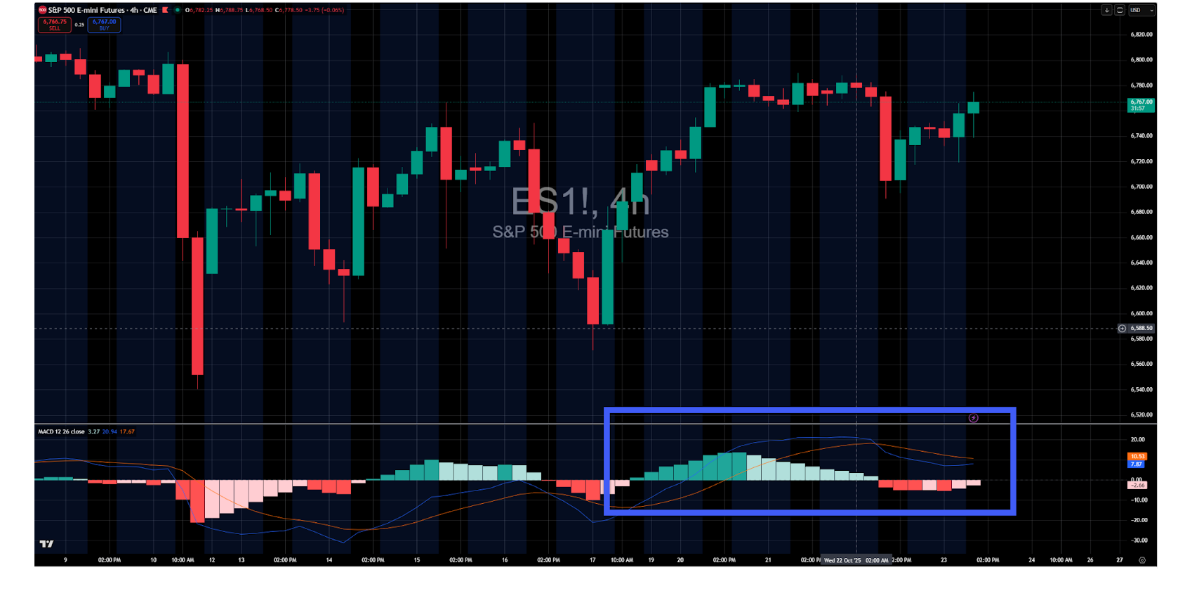
The machines buy every single dip unless the MACD breaks underneath both the signal line and the zero line. Until that happens, you're safe on the wheel even though you're going nowhere.
The algos defend the upward slope regardless of fundamentals, regardless of valuations, regardless of common sense. The wheel keeps turning because the machines are programmed to keep it turning.
When that MACD finally rolls over and breaks below the signal line, then breaches the zero line, the wheel stops dead. None of you are getting out of this one.
The market could drop 400 points and you'll still be buying dips thinking "this is the bottom." The algorithms will turn this thing upside down so fast you won't even know what happened.
You'll watch gains from six months vanish before you can react. That's what happens when the hamster wheel stops spinning and you're still running at full speed.
But the MACD only tells you when the algos will flip the programming. It doesn't tell you if the momentum underneath is real or just mechanical repetition going nowhere.
Why Money Flow Exposes Who's Already Off the Wheel
While you're running in circles feeling productive, smart money is quietly stepping off the wheel and walking away. They see the same MACD you see. But they're watching something else that tells them the wheel is about to stop.
Money flow reveals who's doing the trading and in what volume. When institutional money stops flowing in while price still climbs, that's your warning the wheel is about to stop.
Here's exactly how this played out in Caterpillar. The stock climbed from consolidation in early June, breaking out higher in a perfect linear channel.
Every technical trader saw the breakout. Some bought it. Some didn't trust it. Some waited for confirmation.
But if you just looked at the money flow, the answer was obvious: $36 billion in market cap added over six months. The accumulation distribution line climbed in perfect sync with price.
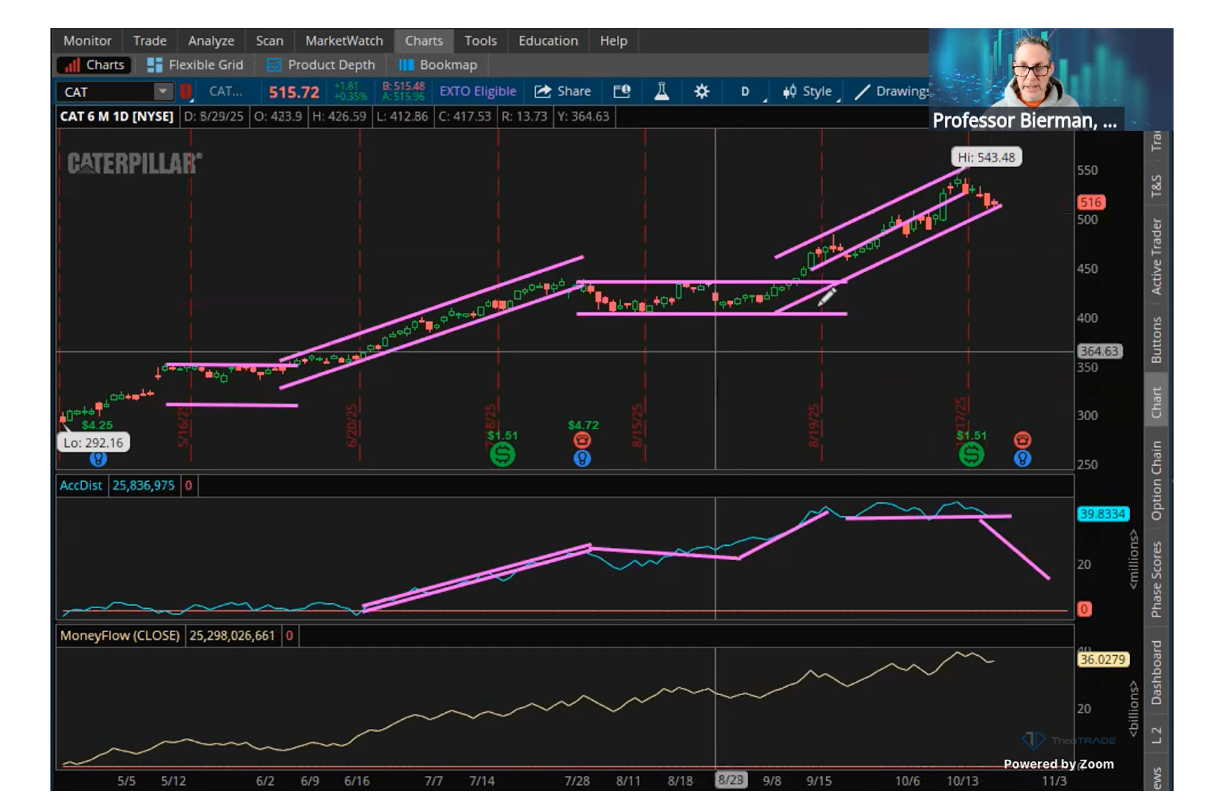
Institutions loaded the boat systematically while the algos defended the upward channel. The hamster wheel was spinning, but real progress was happening underneath because money was actually flowing in.
That's productive momentum. That's when being on the wheel makes sense because you're actually getting somewhere.
Now look at what's happening currently. Caterpillar keeps grinding higher, but the money flow has gone flat.
Price action says "still good." Money flow says "institutions are done accumulating." They've stepped off the wheel.
That divergence is your warning. When a stock walks higher but money stops flowing in, you're back to pure hamster wheel dynamics. All effort, no progress, about to reverse.
The algos still defend the channel because they're programmed to. But once that support breaks, the lack of institutional buying means there's no cushion underneath.
You're running alone on a wheel that's about to stop. I track money flow on every position I hold. When I see money flowing in with price, I stay. When money flow goes flat while price climbs, I start planning my exit.
Follow the money. It will show you who's already positioned for what comes next. But there's one more piece you need to know if the pattern is actually locked in.
When the ADX Confirms You're Trapped
The hamster wheel works in both directions. When markets reverse, the same mechanical pattern that trapped you on the upside will trap you on the downside.
The Average Directional Index measures whether the current pattern has enough momentum to continue. It reveals trend strength, not direction.
Below 20 means non-trending, no wheel pattern established. Between 20 and 25 means trying to establish a pattern.
Above 25 means the wheel is locked in and spinning hard. Above 30 means you cannot fight it until the pattern breaks.
Look at John Deere breaking down from consolidation. The channel slopes lower. Money flow confirms institutions are exiting systematically.
But the signal that tells you this is a locked-in hamster wheel pattern running in reverse is the ADX climbing above 25 as the breakdown unfolds.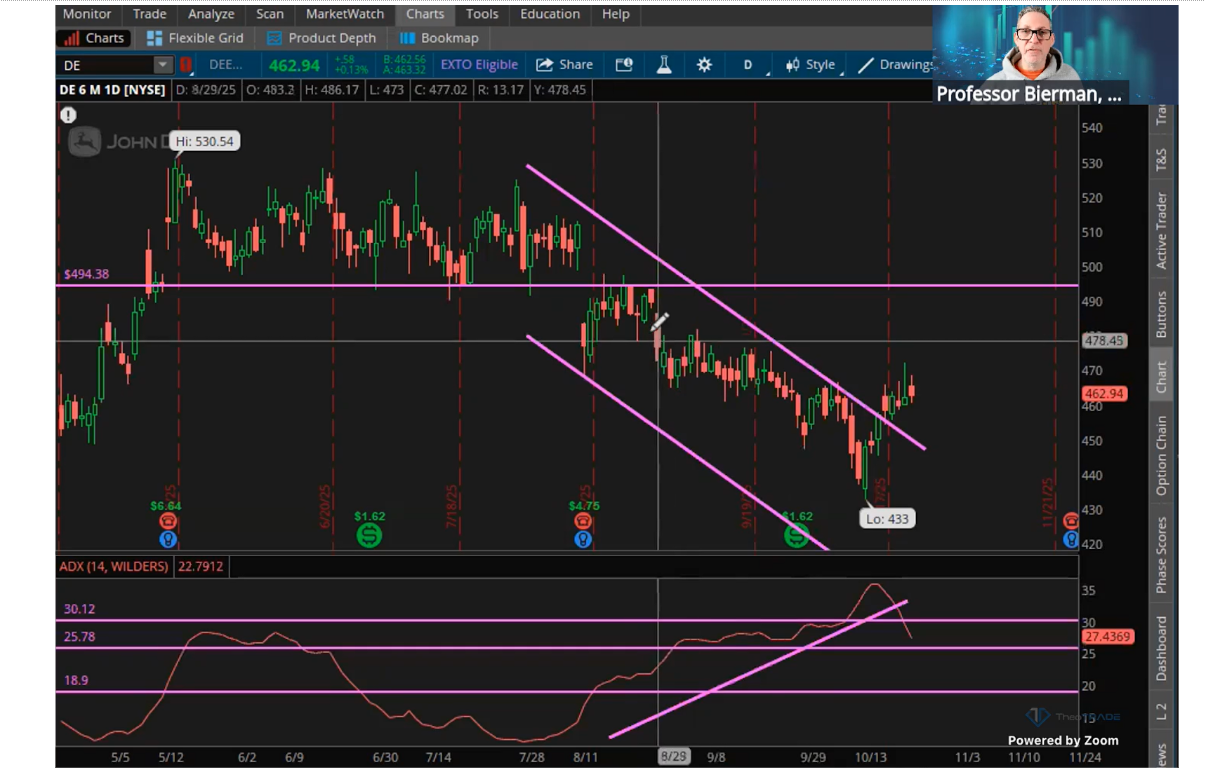
That combination tells you everything: downward channel plus rising ADX equals a new hamster wheel, just spinning the other direction. You can short at 480, at 466, at 450.
The trend strength is confirmed. The algos are defending the downward slope just as aggressively as they defended upward channels. The wheel is locked in.
When the ADX breaks above 35, the pattern is exhausting itself. But between 25 and 35, you're watching a mechanical cycle that will continue until the programming changes.
The ADX tells you whether the hamster wheel is locked in or breaking apart. Miss this and you'll fight a pattern that has weeks left to run. Watch it and you'll know exactly when the mechanical repetition is about to end.
These three indicators work together. The MACD shows when algos will flip programming. Money flow shows when institutions are stepping off early. The ADX confirms the wheel is locked in versus just temporary noise.
Miss any one of them and you're guessing. Use all three and you can see the hamster wheel for what it is before you're the one getting thrown off.
Your Position Right Now
You're on the hamster wheel. Running hard. Feeling productive. Making money on paper.
But you're trapped in a cycle that's about to stop spinning.
The government shutdown is now 23 days old. Every day it continues shaves 0.1% off GDP.
If it lasts four months, that's 1% gone from economic growth. The GDP must stay above 2% for this market to maintain its upward trajectory.
The hamster wheel spins fastest right before it stops. All that energy you're expending will become wasted effort the moment the four-hour MACD rolls over.
When money flow turns negative while price still climbs. When the ADX confirms the trend has broken.
Stop treating this grinding higher as sustainable progress. You're expending tremendous effort to stay in the same place.
And when the algorithms flip from buying to selling, you won't have time to get out.
The genesis of every major correction looks exactly like this: repetitive patterns that feel safe because they keep working, until suddenly they don't. Recognize the hamster wheel for what it is before you're the one flying off when it stops spinning.
The Genesis COG system tracks the exact momentum shifts that separate productive trading from wasted effort on the hamster wheel. It measures four-hour MACD positioning, money flow validation, and ADX trend strength across hundreds of stocks simultaneously.
When you're running in circles expending energy but making no real progress, the scanner reveals it before the cycle breaks and throws you off.
Professor Jeffrey Bierman
Creator of the Genesis COG System