


Gold collapsed 5% in two sessions after a vertical run to all-time highs.
Netflix missed earnings and dropped 10% overnight despite trading at the top of its range for months.
Texas Instruments disappointed and triggered a semiconductor selloff that nobody saw coming.
These weren't isolated events…
…They were algorithmic executions following the same mechanical pattern that controls 90% of daily market volume.
The machines walked these stocks higher in perfectly linear channels for months, then flipped to systematic selling the moment momentum indicators broke.
Traders see stocks climbing in straight lines and assume the trend continues forever.
They buy every dip because it worked yesterday. They ignore the compression building inside tight channels.
Then one extraordinary candle breaks the pattern and they're trapped in positions that collapse 15% in days.
The market doesn't trade on fundamentals anymore. It trades on algorithmic channels.
Linear slopes that walk prices higher or lower until specific momentum triggers force a reversal.
These reversals happen in milliseconds. By the time you see the break, the damage is done.
Today I'm showing you the three-step framework I use to identify these reversals before they happen.
- First, you'll learn how to recognize algorithmic channels and understand why they control price action for months at a time.
- Second, I'll show you the specific candle patterns that signal when algorithms are losing control of a channel.
- Third, you'll see how to validate those breaks with momentum indicators so you don't get faked out by temporary pullbacks.
This framework works on both upward and downward channels. It identifies both collapse setups and breakout opportunities.
Master it, and you'll position yourself ahead of major moves instead of reacting after your account is destroyed.
If you want to make it even easier on yourself, the Genesis COG Scanner automates this exact framework.
It looks for channel breaks, extraordinary candles, and momentum confirmations across hundreds of stocks simultaneously.
Because when algorithms flip direction in milliseconds, manual analysis arrives too late.
Step One: Recognize Algorithmic Channels
The market operates in linear patterns now.
Pull up any chart from the past six months and you'll see the same structure: perfectly drawn channels that walk prices higher or lower for months at a time.
Algorithms force stocks into these channels by defending specific slope boundaries. They pound volatility flat using systematic buying and selling programs.
Daily price ranges stay contained, often just $1-2 on a $70 stock. The overall trajectory remains locked inside predetermined boundaries.
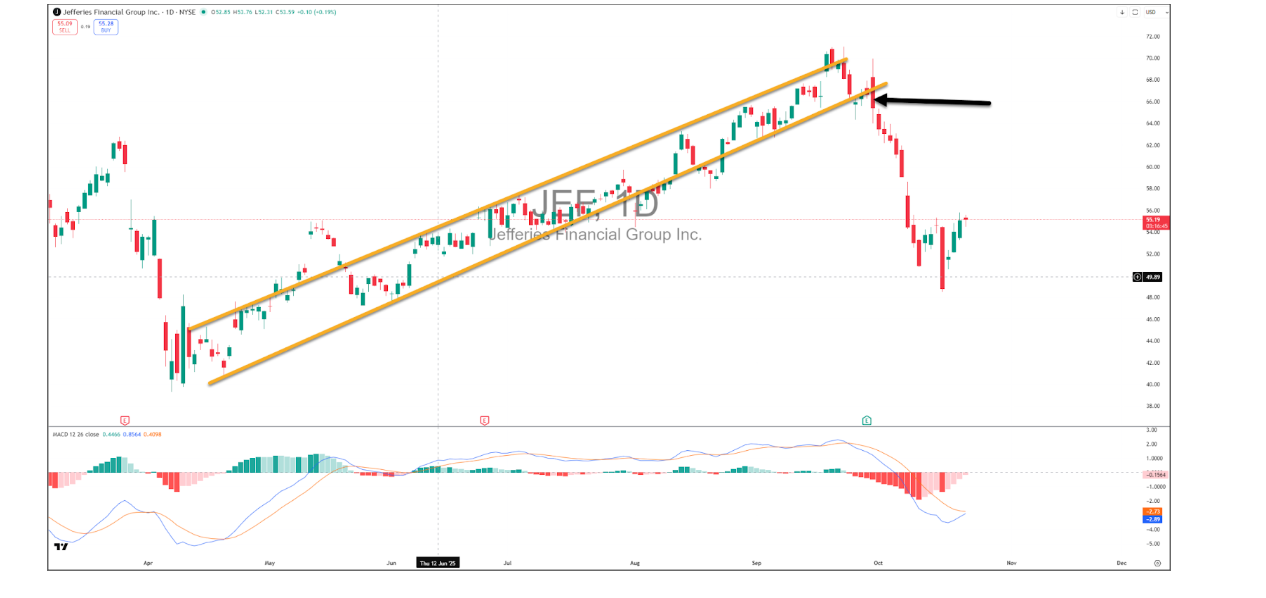
Look at Jefferies running from $48 to $70 over five months. Draw a channel around that move, and you'll see every dip bounce off the lower boundary. Every rally respects the upper boundary.
The algorithms defended that slope relentlessly. Day after day, the machines bought weakness and sold strength to maintain the channel integrity.
This pattern repeats across the entire market. Energy stocks. Tech names. The S&P itself. Everything trades in algorithmic channels that respect mathematical boundaries until specific triggers force a reversal.
Understanding this changes everything about how you approach trades. When a stock climbs inside an upward channel, you don't fight it. The algorithms are programmed to defend that slope.
Shorting inside an upward channel gets you systematically destroyed. The machines will buy every dip until their programming changes.
The same logic applies to downward channels. When algorithms establish a declining slope, buying the dip inside that channel is suicide.
The machines are programmed to sell strength. Your 100 shares don't matter against thousands of algorithms firing sell orders every time the stock bounces to the upper boundary.
The key is identifying when the channel is about to break. That's where the money is made. Positioning for the reversal before it confirms, not chasing it after the move is over.
Step Two: Identify Extraordinary Candles
Channels break when extraordinary candles appear. These are price bars that violate the algorithmic boundaries with unusual size or momentum.
The definition is simple: An extraordinary candle is significantly larger than the typical daily range and closes outside the channel boundaries.
On Jefferies, normal daily ranges averaged $1 during the five-month climb. When the stock dropped $3.20 in one session and closed below the lower channel boundary, that was extraordinary. Three times normal size. Clear violation of the pattern.
That single candle marked the reversal. Within weeks, Jefferies fell from $67 to $50.
The algorithmic buy program had shifted to a sell program. The machines that defended every dip for months now attacked every bounce with systematic selling.
Here's what separates professionals from casualties: recognizing the difference between ordinary volatility inside a channel and genuine breaks that signal reversal.
Jefferies pulled back multiple times during its climb. Traders saw those dips and thought "this is the top." They shorted. They got destroyed.
Why? Because those pullbacks were ordinary candles inside the channel. The algorithms were still defending the upward slope. The pattern remained intact.
The real break required two conditions. First, an extraordinary candle that was significantly larger than normal. Second, a close outside the channel boundary. Not just a wick or intraday violation, but an actual closing price that broke the pattern.
Only then did the reversal become actionable. Only then did shorting become a high-probability trade instead of fighting against systematic buying.
This works in both directions. Devon Energy consolidated for three months near $32 inside a tight range. The stock wasn't climbing. It wasn't falling. It was coiling.
Then it broke above $36 with an extraordinary candle that confirmed the algorithmic buy program had activated. That breakout from consolidation into an upward channel is where you buy. Not during the consolidation. Not on hope. When the pattern actually breaks with confirmation.
Step Three: Validate with MACD Confirmation
Extraordinary candles break channels. But not every break leads to a sustained reversal.
Sometimes stocks break out of one channel and immediately consolidate into a flag pattern. Sometimes they fake a breakdown, then bounce back into the original channel.
This is where most traders blow up. They see the extraordinary candle, take the trade, then get stopped out when the stock doesn't follow through.
The solution is momentum confirmation using MACD slope.
The MACD indicator shows you whether algorithms are genuinely shifting direction or just pausing. When the MACD slope turns positive and climbs above the zero line, algorithms are programmed to buy.
When it curls underneath and trends negative, they're programmed to sell.
The combination of channel break plus MACD confirmation creates high-probability setups.
Look at Schlumberger breaking out of a descending channel at $32. That channel break alone wasn't enough to trust.
But the MACD showed four confirming signals simultaneously:
- The MACD line crossed above the zero line
- The histogram expanded on the positive side
- The MACD line rose above the signal line
- Both lines sloped upward together
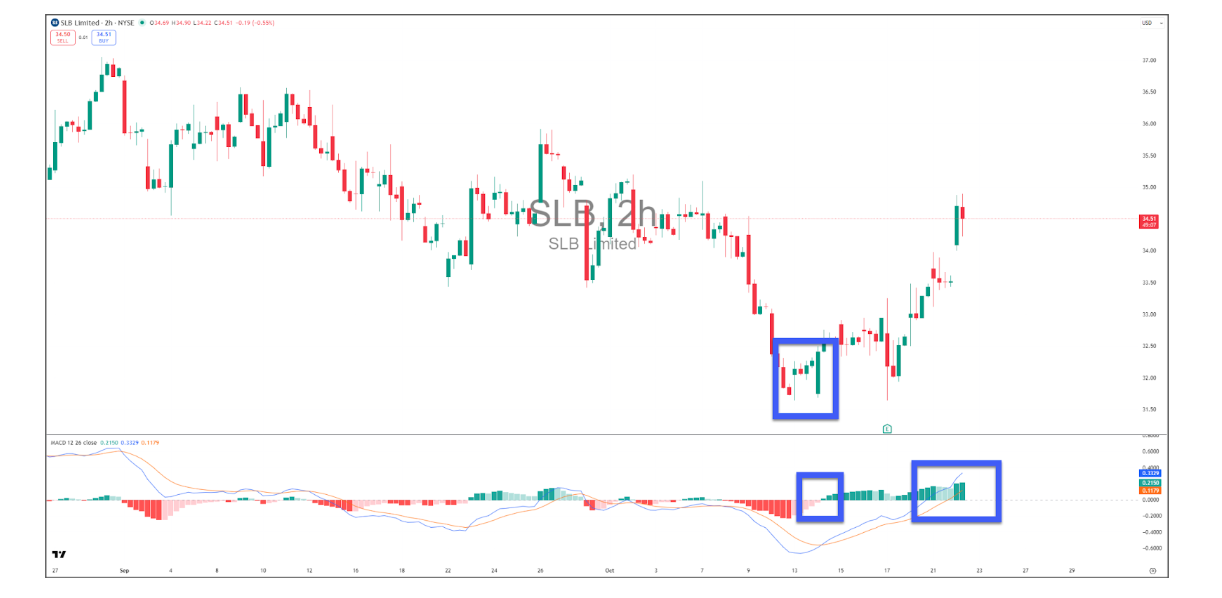 That's full algorithmic confirmation. The machines had flipped from defending a downward slope to defending an upward slope.
I bought at $32.50 despite nobody wanting energy stocks. The fundamentals didn't matter. The sentiment didn't matter. The algorithmic program had reversed.
Contrast that with Etsy's current setup. The stock broke below its upward channel with an extraordinary candle. But the MACD stayed neutral. Not declining, not confirming the reversal.
That signaled consolidation rather than collapse. The stock moved into a sideways flag pattern instead of triggering a sell program.
Without MACD confirmation, the extraordinary candle was just noise. With confirmation, it becomes a high-probability trade.
That's the complete framework: Identify the algorithmic channel. Wait for an extraordinary candle to break it. Validate the break with MACD slope. Then execute with defined risk.
Channel break without MACD confirmation means wait. Channel break with MACD confirmation means act.
Why the S&P Faces the Same Pattern
This framework applies to individual stocks and to the broader market.
Right now, the S&P trades in a vertical channel with compressed volatility. The four-hour MACD remains positive but flat. The weekly MACD trends up with an RSI at 72.
These indicators haven't rolled over yet. The algorithmic buy program remains active.
That's why every dip gets bought within hours. The machines are defending the upward slope exactly like they defended Jefferies from $48 to $70.
But when the weekly MACD curls underneath the signal line, when that zero line gets breached on the four-hour chart, when an extraordinary candle breaks through 6,500 on the S&P, the algorithmic sell program activates.
Think about what just happened to gold. A 5% collapse in two sessions after months of vertical ascent.
The same machines that walked it higher in a perfect linear channel flipped to systematic selling the moment momentum broke. No warning. No gradual rollover. Just instant liquidation.
The S&P will follow the same pattern when its time comes. Money made over six months could vanish in six days.
You'll watch the market down 200 points and think "I should buy this dip." Then it drops 400 points and you're paralyzed.
I'm telling you this eight weeks before it might happen. Not eight minutes after.
The setup is forming. Vertical slope, compressed volatility, deteriorating breadth. When the weekly MACD finally curls over and breaks that zero line, the sell program activates.
Position accordingly. Reduce exposure on rallies. Take profits on extended positions.
Stop believing every dip is a buying opportunity just because it worked for six months.
The rip curl wave is coming. The only question is whether you see it building or get caught underneath when it breaks.
The algorithms controlling today's market calculate these momentum shifts in milliseconds. They identify channel breaks before price confirms the reversal.
They position ahead of major moves while retail traders celebrate new highs.
The Genesis Cog system tracks these same patterns. It scans for channel breaks, extraordinary candles, and MACD confirmations across the entire market simultaneously.
It reveals the mechanical triggers that separate systematic buying from systematic selling before the reversal becomes obvious.
Stop trading blind against machines that process these signals automatically.
Professor Jeffrey Bierman
Creator of the Genesis COG System