


Financials hit record highs in late 2025. Volume has declined for six straight months.
One of those facts is a buy signal. The other is a warning. They can't both be right.
Price making new highs on shrinking volume is one of the oldest divergence signals in technical analysis. It means fewer participants are driving the move. The buyers are running out.
XLF sits at fair price for 2026. The consumer finance stocks inside the sector face even bigger headwinds as stagflation squeezes consumer spending and credit quality.
The Volume Tells the Story
XLF, the financial sector ETF, pushed to all-time highs in late 2025. On the surface, that looks like strength.
But volume has been declining for six months straight.
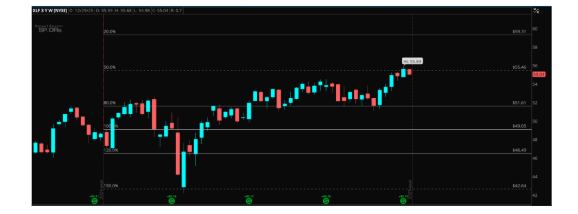
Price making new highs while volume contracts is one of the oldest warning signs in technical analysis. It means fewer and fewer participants are driving the move higher. The buyers are exhausted.
Where Price Sits Now
XLF currently sits at fair price for 2026 based on the projected Monkeybars. This is neutral territory with no directional edge.
The overbought zone sits near $60. I doubt we get there. But if we do, that's where I'm looking to establish short positions aggressively.
The Consumer Finance Angle
Inside the financial sector, consumer finance stocks look most vulnerable. My primary candidates for a move lower include:
- Capital One (COF) — heavy consumer credit exposure
- Ally Financial (ALLY) — auto lending faces headwinds
- Klarna (KLAR) — buy-now-pay-later model under pressure
- Affirm (AFRM) — same BNPL vulnerabilities
These companies depend on consumer spending and credit quality. Both face headwinds in a stagflationary environment. When the dollar weakens and inflation persists, consumers feel the squeeze. Discretionary spending falls. Credit quality deteriorates. Consumer finance companies take the hit.
The Trade Structure
I'm planning to sell call verticals on XLF in the new year. The current premiums aren't quite rich enough to justify the trade today. This requires patience.
When price pushes toward the upper end of the range or volatility expands, the premiums will improve. That's when I'll step in.
For individual stocks like COF and ALLY, the options markets offer better premium right now. Selling call spreads 30-45 days out captures time decay while defining risk.
Why Not Technology
Some traders expect me to fade technology in 2026. I do think tech will struggle. But the setup in financials is cleaner.
Tech had a mixed 2025 with clear rotations in and out of the sector. Financials had a steady grind higher on weakening internals. That divergence between price and volume is more reliable as a reversal signal.
The Bigger Picture
This trade fits the top-down framework I use for all my positioning.
Dollar weakness suggests inflation persists. Persistent inflation hurts consumer purchasing power. Weakened consumers default more and spend less. Consumer finance suffers.
The fundamental thesis aligns with the technical setup. That's when I have the most confidence in a trade.
Risk Management
The defined risk of call verticals means I know my maximum loss from the start. If financials continue higher against my thesis, the loss is contained.
I'm not betting the farm on this view. I'm expressing it with a position size that makes sense relative to my total portfolio.
In the next newsletter, I'll lay out where I'm putting money to work on the long side.
Defensive sectors are setting up with both income potential and capital appreciation.
The utilities trade alone could return 13% or more doing nothing but buy and hold.
Blake Young
Senior Market Strategist, TheoTrade