


Eli Lilly trades at $900 per share with a 70x earnings multiple.
Merck trades at 13x earnings. Pfizer trades at 13x earnings. Abbott Labs trades at 16x earnings. AstraZeneca trades at 31x earnings.
These are all established pharmaceutical companies. Similar business models. Similar product portfolios. Similar market positions. Yet Lilly trades at 70x while every peer sits between 13x and 31x.
Wall Street analysts defend this by claiming Lilly has superior growth prospects. The numbers tell a different story.
Lilly's earnings show typical pharmaceutical lumpiness. Strong quarters followed by average quarters. Nothing that justifies a multiple five times higher than its closest competitor.
This isn't about hating Lilly. This is about recognizing when Wall Street's fuzzy math has pushed a stock so far from reality that reversion becomes inevitable.
Every major crash started with valuations that made no sense but kept climbing anyway. Dot-com. Housing crisis. COVID. The pattern repeats.
Spotting one overvalued stock is easy when you look at the numbers.
Finding all of them before they crash is impossible manually.
The Genesis COG Scanner runs the same peer comparison analysis across 3,000 stocks daily, flagging extreme disconnects like Lilly's 70x multiple versus the sector's 13-16x range.
Today I'm showing you the five-minute framework that reveals these valuation lies.
First, you'll see exactly why Lilly's numbers don't support its price.
Then you'll learn the methodology to spot these disconnects yourself across any stock.
The Peer Comparison That Exposes Everything
Pull up the pharma sector right now. Look at what established players trade for.
- Merck: 13x earnings, 25% profit margins, stable drug pipeline.
- Pfizer: 13x earnings, solid balance sheet, diversified revenue.
- Abbott Labs: 16x earnings, medical devices plus pharma.
- AstraZeneca: 31x earnings, aggressive growth initiatives.
- Eli Lilly: 70x earnings, weight-loss drug narrative.
AstraZeneca's 31x multiple represents the high end for pharma with genuine growth catalysts. Even that premium valuation sits less than half of Lilly's multiple.
Lilly earned roughly $12 per share over the last four quarters. At $900 per share, you're paying 70 times those earnings. For a pharmaceutical company that's been around for decades, that valuation makes zero mathematical sense.
Historically, established pharma trades between 8x and 20x earnings. During bull markets with blockbuster drugs in the pipeline, these companies might push to 25x. But 70x? That's not a valuation. That's a narrative.
The weight-loss drug story created a frenzy that lifted Lilly to dot-com era multiples. Ozempic. Wegovy. Wall Street analysts kept upgrading after each 50% run.
The fundamentals never justified the price. The momentum did.
Now let me show you exactly how to spot these disconnects yourself before you're holding a position that crashes 60% in weeks.
The Five-Minute Framework That Reveals True Value
Most traders never look past the chart. They see a stock climbing and assume it's cheap. They watch it falling and think it's expensive.
Price tells you nothing about value. The relationship between what a company earns and what you're paying for those earnings tells you everything.
Here's the framework I use to price any company in under five minutes.
- For service companies like pharma:
- Start with Return on Equity. This becomes your implied growth rate. A company generating 15% ROE can sustainably grow earnings at roughly 15% annually.
- Check profit margins to validate the ROE calculation. High margins over 20% support sustained profitability. Low margins under 10% suggest pricing pressure.
- Compare the PE multiple to the ROE. They should align. A 15% ROE justifies a 15-20x multiple. A 70x multiple requires 70% growth.
- Calculate the PEG ratio. PE divided by growth rate. Fairly valued growth stocks trade between 1.5 and 2.0 times their growth rate. Anything above 2.5 indicates overvaluation.
For all companies:
- Current ratio shows liquidity. You need 2.0 minimum. This means the company has twice the short-term assets to cover short-term liabilities.
- Quick ratio strips out inventory. You need 1.0 minimum. This tests whether the company can survive without selling inventory.
- Debt-to-equity under 0.5 is clean. Over 2.0 is dangerous. This reveals leverage risk that can destroy companies during downturns.
Here's how this works in practice:
Say a company earns $10 per share with 15% ROE and 15% sustainable growth.
Fair multiple range: 22.5x to 30x. That's 1.5-2.0 times growth rate.
Fair value: $225 to $300 per share.
Actual price: $450.
Verdict: Overvalued by 50-100%.
This isn't academic theory. This is how you avoid paying $900 for $400 worth of actual business value. Now watch what happens when we apply this framework to Lilly.
Running The Numbers On Eli Lilly
Pull up Lilly's financials. The profit margin sits at 25%. That's excellent. The company generates a quarter of every revenue dollar as profit.
The ROE sits at 13.5%, up 25% year-over-year. This number tells you the company's implied growth rate. When you analyze earnings progression, you see sustainable growth around 13-15% annually.
Now apply the PEG ratio formula. A fairly valued growth stock trades at 1.5 to 2.0 times its growth rate. At a 13-15% growth rate, Lilly should trade between 19.5x and 30x earnings maximum.
At $12 in earnings, that puts fair value at $234 to $360 per share. The stock trades at $900. That's a 150-250% premium over fair value.
The balance sheet is pristine. Current ratio of 4.0 means they're sitting on 400% cash reserves. Debt-to-equity of 0.35 means they're barely leveraged. This company could acquire a competitor tomorrow without blinking.
But none of that justifies a 70x multiple for a company growing at 13%. There isn't a pharma company in the world that's going to grow at 70% annually at this size.
The law of large numbers dictates that as companies get larger, the rate of change normalizes. Lilly is one of the 50 largest companies on the planet. Hyper-growth doesn't happen at this scale.
Look at Lilly's actual earnings progression. Here's what the numbers show over recent quarters.
Strong quarter: $0.56 per share. Average quarter: $0.23 per share. Good quarter: $0.33 per share.
Another average quarter: $0.40 per share. That's lumpy pharmaceutical earnings.
Typical cyclical performance driven by drug approvals, patent cycles, and competitive dynamics. Nothing that justifies a multiple five times higher than every competitor.
The math is simple. Lilly trades like a hyper-growth tech startup. But it's a 140-year-old pharmaceutical company with mature products and predictable earnings patterns.
Wall Street created fuzzy math that justifies any price they want to defend. They upgrade stocks after 300% runs. They downgrade quality companies at bottoms. The objective analysis gets replaced by narrative trading where momentum matters more than margins.
The Pattern That Destroys Accounts Every Decade
This same disconnect destroyed traders in the dot-com bubble. Stocks trading at 100x revenues because "eyeballs" and "network effects" justified any price. Companies with zero earnings commanded billion-dollar valuations.
The logic was identical. "This time is different. These metrics don't apply to revolutionary companies. Traditional valuation is obsolete."
Until it wasn't. The Nasdaq collapsed 78%. Companies trading at 200x sales went to zero. The math that never made sense finally caught up with the narrative.
The housing crisis revealed the same pattern. Banks trading at multiples that assumed housing prices would rise forever. Mortgage companies valued like tech startups despite commodity business models.
Everyone knew the fundamentals didn't support the prices. The momentum kept pushing them higher anyway. Then gravity took over.
Now we're watching it happen again. Certain pharma stocks trading at 70x earnings. AI plays commanding valuations that assume 100% growth for a decade. The story is always the same. The narrative overrides the math. Until the narrative breaks.
When Lilly normalizes, and all growth eventually normalizes, this stock could easily revert to a 20-25x multiple. At $12 in earnings, that puts the stock between $240 and $300.
Not predicting a crash. Just acknowledging that 70x earnings for a mature pharmaceutical company defies every historical valuation metric.
The weight-loss drug story lifted Novo Nordisk to similar extremes. That stock already crashed from its peak. The same machines that walked it higher in a perfect linear channel flipped to systematic selling the moment momentum broke. 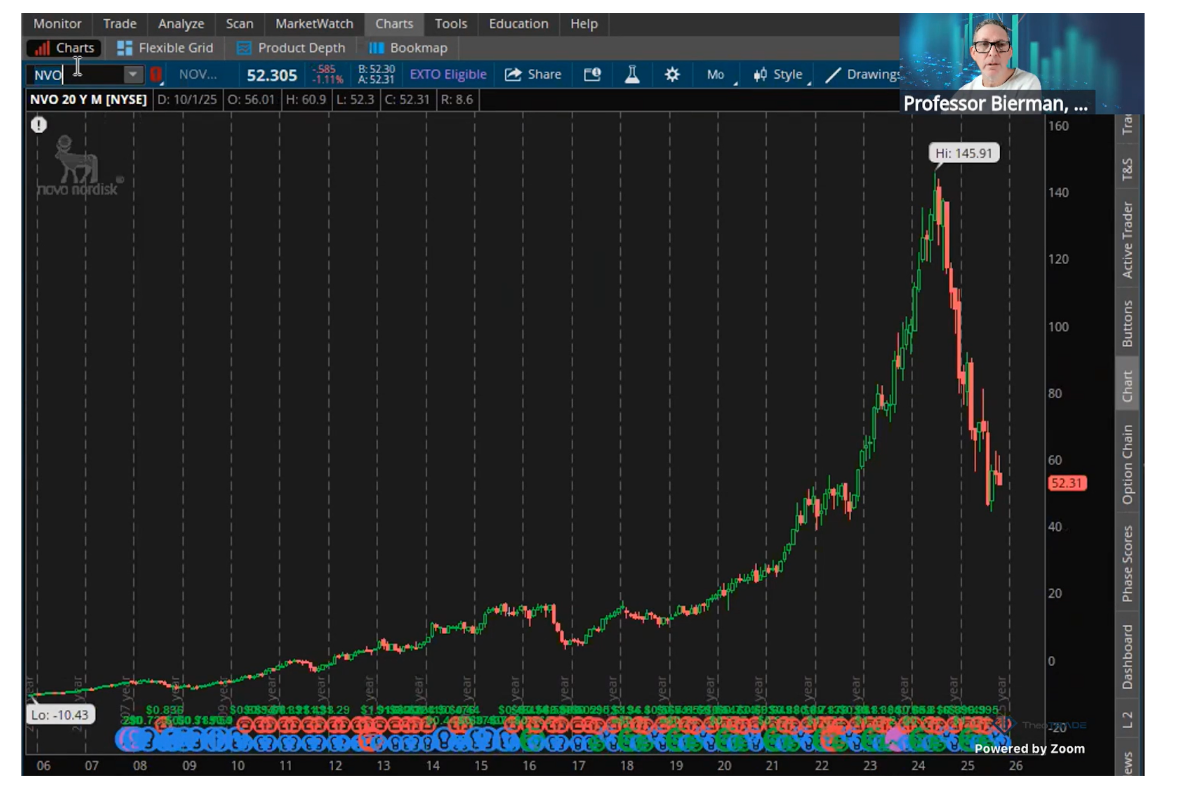
Every bubble follows this pattern. Vertical move into extreme valuations. Months of sideways consolidation at the highs. Then sudden reversion when the last buyer finally exhausts themselves.
Lilly sits in the consolidation phase right now. The stock keeps hitting new highs but the gains are smaller. The momentum that carried it for months is exhausting itself.
Your Framework For Finding These Disconnects
The market gives you two types of opportunities at extremes like this.
Bubbles trading on narrative: Companies priced for 70% growth delivering 13% growth. These work until cash flow normalizes and the multiple compresses. When that happens, 60% of the value evaporates in weeks. That's Lilly today.
Value ignored by momentum: Companies delivering 25% margins and 13% growth trading at 13x earnings when they should trade at 20x. These work when the narrative finally shifts and algorithms rotate into fundamentals. That's Merck and Pfizer today.
Run the five-minute framework yourself on any stock you're considering.
Calculate the ROE to find implied growth rate. Compare the PE multiple to that growth rate. Check if they align.
Apply the PEG ratio to see if you're paying reasonable prices for growth. Verify the balance sheet can support the business through downturns.
The math will tell you what a company is actually worth. The chart will tell you what traders are willing to pay. The gap between those two numbers is where you make money or avoid devastating losses.
For Lilly specifically, the framework reveals a stock trading 150-250% above fair value based on fundamental metrics. The peer comparison shows no justification for the premium. The earnings progression shows no evidence of 70% growth capability.
Every analytical lens points to the same conclusion: extreme overvaluation. The only question is timing.
I'm not saying short Lilly tomorrow. Bubbles can stay irrational longer than you can stay solvent. But understand what you own.
If you bought Lilly at $800 expecting it to hit $1200, you're betting on narrative expansion, not fundamental value. When that narrative shifts, you won't have time to exit.
Finding these gaps manually across hundreds of stocks takes hours. The Genesis COG Scanner automates this fundamental analysis at scale.
It identifies stocks where valuation disconnects have reached extreme levels. The system combines these metrics with technical timing to show you when Wall Street's fuzzy math has pushed prices so far from reality that reversion becomes the highest-probability trade.
Stop trading on narratives that make no mathematical sense. Start trading on numbers that reveal what businesses are actually worth.
See how Genesis COG separates real value from Wall Street's fuzzy math →
Professor Jeffrey Bierman
Creator of the Genesis COG System