


Twelve out of thirteen days. Up. Up. Up.
That's not a free market. That's machine-driven manipulation.
The Martingale probability of that happening naturally is almost zero.
But in a market controlled by algorithms programmed to buy every single dip it becomes a foregone conclusion.
Today, I'm showing you the two indicators that prove why forcing trades destroys accounts.
Because at this point, I could literally take a melatonin and go to bed. This is ridiculously frustrating.
You make more money doing nothing and being patient than trying to force a trade.
That’s why patience is the only edge that works right now.
The Indicator That Never Lies
Look at the MACD on the S&P. Flat.
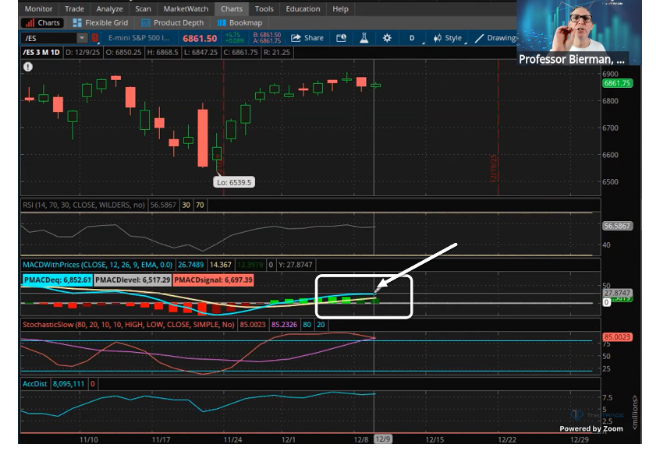
Is that pointing down? No. That's why the market's not going down.
If you want the market to go down I'm one hundred percent guaranteed it's never going down unless that MACD goes that way. You need this to cross underneath the signal line.
Or you got no shot. None. It ain't going down.
All benefit goes to the dippers right now. Nobody cares about fundamentals. They're hooked one hundred percent on technicals.
When that MACD sits flat above the signal line and zero line the algorithms execute one instruction. Buy.
They don't care that consumer confidence hit four-month lows. They don't process that housing sellers are pulling listings at the fastest pace in months. The machines are data agnostic through December.
Their only job is maintaining this level through year-end so fund managers can report acceptable fourth-quarter numbers.
The Money Flow Shows What They're Actually Doing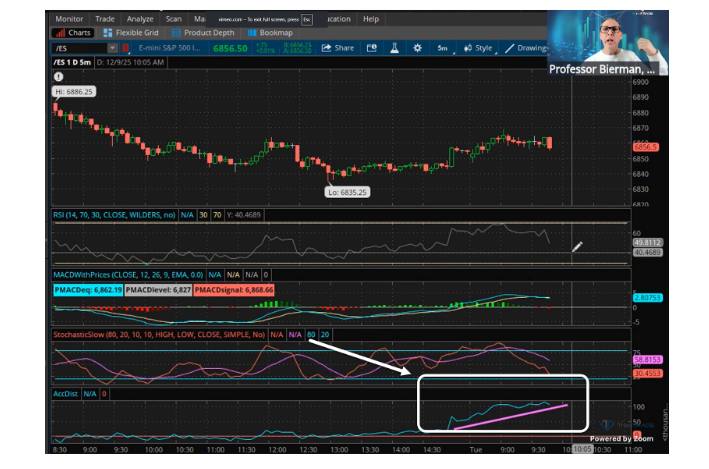
Do you see money coming out of the market? Me neither.
See how they're jamming money in? That's why the S&P goes up.
The money flow indicator is the most important indicator ever designed outside the MACD. Just those two alone can make you a millionaire.
The accumulation distribution line points upward. Institutions are not selling. They're not even hedging.
All they're doing is curating. Sell the weak. Buy the strong. Pick and choose. Prune the garden.
If they were selling you'd see that line go down. They'd be shorting futures to offset long positions they own in stock. They're not doing that yet.
Watch that money flow on a five-minute basis. That's my absolute favorite timeframe for the smoothing factor.
You'll figure out when the market's ready to go down. It's not ready. We're close but not there yet.
No Soup For You
After tomorrow there won't be another Fed rate cut until April.
Four months of nothing. No catalyst. No liquidity driver. Nothing to lean on.
Traders can't sit there and say they'll buy because another rate cut is coming. That's over. Tomorrow is it.
You're in a vacuum of no data for four months.
All the data's telling you we have hyperinflation coming or we have stagflation. Pick your poison. Interest rates are going higher and that's the way it's gonna be.
The market will rally tomorrow on the rate cut. Markets always rally on Fed rate cuts. It would surprise me if the market sold off tomorrow.
But that doesn't change anything. Every day through December stays the same. Machine driven. Machine controlled.
I will make a bet against all of you that the market moves sideways to 6,800 till December 31st. Bet against me. Unless the MACD turns you ain't got a shot at getting this down.
What Home Depot Just Told You
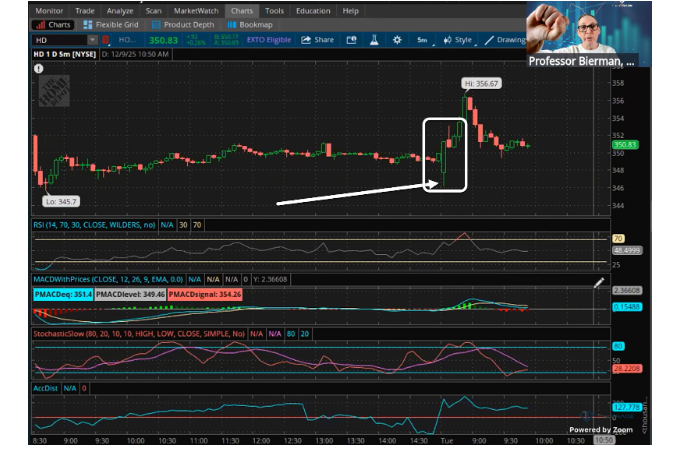
Home Depot dropped to 347 in premarket. The CEO said housing will correct.
They expect higher sales in 2026 but lower earnings. How can you have it both ways?
Higher sales and lower earnings means margins are falling. Their costs have gone up to build houses.
Labor costs are up. Material costs are up. Logistics costs are up.
What are they gonna do? They're gonna pass it on to people who wanna buy houses. And the people who wanna buy houses ain't got the money because they're being displaced by AI.
The stock bounced and settled in at 350. Why? Financial porn. People figure Home Depot already sold off from 430 to 350. Maybe it's already priced in.
My problem is you can't buy a stock at twenty-four times earnings. You can't do that. You shouldn't do it for a stock that's not even growing at ten percent earnings.
This tells me there are problems in the housing market. Problems in the consumer market. Things are not so rosy.
Yet the market ignores everything. Deaf, dumb and blind. Doesn't want to hear anything except getting through this year at sixteen percent gains.
How I'm Positioned Right Now
I have long positions. I have short positions. I go to bed and rest my head on the pillow. Done.
I'm not forcing trades. Not at all.
Yesterday I shorted a stock. Made two and a half bucks. I'm not taking that short off. I pick and choose my spots.
But every single day to the end of the year is like pulling teeth. Tedious. Frustrating. Difficult.
Don't fight this through December. I don't think the market falls out of bed the rest of the year. Even if Powell says he's raising rates one hundred basis points I still think we go nowhere.
The market is disconnected from the Fed and from fundamentals. Their entire mission is screening out every piece of risk and getting that market to year-end at acceptable numbers.
When the real market begins in January things change. Let the first three days pass. Let all the 401k money get spent. Let the passive funds establish their long positions.
By the fourth day of the new year systematic pressure disappears. Then you can start contemplating positions.
The Genesis COG System identifies exactly when mechanical support patterns break. When year-end positioning exhausts itself. When algorithms shift from defending every dip to real trading.
Every day through December twelve more times? Thirteen more times? It's all machines. There's no randomness. Expect the market to be up unless that MACD breaks.
Stop fighting what you can't beat. Be patient. That's the only edge that works right now.
See how Genesis COG detects when algorithmic support disappears and real markets return →
Professor Jeffrey Bierman
Creator of the Genesis COG System