


Hey trader,
Institutions are reloading their hedges into strength.
A massive rally in the S&P 500 looks like relief to most traders.
For the desk behind this print, it was a discount on protection.
The Block Prints Console flagged 70,000 put contracts bought on SPY at the $625 strike for April 17 expiration.
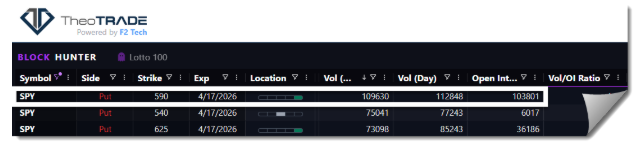
The fill landed in a single print while the market was still climbing.
Rallies make puts cheaper. The institution behind this print knows that.
I'm going to show you exactly how that pricing dynamic works, what the diagonal connecting April and May tells you about their expected move, and how to position around $625 where the inventory just landed.
Why Green Days Create a Pricing Edge
When the S&P 500 rallies, implied volatility drops. That makes puts cheaper.
The VIX has been above 20 for roughly two months. It faded toward 28 during today's session as equities caught a bid.
An institution monitoring that drop saw a window. Buying 70,000 puts on a green day captures lower premiums than buying the same contracts on a sell-off when the VIX spikes.
The $625 strike sits roughly 20 points below where SPY was trading at the time. The delta was approximately 14, which means market makers only need to hedge a small fraction of the notional right now.
That changes if SPY reverses. As the stock moves toward $625, delta accelerates. The market makers who sold those puts must sell shares to stay hedged, and that selling creates mechanical downside pressure near the strike.
What the Diagonal Structure Reveals
The Console flagged the 70,000-contract buy at $625 for April 17. A separate series of prints showed approximately 60,000 puts sold at the $575 strike for May 15 expiration.
That combination is a diagonal spread. The institution bought near-term protection at a higher strike and sold further-dated protection at a much lower strike to offset the cost.
The near-term leg at $625 reflects where they expect downside pressure to arrive within 17 days. The longer-dated leg at $575 collects premium while sitting far enough below to avoid being tested.
The contract count confirms the directional lean. They bought 70,000 on the near-term leg and sold only 60,000 on the further-dated leg. That imbalance is net bearish.
Today was the last day of the quarter. Target date funds and balanced portfolios will rebalance by selling bonds and buying stocks to restore their allocation weights. Short interest on the Russell 3000 has climbed to 4.3%, the highest level in years.
Those two forces can support the market for a few sessions. Rebalancing flows and short covering provide a mechanical bid. The institution behind this print is positioned for what happens once that temporary buying exhausts itself.
How to Structure the Trade
The institution bought far out-of-the-money puts, but a vertical spread at higher strikes captures the same thesis with defined risk.
- Buy the SPY May 1 $633 put
- Sell the SPY May 1 $631 put
- Spread width: $2
- Cost: Approximately $0.68
- Target: $1.16 (70% return on the spread)
- Max risk: $0.68 (the debit paid at entry)
- Direction: Bearish
- Catalyst: Institutional hedge reloading into strength, quarter-end rebalancing exhaustion, elevated short interest creating squeeze-then-fade dynamic
SPY does not need to reach $625 for this spread to produce a return. A move to $630 puts the lower strike at the money and accelerates the value of the spread as expiration approaches.
Intraday put skew flattened today on the downside. That means the pricing advantage for bearish verticals has compressed, and the spread prices well relative to recent sessions. Buying on a green day when skew is flat gives better relative pricing than waiting for a sell-off to reload.
If you hold long stock in your portfolio, this spread functions as a partial hedge. The cost is 68 cents for 31 days of defined-risk downside exposure.
What the Console Is Tracking Now
The Block Prints Console flagged the 70,000-contract print and confirmed through fill location that the puts were bought. The diagonal structure connecting April and May expirations was visible across both legs.
Quarter-end rebalancing and short covering may support the market briefly. The institution behind this print is not positioned for that bounce. They are positioned for the selling that follows once the mechanical bid fades.
The print gave you the instrument, the direction, and the timeframe. The spread gives you the structure to act on it with 68 cents of risk.
See exactly how Block Prints catches institutional positioning before the crowd catches on.
Brandon Chapman, CMT
Creator of Ghost Prints