

If someone asked me to summarize my general outlook on markets - whether equities, fixed income, FX, or otherwise - in one sentence I’d say this: we are investing and trading in exceptionally uncertain times.
Yes, that’s a cliche. But I think it’s an appropriate one in this case.
To be sure, being bearish and cynical is in Vogue. Suddenly, everyone wants to talk about central banks losing credibility. And about the imminent collapse of concurrent equity and bond bubbles both inflated by eight years of ultra accommodative monetary policy. It’s as if something finally snapped for good in January. It was always cool and edgy to be a bear, but this year it’s become the norm.
Need proof? Pull up a YTD chart of the yen on your terminal. Note the spike on January 29. That shouldn’t have happened. The BoJ adopted negative rates and instead of moving lower, the yen appreciated.
Did that suggest a so-called “policy mistake” on the part of Japan’s central bank? Not really. Japan desperately needs to weaken their currency to pull the country out of the deflationary doldrums (to use a phrase I’m quite fond of) and in a world where the ECB, the Riksbank, the Nationalbank, and the SNB are all operating in NIRP-dom, you simply cannot afford to keep your policy rate in positive territory if your economy is in any way export dependent.
In short, the BoJ did what they had to do given the prevailing central bank dynamic. The market’s reaction was a function of frayed nerves. The BoJ was already monetizing every single Japanese government bond Tokyo bothered to issue (literally). And Kuroda owns more than half of the entire Japanese ETF market. If that’s not enough to get the job done when it comes to boosting inflation, then clearly we have crossed some manner of deflationary Rubicon from which there is no return. It’s not that the market thought Kuroda did the wrong thing per se, it’s just that the market finally threw its hands up when it came to explaining why nothing central banks are doing is working.
The move in the yen after the BoJ adopted negative rates wasn’t so much a function of central bankers having “failed,” but rather seemed to be indicative of traders being so confused as to pile into contrarian bets for the sake of being contrarian. The yen may be a magnet for safe haven flows, but let’s not kid ourselves, there’s absolutely no fundamental reason at all to be bullish on a currency printed by a tiny island nation whose debt has so many zeros that the figure won’t fit in a standard headline.
To me, the way the yen has traded this year is indicative of one thing: the market is scared of the great unknown. Common sense no longer matters. Up is down. Black is white. To quote Bill Murray: “Dogs and cats living together… mass hysteria!”
Just look at oil for goodness sake. The fundamentals are so bad as to be laughable and yet crude has staged an otherworldly rally off the January lows. It’s just as counterintuitive as yen strength.
In this kind of environment it’s incredible that the VIX is bumping along near 15. Every day feels like a nail-biter (we’re always just one Fed mis-speak, one OPEC headline, or one geopolitical catastrophe away from a disaster) and yet the purported “fear gauge” is just kind of languishing below 20. It makes no sense.
I bring this up today because Bloomberg ran a piece earlier that carried the following headline: “Love Affair With U.S. Low-Volatility ETFs Is Turning Torrid.” Here are some excerpts:
The PowerShares S&P 500 Low Volatility fund and the iShares Edge MSCI Minimum Volatility USA ETF saw combined assets reach $20 billion this month for the first time, adding $7 billion for the year, exceeding the total for 2014 and 2015 combined. Due mostly to inflows, the market value of the PowerShares ETF jumped by about $1.3 billion this year, while the iShares fund has seen its capitalization roughly double to $13.1 billion.
The inflows highlight a conundrum that has plagued asset managers in 2016: anxiety among clients is skyrocketing and they’re yanking money from the broader market at a time when conventional measures of volatility are below historical averages. Low-volatility ETFs became investor darlings following the dual traumas of August and January and remain one of the only destinations for money even after markets calmed down.
“A lot of investors are trying not to make a mistake right now, so this is the default choice,” said Alan Gayle, a senior strategist at Atlanta-based RidgeWorth Investments, which has about $37 billion in assets. “There’s a lot of anxiety, and in this kind of environment, investors gravitate to what they perceive as safe.”
Right. But here’s the problem: nothing is safe. Just look at the safe haven asset par excellence for instance: the 10-year German bund. The damn thing is yielding 17 bps. Let me reiterate: 17 bps. That’s a nightmare lose-lose scenario. If you hold it to maturity you’re going to lose assuming Europe doesn’t dive into deflation for a decade and on a short-term basis you’re almost guaranteed to lose because how much lower can Draghi realistically take rates?
So that’s bunds. How about US paper? Well, if you’re buying it for the long-run I suppose that’s fine assuming you’re happy with a yield that doesn’t even match already subdued inflation expectations, but you certainly don’t want to be in it for a trade going into a rate hike cycle. Oil has rallied something like 80% off the lows and gold is sharply higher on the year as well.
There’s literally nothing you can buy!
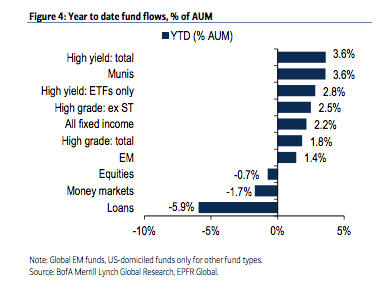
For a bit of comic relief, here’s a bar chart from BofAML’s recent flows data. Apparently, now is a great time to be in HY and Munis. If you know anything about the state of the HY market or about the pitiable plight of America’s state and local governments you know how absurd the following is:
But here’s the punchline from Bloomberg:
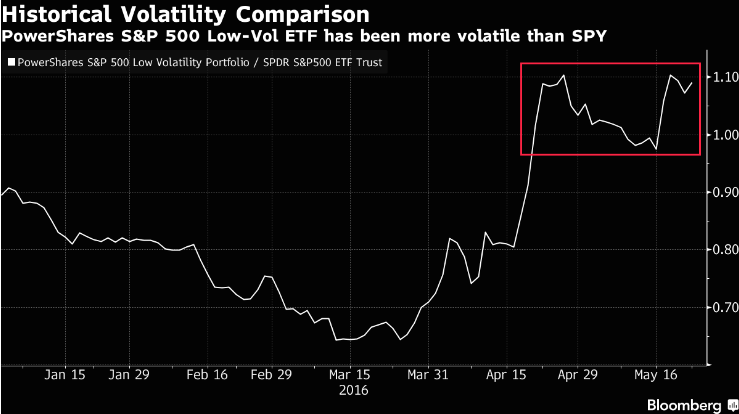
“Obsession with low-volatility stocks has not been without ironic consequences. One is that the shares that make up the underlying indexes are getting more expensive, something that in isolation makes them more turbulent. As a result, the PowerShares ETF is currently showing more pronounced price swings than the SPDR S&P 500 ETF over the past 30 days, Bloomberg data show.”
As CNBC’s favorite pundit (who I have met and talked with) is fond of saying, “there’s always a bull market somewhere.”
Only this time, I’m not sure even he can tell me where it is.