


Zoom trades at $85.
The company:
- Earned $6 to $7 per share last quarter
- Sits on 400% cash reserves with zero debt
- Profit margins run at 25
- Return on equity hit 13.5%
DoorDash trades at $275, and they:
- Earned pennies per share
- Burn through cash to maintain 6% profit margins
- Bariely achieves a return on equity of 9.6%
- Has a growth rate projected at just 8% annually
One of these valuations makes sense. The other is financial insanity.
Wall Street analysts defend both with the same fuzzy math that convinces retail traders to chase bubbles while ignoring value.
I've spent 38 years pricing companies. CFA charter. Finance professor. Series 7 since 1991. I understand how to calculate what a business is actually worth versus what momentum traders are willing to pay for it.
The gap between those two numbers is where fortunes get made and accounts get destroyed.
Today I'm showing you exactly how to spot the difference before you're holding a $275 stock that's worth $80 or missing an $85 stock that should trade at $120.
The Genesis COG Scanner combines this fundamental analysis with technical timing to identify stocks trading at massive disconnects from their actual value.
It reveals when Wall Street's fuzzy math has pushed prices so far from reality that reversion becomes inevitable.
Now let me show you the five-minute fundamental analysis framework that separates real value from manufactured narratives. This is the exact methodology I use to spot these disconnects before they become obvious.
The Numbers That Actually Matter
Most traders never look past the chart. They see a stock climbing and assume it's cheap. They watch it falling and think it's expensive.
Price tells you nothing about value. The relationship between what a company earns and what you're paying for those earnings tells you everything.
Here's the framework I use to price any company in under five minutes:
For service companies (no physical assets):
- Return on Equity (ROE) becomes your implied growth rate
- Profit margins validate the ROE calculation
- Compare the PE multiple to the ROE - they should align
- Calculate the PEG ratio (PE divided by growth rate)
For manufacturing companies (heavy assets):
- Return on Assets (ROA) becomes your baseline
- Asset turnover shows efficiency
- Debt-to-equity reveals leverage risk
- Free cash flow confirms the earnings quality
For both:
- Current ratio shows liquidity (need 2.0+ minimum)
- Quick ratio strips out inventory (need 1.0+ minimum)
- Debt-to-equity under 0.5 is clean, over 2.0 is dangerous
This isn't academic theory. This is how you avoid paying $275 for $80 worth of actual business value.
Let me show you this framework in action with two companies that prove exactly why it matters.
Why Zoom Should Trade 40% Higher
Pull up Zoom's financials right now. I'll wait.
Look at the profit margin: 25%. That's not a typo. The company generates a quarter of every revenue dollar as profit. Compare that to 30 other tech stocks trading at all-time highs with 2-3% margins.
The ROE sits at 13.5%, up 25% year-over-year. This number tells you the company's implied growth rate. When you divide earnings into this, you get a P/E ratio of 12.
The PE and ROE validate each other. They're almost identical. This means you can use either number as the company's sustainable growth rate.
Now apply the PEG ratio formula. A fairly valued growth stock trades at 1.5 to 2.0 times its growth rate. At a 13% growth rate, Zoom should trade between 19.5x and 26x earnings.
At $6.50 in earnings, that puts fair value at $127 to $169 per share. 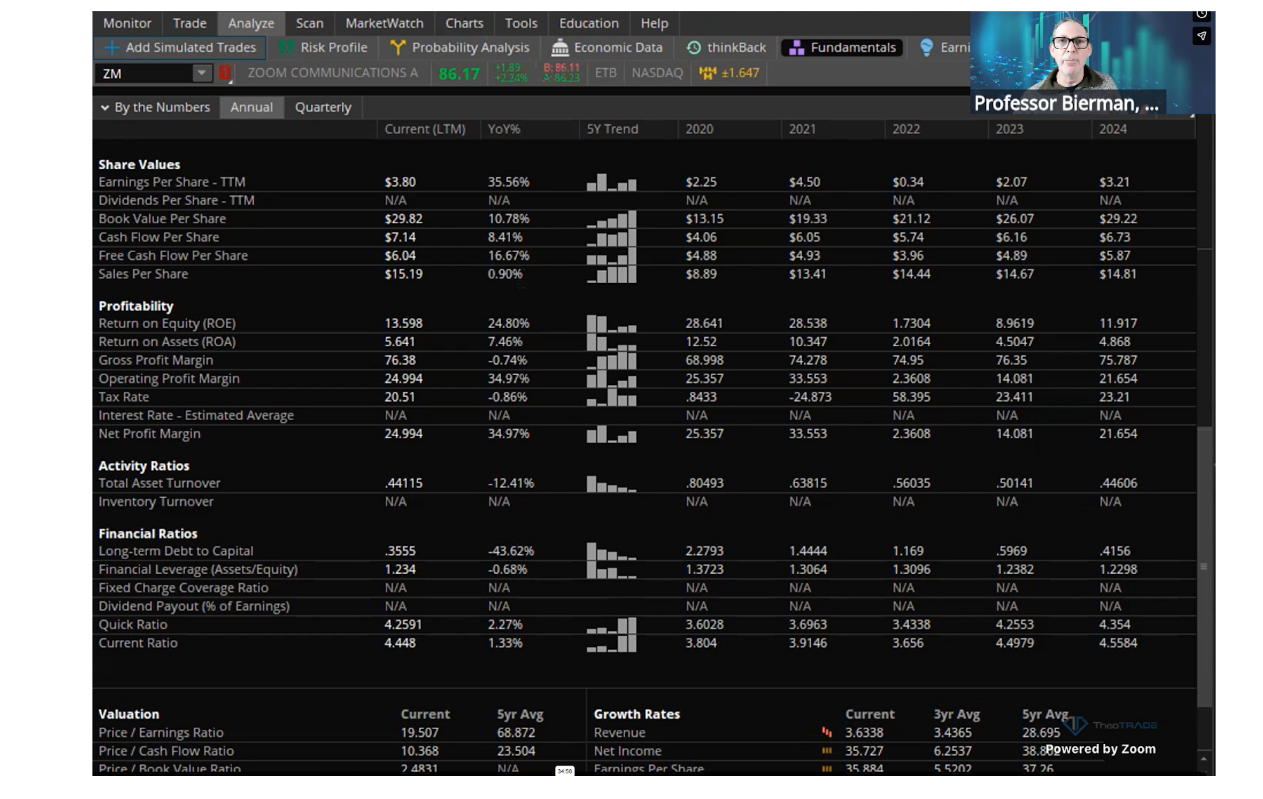
The stock trades at $85. That's a 25% discount to the low end of fair value.
But Wall Street doesn't want it. Analysts downgrade it after every earnings beat. They ignore it when it misses. The company keeps pyramiding cash flow - look at the progression over the last eight quarters. Earnings climb from $1.39 to $1.53 to $1.43 to $0.66 (which doubled to $1.40).
The business is growing. The margins are expanding. The balance sheet is pristine - current ratio of 4.0 means they're sitting on 400% cash reserves. Debt-to-equity of 0.35 means they're barely leveraged.
This company could acquire a competitor tomorrow without blinking. They have monopoly positioning in what they do. They trade at a ridiculous valuation discount.
Why? Because it doesn't fit the AI narrative. Because momentum traders want parabolic moves, not steady 13% growth.
Why DoorDash Should Trade 60% Lower
Now look at DoorDash. Everyone knows what they do. Food delivery. Logistics. They're a middleman taking a cut on both sides of every transaction.
Pull up the fundamentals. What do you see?
Profit margin: 6%. For a service company. That's razor-thin. Any compression in their take rate and they're losing money.
ROE: 9.6%. That's your implied growth rate. The company should grow earnings at roughly 10% annually based on how efficiently they use shareholder capital.
Now look at the PE ratio: 150x earnings.
Read that again. You're paying 150 times earnings for a company growing at 8-10% annually.
The math is insane. A fairly valued growth stock at 10% growth should trade at 15-20x earnings maximum. That puts DoorDash's fair value around $18-25 per share, not $275.
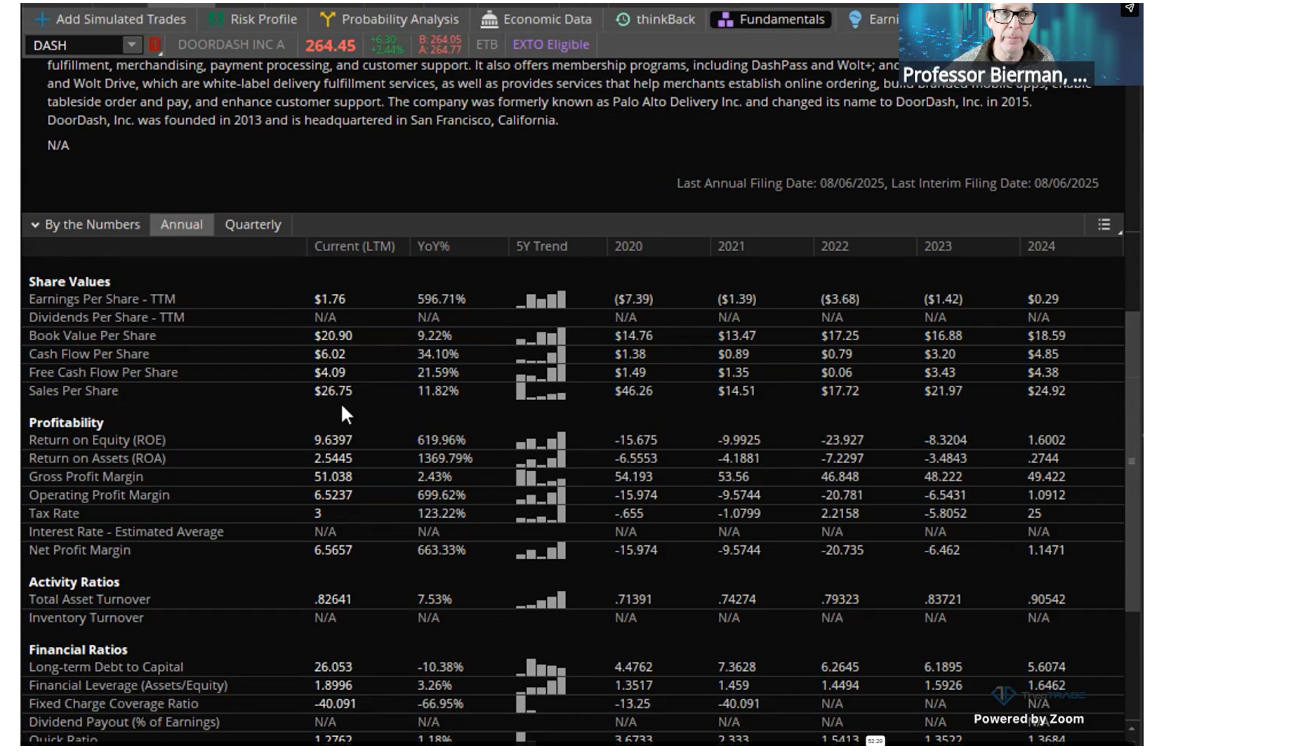
But Wall Street isn't pricing this on earnings. They're pricing it on cash flow. Look at the price-to-cash-flow ratio: 41x.
That implies the company's cash flow is growing at 41% annually. Is that sustainable? Of course not. When cash flow growth normalizes - and it always normalizes - that multiple compresses to 12-15x.
That's a 60-70% haircut from current prices.
The company only started making money last year. It took them five to six years to monetize the model. They lose money, normalize it, lose more money, restate because they cooked the books, normalize again, then finally turn profitable.
The business has zero moat. Uber could do this. Lyft could do this. FedEx could build this out. Any logistics company with existing infrastructure could replicate DoorDash's entire model in 18 months.
Yet the stock trades at $275 because it's "unstoppable" and fits a momentum narrative that retail traders buy without questioning the underlying math.
These two cases aren't outliers. They reveal a pattern that repeats across the entire market.
The Fuzzy Math Wall Street Sells You
Here's what drives me crazy after 38 years watching this game.
Analysts upgrade stocks after they've already run 300%. "Buy now before it goes higher!" Meanwhile, the valuation has gone from expensive to absurd.
Then they do the opposite with quality companies. Zoom gets downgraded after beating earnings. Target gets downgraded at $90 when I'm buying it hand over fist. The pattern reverses exactly when it should support value.
The objective analysis has been replaced by narrative trading. Charts matter more than cash flow. Momentum matters more than margins. The letters "AI" matter more than actual profitability.
This works until it doesn't. When it stops working, you get 2000. You get 2008. You get COVID. Everyone gets exposed in a crash.
What you realize in a crash is simple: the valuations never made sense. The logic was perverse. The math was fuzzy. But everyone bought into it because greed beat common sense and FOMO beat analysis.
I'm not saying don't trade momentum. I'm saying know what you own. Know if you're paying $275 for $80 of value and plan accordingly. Know if you're getting $120 of value for $85 and size up appropriately.
Your Trading Edge Right Now
The market is giving you two types of opportunities.
Bubbles trading on narrative: Companies priced for 40% growth delivering 8% growth. These work until the cash flow normalizes and the multiple compresses. When that happens, 60% of the value evaporates in weeks.
Value ignored by momentum: Companies delivering 25% margins and 13% growth trading at 12x earnings when they should trade at 20x. These work when the narrative finally shifts and algorithms rotate into fundamentals.
I'm holding both. I'm short the bubbles with defined risk. I'm long the value with patience for the recognition.
The numbers don't lie. People do. Wall Street analysts spin fuzzy math that makes bubbles sound reasonable and value sound risky.
Run the five-minute framework yourself. Calculate the ROE. Compare it to the PE. Apply the PEG ratio. Check the balance sheet for cash and debt.
The math will tell you what a company is actually worth. The chart will tell you what traders are willing to pay. The gap between those two numbers is where you make money.
Finding these gaps manually across hundreds of stocks takes hours. That's exactly why the Genesis COG Scanner automates this fundamental analysis at scale.
It identifies stocks where this valuation disconnect has reached extreme levels, combining these metrics with technical timing to show you when Wall Street's fuzzy math has pushed prices so far from reality that reversion becomes the highest-probability trade.
Stop trading on narratives that make no mathematical sense. Start trading on numbers that reveal what businesses are actually worth.
See how Genesis COG separates real value from Wall Street's fuzzy math →
Professor Jeffrey Bierman
Creator of the Genesis COG System