


Hey trader,
Institutional call buying usually creates mechanical pressure on the upside. Dealers who sell those calls must buy shares to hedge, and that hedging drives the stock higher.
Today, three separate banks saw massive call prints. The stocks went down anyway.
That disconnect tells you something important about the current tape. The selling pressure in financials right now is overwhelming the dealer hedging from over 22,000 contracts across Wells Fargo, Citigroup, and Jefferies.
The Block Hunter Console flagged all three prints during the session:
- 8,000 calls on Wells Fargo at the $84 strike.
- 6,000 on Citigroup.
- 8,000-contract spread on Jefferies buying the $45 calls and selling the $55 calls.
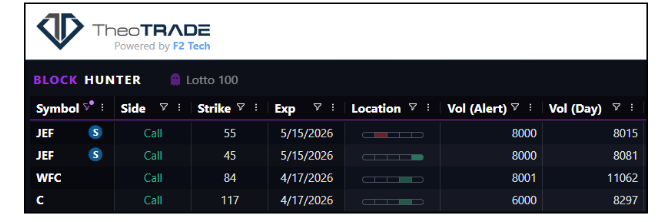
Every fill confirmed at or near the ask. All bullish. None of them produced a gamma squeeze.
I'm going to break down why these prints failed to move price intraday, what it means when dealer hedging gets overwhelmed, and why the trade may still work on a longer timeframe.
What the Prints Tell You
Wells Fargo saw 8,000 call contracts land in one print at the $84 strike for April 17th expiration. The fill came at the ask at 10:21 Eastern Time. The delta on those contracts was approximately 30.
The Block Hunter Console confirmed the trade as an opening position. Volume exceeded open interest at the time of the alert.
Citigroup printed 6,000 call contracts at 10:08 Eastern Time. The intraday chart showed massive volume on that candle, but the candlestick itself was a spinning top. Equal amounts of selling met the hedging activity in real time.
Jefferies produced an 8,000-contract spread. The institution bought the $45 calls and sold the $55 calls, creating a $10-wide call vertical. Jefferies has been cut nearly in half from its highs, trading around $38 at the time of the print.
All three banks that received institutional call flow today share one characteristic. They have outperformed the broader financial sector over the past several sessions. The institutions chose relative strength within the group.
Why the Squeeze Did Not Happen
When an institution buys 8,000 calls and the stock goes down, it does not mean the trade is wrong. It means the selling in the broader market is larger than the hedging flow created by those contracts.
Dealers who sold the Wells Fargo calls needed to buy shares to hedge their short delta. That buying pressure was real. But the overall selling in the financial sector absorbed it entirely.
XLF has dropped from $56.50 to $49, a decline of approximately 15%. Treasuries were selling off during the same session. The combination of rising rates and geopolitical risk created a headwind that 8,000 contracts could not overcome in a single afternoon.
The Citigroup print illustrated this perfectly. The volume spike at 10:08 was visible on the intraday chart, but the candle showed no directional follow-through. Buying and selling met each other at the exact same price.
That tells you the hedging is happening. It is just being neutralized by directional sellers on the other side.
Why the Flow Still Matters
The institutional inventory is now built. Those 8,000 Wells Fargo calls at $84 do not disappear because the stock dipped after the fill.
As long as those contracts remain open, the gamma at the $84 strike creates latent buying pressure. If the selling pressure in the broader market eases, the hedging from those contracts can begin to influence price without opposition.
Financials are sitting at a 50% Fibonacci retracement of the trend that began last April. Earnings season for the major banks arrives in approximately two weeks. If results stabilize the sector, the institutional call inventory at $84 on Wells Fargo, the $45/$55 spread on Jefferies, and the Citigroup positioning all activate at the same time.
The prints are early. Early is not wrong. Early requires a structure that gives you time.
How to Structure the Trade
The vol skew in financials is working against call verticals right now. Implied volatility on the call side is elevated relative to where it flattens further out of the money.
Wells Fargo's skew levels off around the 40 delta, which makes a nearby vertical more viable than a wider spread.
- Buy the WFC April 17 $81 call
- Sell the WFC April 17 $82 call
- Spread width: $1
- Cost: Approximately $0.79
- Max risk: $0.79 (the cost of the spread)
- Target zone: $83 to $84, consistent with the institutional strike
- Timeframe: 22 days
- Catalyst: Bank earnings, stabilization in Treasuries, easing of broad market selling
WFC does not need to reach $84 for this spread to produce a gain. A move toward $83 puts the bought strike deep in the money and pushes the spread toward full value as expiration approaches.
If the selling pressure persists and the stock fails to recover, the maximum loss is defined at entry. The vol skew is not ideal, but the flattening at the 40 delta keeps the cost within an acceptable range.
What the Console Is Tracking Now
The Block Hunter Console flagged all three financial prints and confirmed each fill at or near the ask. The institutional call inventory across Wells Fargo, Citigroup, and Jefferies is now built.
The selling pressure in the current tape buried those prints on the day they were placed. The gamma at those strikes does not care about the day it was placed. It cares about where the stock is when the selling stops.
Three prints. Three banks. Three fills at the ask. The broader tape said no today. The inventory says the thesis is still live.
See exactly how Block Hunter catches institutional positioning before the crowd catches on.
Brandon Chapman, CMT
Creator of Ghost Prints