


The S&P just broke to new highs again this morning, up 53 points.
Every technical indicator flashing bullish signals on the two-hour chart.
And half the trading community is still convinced this market's about to roll over.
I've been saying the same thing for six weeks straight. Don't short this market. You're walking a thin line on a vertical slope. The algorithms are defending every single dip with mathematical precision.
Yet traders keep emailing me… "When can I finally short this thing?"
They're holding their breath…waiting for permission to exhale…waiting for that one signal that says the collapse is coming.
No algorithm nor complex trading program gives a hoot about your bearish thesis.
They don't trade narratives or fundamentals or gut feelings. They trade slopes. And right now, that slope integrity remains completely intact.
The Genesis Cog Scanner tracks these exact slope breaks in real time. It identifies when weekly momentum indicators roll over and algorithmic channels lose integrity. When the cable finally snaps, you'll know before the breakdown confirms on price.
Because trying to short before these signals trigger? That's how accounts get destroyed.
Today, I'm going to show you the specific algorithmic signals that separate hopeful bears from positioned traders.
First, you'll see why the current setup makes shorting impossible.
Then I'll introduce the indicator that reveals when machines actually flip their programming.
Finally, you'll learn the exact conditions that give you permission to position for the reversal.
Let me start with what's happening right now that keeps this rally intact.
The Five Bullish Signals You're Ignoring
Pull up the S&P on a two-hour chart right now. I'll wait.
You see that linear line trending straight up? The RSI gaining traction at 80? The histogram bars expanding bullish? The breakaway above the old high? The stochastic climbing higher?
That's five simultaneous bullish signals. Five.
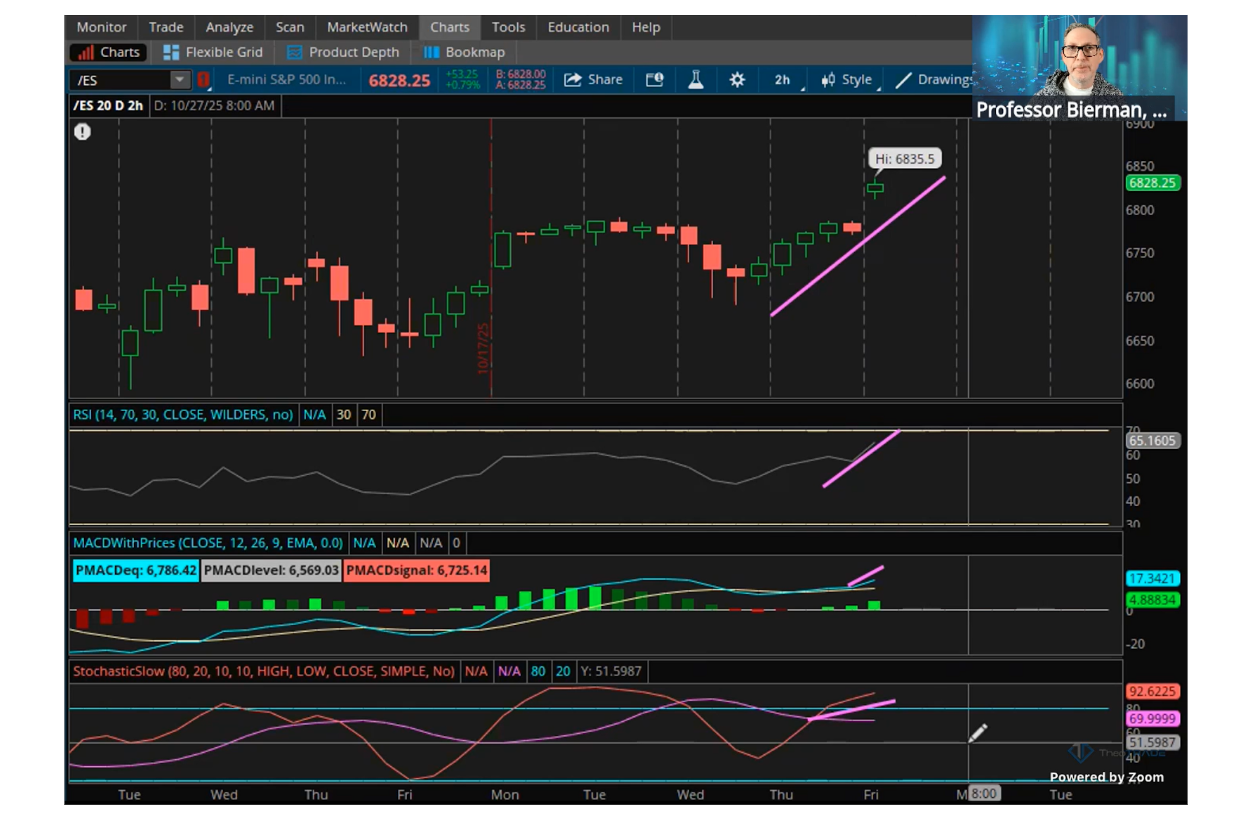
The advanced decline ratio sits at 18 to 6. Money flowing into strength across the board.
Now tell me. Who exactly is going to sell this market today? What money manager is going to short a breakout?
They don't sell breakouts. They sell breakdowns.
The machines are programmed to defend this upward slope. They calculate liquidity absorption rates and execute systematic buying at predetermined levels. No emotion. No hesitation. Just mathematical precision.
You're turning blue in the face waiting for this to reverse. But the setup isn't there. The psychology isn't there. The technicals aren't there. The narrative isn't there.
None of it supports a short position right now.
Never Short on the Way Up
Write this down. Tattoo it on your forehead if you have to.
Never short on the way up.
I just saved you millions of dollars with that one rule. How's shorting the rally working out for you? It's not.
Look at the 30-minute chart. Parabolic move. RSI at 80. This is a Corey Rosenblum flag formation channel. There's the flagpole. There's the channel extension.
You blew it.
Close your short positions and walk away. Stop wasting your time fighting an algorithmic feedback loop that you cannot win against.
This is like watching someone try to take down a Transformer with a BB gun. You're outmatched. You're outgunned. The machines are gigantic force multipliers and you're trying to fight them with hope.
Get serious.
The RMI Reveals Machine Programming
Here's the indicator that saves you from fighting machine momentum. The Relative Momentum Index.
This is different from RSI. The RMI measures sustainability of momentum by counting up and down days over a 20-day lookback with smoothing.
Simple rule. If RMI is above 50, the trend is bullish. You cannot short it. The machines are programmed to buy strength.
If RMI is below 50, the trend is bearish. You cannot buy it. The machines are programmed to sell weakness.
The thresholds work like RSI. Above 70 is overbought. Below 30 is oversold.
But here's the critical difference. When RMI hits overbought above 70, machines don't sell. They buy more. They buy strength. That's algorithmic programming.
A human trader sees overbought and thinks "time to take profits." A machine sees overbought and thinks "buy more because momentum is sustainable."
That's the difference between fighting the machines and trading with them.
Pull up the S&P futures right now. Look at the RMI on the weekly timeframe. It's trending up. Sitting comfortably above 50. The weekly MACD hasn't rolled over.
Until those indicators break, every selloff is temporary. Every dip gets defended. Every correction finds support.
You had one legitimate shot to short this market recently. One small window when the RMI broke below 50 briefly. That opening gave you maybe 200 points before it slammed shut.
Now the RMI is back above 50 and climbing. The machines are walking this higher with systematic precision.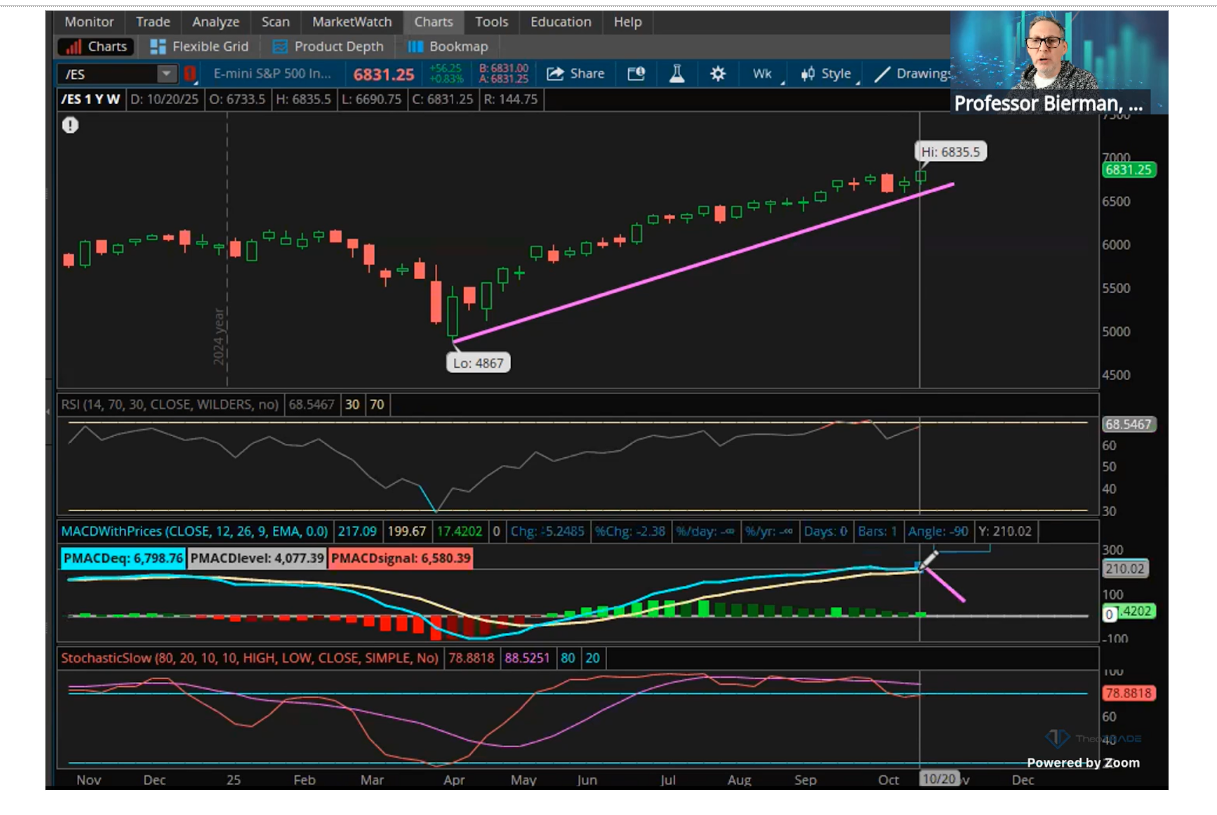
I won't fight it. I won't buy it either because I can't price the risk at these levels. But I'm comfortable sitting on my hands.
Are you?
When You Can Actually Short This Market
Now that you understand how RMI works, I'll tell you exactly when shorting becomes actionable.
You need three confirmations. Not one. Not two. Three simultaneous signals that the machines have flipped their programming.
First: Draw the linear regression line on the daily chart. Wait for a disgusting red candle that breaks below that line. Not a wick. Not an intraday violation. A closing price that shatters the pattern.
Second: The four-hour MACD must roll underneath both the signal line and the zero line. This confirms the algorithmic sell program has activated across multiple timeframes.
Third: The RMI must break below 50 and stay there. This proves momentum has shifted from sustainable strength to sustainable weakness.
Miss the first 200 points. Give up the slippage. Let it fall to 6,500 without you.
Wait for the slope to turn. Wait for all three confirmations to align.
When that happens, send me an email. Then we'll see if you're right about the reversal.
The machines are revved up to buy today. That doesn't make me want to short. Nothing on the intraday chart. Nothing on the daily chart. Nothing on the weekly chart gives me a short setup.
You're going to wait to exhale longer than you think.
Your Position Right Now
Look at your shorts. Look at the pain. Look at the stress.
Stop fighting this. The integrity of that slope hasn't changed. We're walking right on the edge of a cliff. We could fall. But until that slope breaks, the machines defend the upward trajectory.
I've got long positions that are working. I've got retail positions crushing it today. Cyclicals running higher. As they move up, I scale out. I don't sell entire positions. I just take profits methodically.
But I'm waiting to exhale on my shorts. What does that mean?
It means I'm willing to add to short positions as long as they fit the Genesis Cog imprint. Broken channels. RMI breaks. Slope integrity violations.
If they don't meet those criteria, I have zero interest.
You bears can finally exhale when the weekly MACD rolls over. When the four-hour timeframe breaks the zero line. When an extraordinary candle violates the linear channel with conviction. When the RMI confirms the momentum shift.
Not before. Not on hope. Not because you think the market "should" go down.
The algorithms don't trade what should happen. They trade mathematical probabilities. Position sizing. Momentum confirmation. Slope integrity.
That's the game. Learn to play it or keep getting destroyed.
The machines controlling today's market calculate these momentum shifts before executing any trade. They measure slope integrity. They track RMI thresholds. They know exactly when to flip from systematic buying to systematic selling.
The Genesis Cog Scanner reveals these same algorithmic footprints in real time. It identifies when weekly indicators are rolling over. When four-hour MACD crosses signal lines. When RMI breaks key thresholds that separate machine buying from machine selling.
Stop waiting to exhale based on hope. Start tracking the mathematical triggers that tell you when the machines have actually changed their programming.
Professor Jeffrey Bierman
Creator of the Genesis COG System