Very Strong September Jobs Report
September jobs report was very strong. It actually beat expectations for private sector growth. Some economists are missing that the big decline in job creation came from the government which is temporary. They just show the headline change in jobs and then add in how bad the recession is. Of course, the recession was very bad. However, this was an improvement.
We need to understand that the jobs in the industries hardest hit by the virus can’t come back until the virus is gone. This will only be a partial recovery until then. You need to keep that in mind before the employment reports come out or you will be expecting the impossible.
Hotels and airlines aren’t going to expand in this environment. Labor market is weak, but when you adjust your expectations for the virus and the decline in government jobs, this was a good report. The economy is still headed in the right direction. Job creation isn’t going to increase from prior months because there are fewer people left that are temporarily unemployed. We will only see a spike in job creation when the economy fully reopens.
Huge Reversal In Government Job Creation
Headline job creation in August was revised up from 1.371 million to 1.489 million. That’s a crazy revision because more than 100% of the upward revision came from even more government job creation. It was already very high before that. August’s private sector job creation was revised down 5,000 to 1.022 million. Therefore, government job creation went from 344,000 to 467,000. That’s a huge spurt of jobs added due to the census.
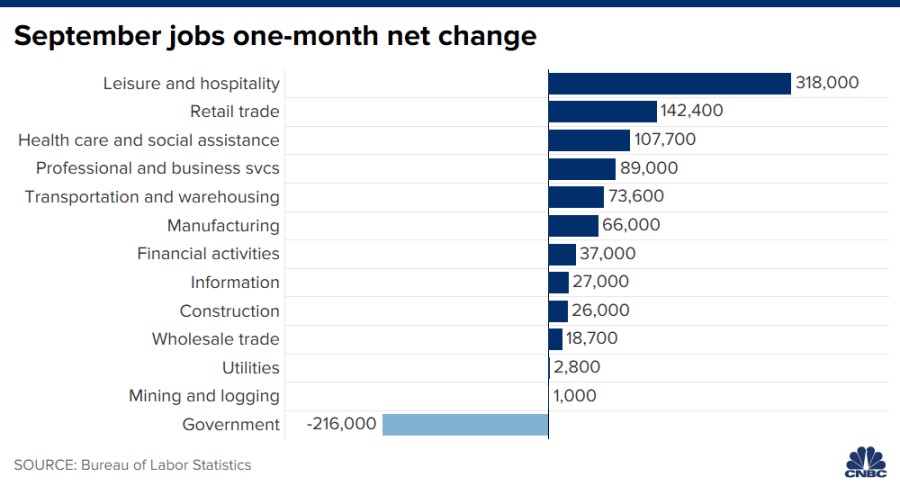
In September, overall job creation was 661,000 which vastly missed estimates for 894,000. However, private sector job creation was 877,000 which barely missed estimates for 900,000. That implies the government was expected to lose 6,000 jobs, but as the chart above shows, it actually lost 216,000.
In general, most would rather the government lose jobs than the private sector because we follow the business cycle for private corporations. This decline was only partially because of the census which caused a 34,000 decline in employment.
Most of the decline was related to education as local education jobs fell 231,000 and state education jobs fell by 49,000. Excluding education, local governments added 96,000 jobs. Some of that may have been in construction as there has been a boom there.
Breakdown Of Private Sector Job Creation
Private sector job creation was driven by leisure and hospitality which added 318,000 jobs. This industry had the most jobs to gain back. This reading is dramatically different from the homebase survey which suggested jobs were lost after summer outdoor activities ended.
Airlines are about to get a government bailout which will avoid some additional job losses in this industry in the fall. Leisure and hospitality is still down 3.8 million from the end of the last expansion. That’s a big chunk of the 10.7 million jobs that the economy has lost from February.
Retail trade gained back 142,400 jobs. Remember, retail bankruptcies in 2020 were 1/10th the total in 2008 because investors are willing to invest in junk bonds at low rates. Shopping in stores is a relatively safe activity, so many people have gone back to doing so. Manufacturing sector added 66,000 jobs which doubled the estimate, but was way below the ADP reading of 130,000.
Decline In Unemployment & Participation Rates
Unemployment rate fell dramatically from 8.4% to 7.9%. This decline was caused by people getting jobs and by people leaving the workforce. It’s the perfect combination to get the rate down, but obviously we want people coming back to the labor force not leaving it.
Underemployment rate actually fell even further than the headline reading as it was down from 14.2% to 12.8% which means a lower percentage of people were working part time for economic reasons or marginally attached to the labor force.
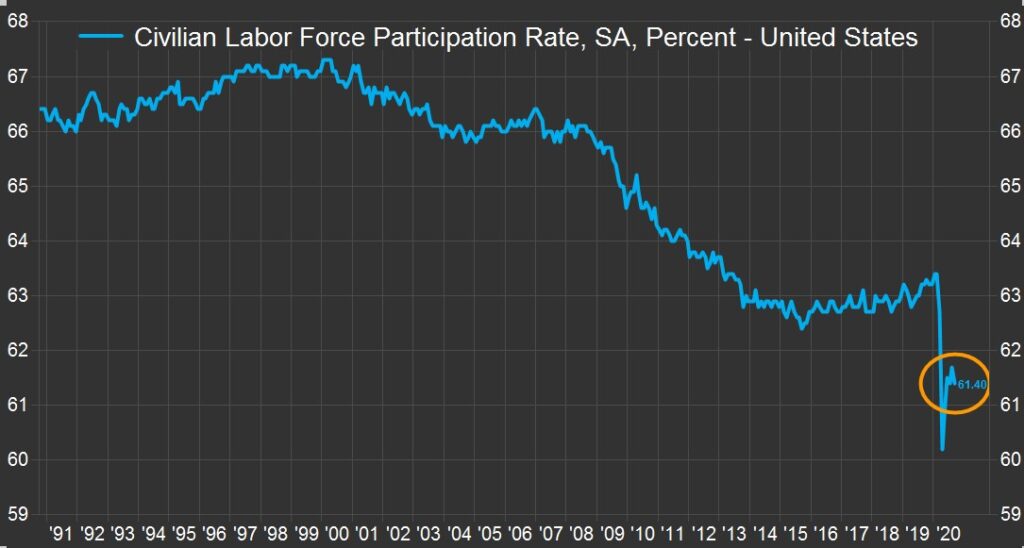
Labor force participation rate went in the wrong direction. As you can see from the chart below, the participation rate fell from 61.7% to 61.4%. That’s likely a temporary decline. It’s the 2nd decline since the bottom in April and the same rate as July.
Prime age labor force participation rate fell further. It’s in worse shape as it went from 81.4% to 80.9% which is the lowest reading since May. Generally, these readings take 2 steps forward and one step back, but this was a big step back. All the job creation this month came from the 16-24 age group.
Temporary Versus Permanent Layoffs
There was a decline in temporary layoffs and an increase in permanent job losses as expected. Don’t get fooled by the charts that show the percentage of permanent layoffs rising. Obviously, if someone is temporarily laid off, they will either get their job back or lose it.
We just need the temporarily laid off people to get their jobs back at a higher rate than they lose them. This time it was about evenly split. Unfortunately, we still haven’t solved the COVID-19 crisis; therefore, all the temporarily laid off people won’t get their jobs back.
Number of people temporarily laid off fell from 6.16 million to 4.637 million which means there are fewer ‘easy to create’ jobs left. That being said, the unemployment rate has fallen and more people are employed. Once all these temporary layoffs are gone, it will be tougher to create jobs.
Most of them might be gone by the end of the year. That’s not great because total non-farm employment is down from 152.463 million to 141.72 million. We have 10.743 million jobs to get back.
Number of permanent job losses rose, but at a lesser rate than August. It increased from 3.411 million to 3.756 million. That 345,000 increase is less than the 534,000 increase last month. This recession had more permanent job losses than the 2000 recession which was a mild one, but less than the last one which peaked at 6.818 million. It's unlikely that this one will get as bad if we continue at the current rate.