


General Electric Aerospace sat at $190 for three weeks straight.
The same pattern happened over and over… higher highs…pullback…rinse and repeat…
…Then suddenly nothing.
The stock just parked itself in a tight range between $185 and $195.
Every attempt to push higher got rejected immediately.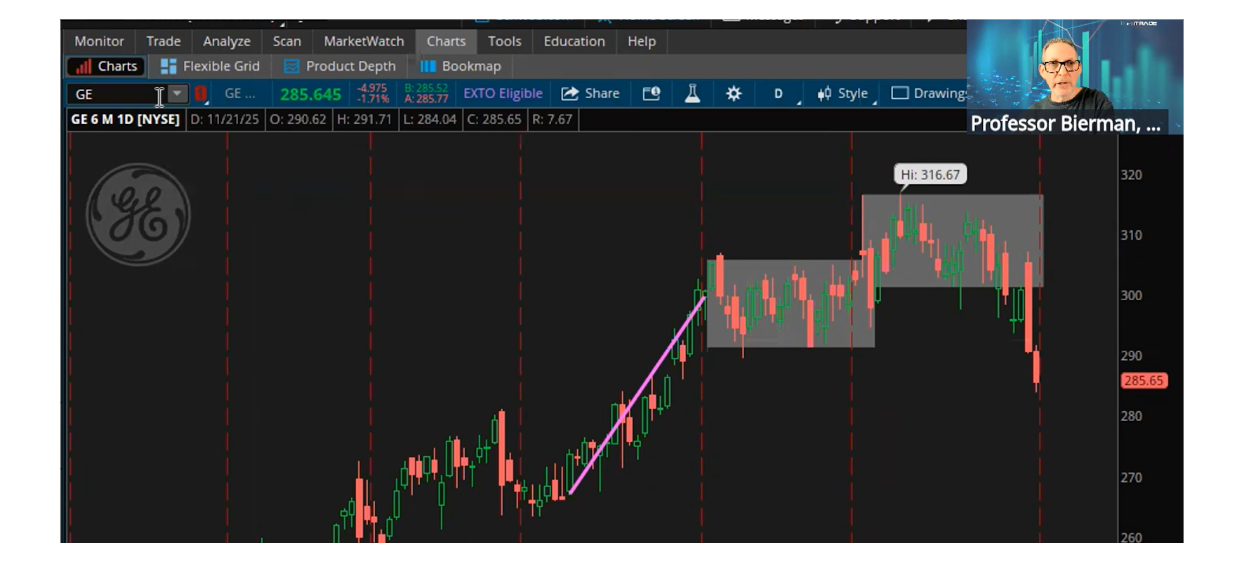
Most traders looked at that consolidation and saw indecision. They walked away thinking the stock had lost momentum.
They missed what was actually happening underneath that price action.
The institutions that actually run numbers looked at 40 times earnings and said no.
It wasn’t confusion, and it wasn’t a need for more information. Buyers had simply reached the maximum price they were willing to pay for this company.
At the margin, nobody wanted to commit one more dollar at that valuation.
This isn't momentum breaking. This isn't a technical weakness.
This is pure valuation equilibrium.
When you understand this distinction, sideways channels stop looking like dead zones.
They become high-probability setup zones where you can identify exactly when stocks hit their ceiling or floor based on fundamental value.
Today you'll see exactly how valuation equilibrium works at both extremes. You'll learn to spot when consolidation signals a ceiling where buyers refuse to pay more versus a floor where sellers refuse to take less.
You'll understand why some sideways patterns lead to breakouts while others precede collapses.
This reveals the high-probability setups before the next major move confirms.
Let me show you how to read these patterns and position ahead of the break.
The Two Faces of Valuation Equilibrium
Valuation equilibrium appears at both market extremes. Understanding which type you're seeing determines whether you're setting up a short or positioning for a long.
The ceiling version happens when stocks run hard and fast. They stair-step higher in perfect algorithmic channels.
Then suddenly they stop cold.
Not a breakdown. Not a reversal. Just a complete halt in upward progress.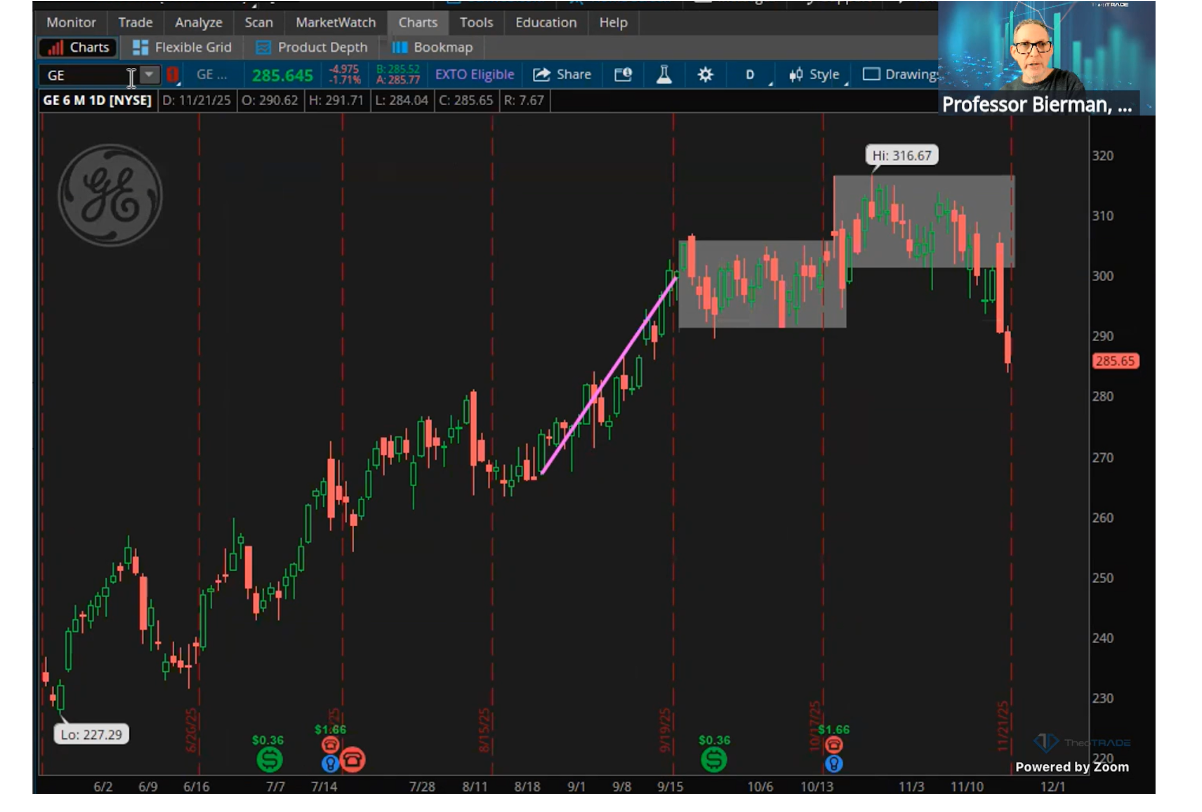
Traders see that flat action and think momentum died. They assume the buyers left.
They're completely wrong about what's happening.
The institutions running fundamental models looked at 40 times earnings and reached their limit. They won't pay 41 times.
They won't pay 40.5 times.
At the margin, every additional penny became prohibitively expensive relative to growth rates and earnings power.
This creates a mathematical ceiling. Price can't advance because buyers refuse to step up.
The valuation itself prevents higher prices regardless of how strong the chart looks or how much momentum existed previously.
The floor version works identically but in reverse. Stocks get destroyed by sector rotation or narrative shifts.
They drop hard. Then they park themselves in a tight range at depressed levels.
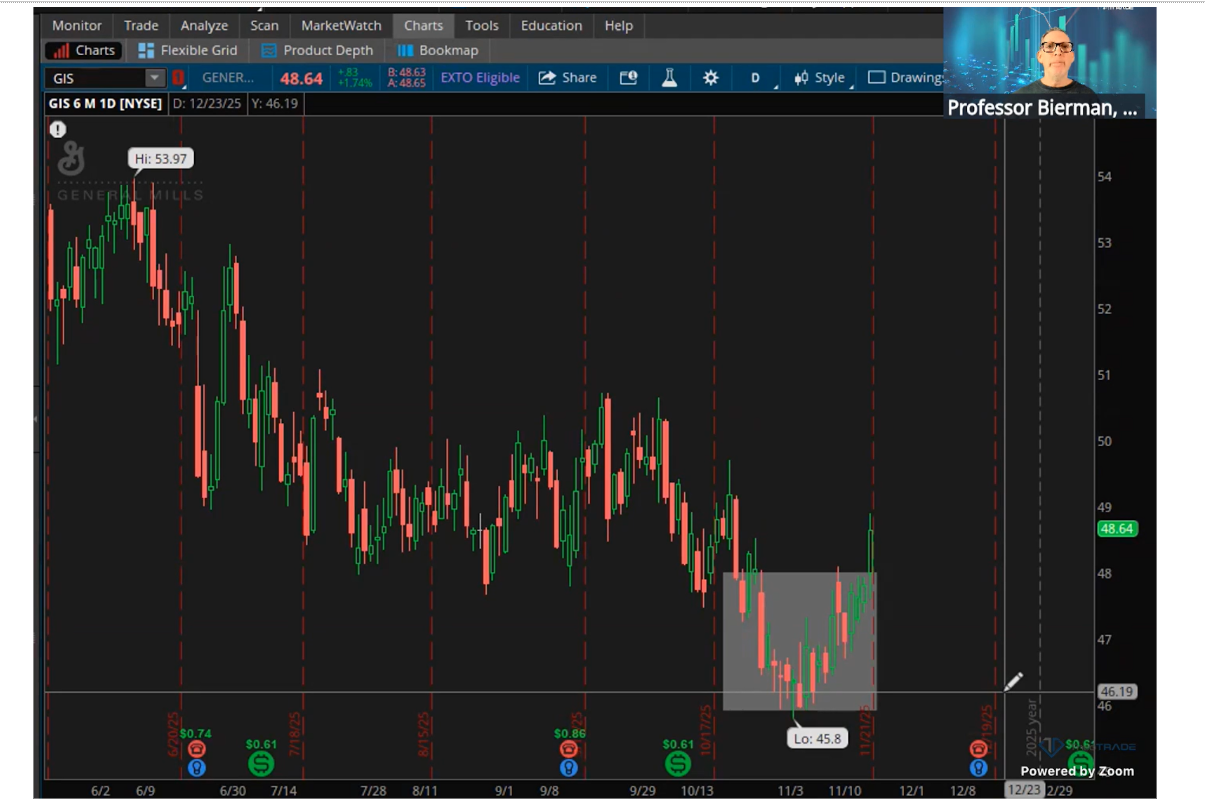
Traders see that flat action after a decline and assume it's dead money. They rotate into momentum plays.
They miss the setup completely.
The value buyers running actual numbers looked at nine times earnings with a 5% dividend and said this is a gift. They won't let it go lower.
At the margin, every penny cheaper represents such obvious value that accumulation prevents further decline.
How to Identify Which Type You're Seeing
The distinction isn't about chart patterns.
Both appear as sideways consolidations with tight trading ranges, and visually, they look almost identical.
The real difference is where the stock is consolidating relative to its valuation metrics.
Check the P/E ratio against its five-year average and against sector peers.
Compare the company’s growth rate to its current multiple.
Review its margins relative to competitors.
If the stock consolidated near historical valuation peaks, you're seeing a ceiling. GE Aerospace at 40 times earnings versus a five-year average of 25 times.
Interactive Brokers at 36 times versus historical norms around 18 times.
These are mathematical limits where buyers refuse to extend further.
If the stock consolidated near historical valuation troughs, you're seeing a floor. General Mills at nine times earnings when its five-year average is 16 times.
Budweiser at similar compression with a 5% dividend.
These are levels where value buyers systematically accumulate.
The chart can't tell you which scenario you're in. The fundamental metrics reveal everything about what happens next.
Why the Ceiling Breaks Violently
When valuation equilibrium forms at the top, the subsequent breakdown accelerates fast.
Here's why.
Every buyer at elevated levels is there for momentum, narrative, or gamma squeezes. Nobody owns it for value.
Nobody owns it for long-term conviction.
Everyone is playing the same game of rotation and relative performance.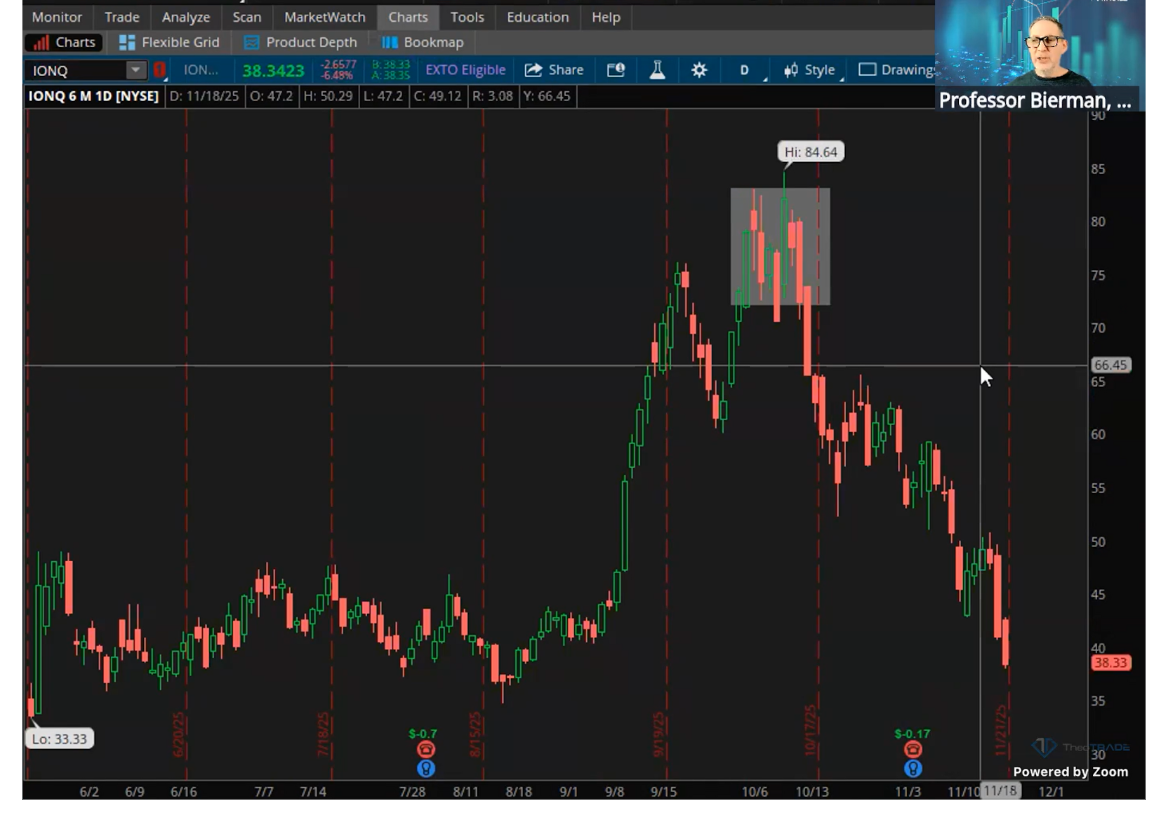
Once the consolidation breaks to the downside, there's no support underneath. No value buyers step in at these levels.
No institutions see opportunity.
The only participants are momentum traders desperately trying to exit positions that stopped working.
I shorted Interactive Brokers at the top of its consolidation range. The stock sat at $175 for three weeks refusing to break higher.
I looked at 36 times earnings for a brokerage with single-digit growth and knew institutions wouldn't pay more.
When it broke underneath that range, the decline happened systematically. No bounces.
No dip buyers.
Just straight down as everyone who bought for momentum recognized the trade stopped working.
Why the Floor Holds and Launches
When valuation equilibrium forms at the bottom, the subsequent breakout sustains momentum.
The dynamic reverses completely from the ceiling scenario.
Every buyer at depressed levels is there for fundamental value. They're accumulating based on earnings power, cash flow, and dividend yield.
They're not playing short-term games.
General Mills consolidated between $60 and $63 for six weeks. The stock had dropped from highs.
Momentum traders bailed. Growth investors rotated into AI names.
Nobody cared about a consumer staples company with single-digit growth.
I looked at the valuation and saw nine times earnings with improving margins and a 5% dividend. I bought at $60.50 knowing institutions wouldn't let it trade lower.
The value proposition became too obvious.
When it finally broke above $63, the move had support underneath. Value buyers stayed positioned.
New momentum players recognized the breakout.
The combination created sustained upward movement rather than a brief pop.
The Genesis COG Scanner identifies these valuation equilibrium patterns by combining fundamental metrics with technical consolidation.
When PE ratios reach historical extremes while price action goes sideways, the system flags the setup before the break confirms direction.
Stop treating all consolidation patterns the same. Start checking whether valuation metrics support continuation or signal exhaustion.
The chart shows you when. The fundamentals tell you why and which direction comes next.
Professor Jeffrey Bierman
Creator of the Genesis COG System