

Someone forgot to tell the terrorists that we’re in the middle of an increasingly epic bout of risk-on sentiment driven primarily by expectations that the Bank of Japan is all set to start throwing cash out of helicopters (figuratively speaking - maybe).
Displaying a complete and total lack of regard for the ongoing global equity rally, 31-year old Mohamed Lahouaiej Bouhlel decided it would be a good idea to drive a truck through a crowd of people celebrating Bastille Day on the French Riviera. At least 84 people are dead in yet another completely senseless (not to mention horribly tragic) act of violence.
While expressing his sympathies for the victims, one trader asked us the following last night: “You really think this will affect my portfolio though, another attack?”
Long-term, the answer to that question is “no,” at least as it relates to this specific incident. Of course markets aren’t fans of uncertainty and generally speaking, having to worry about being run over by a box truck during a public fireworks display doesn’t exactly contribute to a feeling of collective geopolitical calm, but that’s a separate issue.
In the short-term though, the answer is “yes.” No one likes hearing about these types of events. Colloquially speaking, they’re a real bummer. And on a week when the market was running on yet another central bank sugar high, the events in France were just as good an excuse as any for everyone to step back and take a breather headed into the weekend.
Still, European stocks managed to close largely mixed. The DAX, for instance, was basically flat on the session. Similarly, US equities were holding up reasonably well through midday, all things considered.
The takeaway for investors and traders though, is that geopolitics matter. A lot. One terrorist attack doesn’t have a snowball’s chance in hell of making a serious dent in the risk-on mood when Ben Bernanke just loosened the collar, ducked into a Tokyo phone booth, and emerged in true Atlantic “hero” super garb…
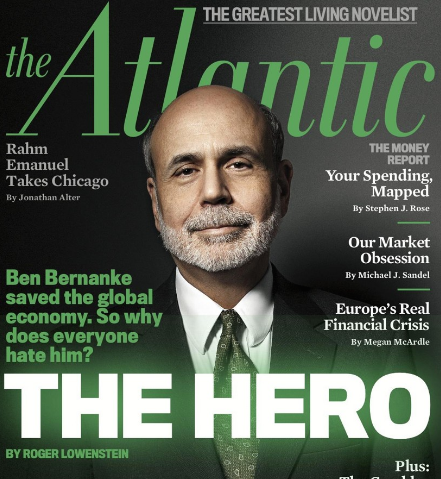
...BUT, the thing you need to understand is that these geopolitical tragedies influence politics. And politicians set policy. And policies affect markets.
The more uncertain the world becomes, the more momentum populist candidates and their nationalist agendas enjoy. We’re not here to pontificate on whether that’s a good or a bad thing from a political perspective (you can decide that for yourself at the ballot box) but what we can say with something that approximates absolute certainty, is that there’s nothing absolutely certain about the future of global growth and trade if the generally protectionist-oriented platforms of nationalist candidates and parties sway voters.
Consider how Citi summed up everything said above earlier this month:
“The problems investors face are those we have referred to many times: markets being driven more by momentum than by value, and most negatives being extremely long-term in nature (the need for deleveraging; political trends towards deglobalization; a steady erosion of confidence in central banks). Against these, the combination of UK political fudge (and perhaps Italian tiramisu), a lack of near-term catalysts, and overwhelming central bank liquidity risks proving overwhelming – albeit only temporarily.”
Here’s what they mean by “overwhelming central bank liquidity”:
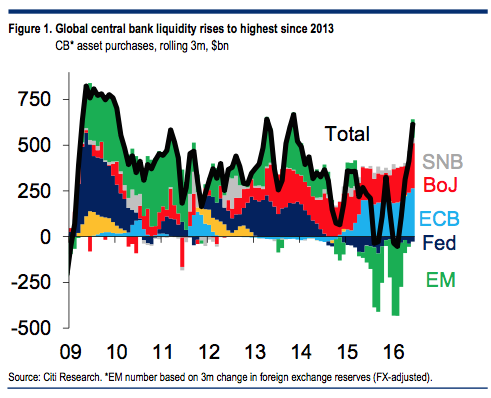
(Chart: Citi)
But once again, the long-term risk to sentiment that the increasingly uncertain geopolitical backdrop presents is something to keep in the back of your mind as you trade the short-term euphoria. Just how euphoric have things gotten since Brexit? Well, let’s look at flows. Here’s BofAML:
“Full risk-on in fund flows. The flows to stocks are finally catching up to the rally in equity prices with a $13.08bn inflow to US fund and ETFs – the largest inflow since September of last year – and up from a small $0.75bn outflow in the prior week. At the same time inflows to bonds remained robust at $6.89bn, down a bit from $7.95bn purchased the week before. Within fixed income, however, flows shifted markedly towards riskier assets, including high yield, EM and leveraged loans, and away from high grade, government bonds and munis.”
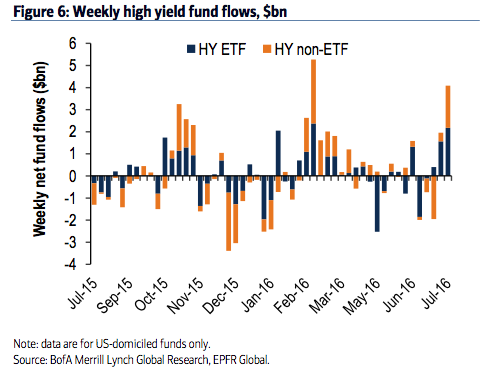
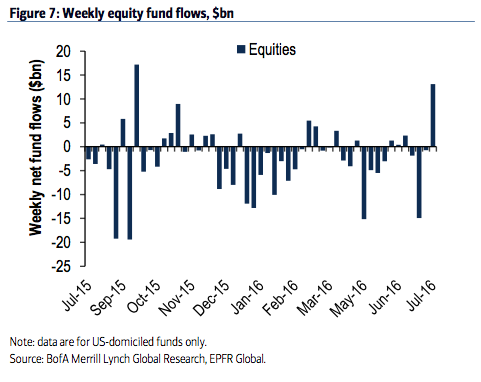 (Charts: BofAML)
So there’s some food for thought on the day after another indiscriminate attack on civilized society. We’ll close with the latest from Bloomberg’s Richard Breslow, a former FX trader and fund manager:
“If you’re involved in liquid markets, the current environment is no time to pontificate on the big picture and hope it all works out. The volatility in prices and story-lines makes this overly risky and leaves too many opportunities on the table.”