


Most traders look at volume indicators and see one thing: buyers versus sellers.
Green means buying. Red means selling. Simple enough.
That approach misses the entire story.
Recently, I walked through my modified Chaikin Money Flow indicator in detail. The response was overwhelming. Dozens of emails flooded in asking for more. So let me break down what separates surface-level volume analysis from the institutional-grade approach.
The difference isn't just academic. It's the difference between guessing at market direction and actually seeing where money flows before price confirms it.
The Three Signals That Matter
Traditional money flow analysis stops at one question: Is money coming in or going out?
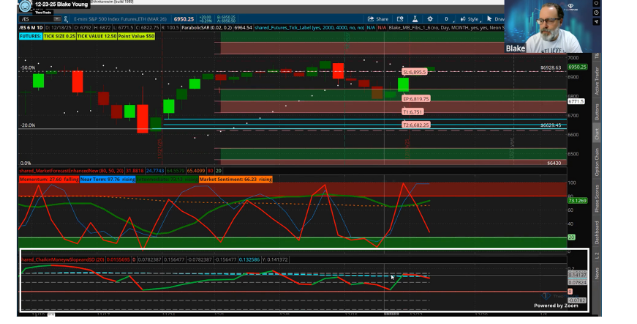
My approach watches three things simultaneously: the zero line, the 20-period average, and the two standard deviation bands.
The zero line tells you the basic direction. Above zero means net accumulation. Below zero means net distribution. But that's just the starting point.
The average tells you the trend within that direction. You can be above zero but below your average. That's neutral territory. You can be below zero but climbing toward your average. That's a potential reversal setup.
The standard deviation bands tell you when money flow is overextended. When capital pushes past two standard deviations, you've exhausted the buyers or sellers. There's no one left to push price further in that direction.
This is where most traders get it backwards.
Overbought Does Not Mean Sell
Here's the part that breaks most traders' brains.
When an oscillator sits above 80, most people think it's time to sell. When the money flow indicator pushes past two standard deviations, they want to fade the move.
That's exactly wrong.
Being overbought on an oscillator does not tell you to reverse. It tells you the trend is strong. Your best trending moves often happen when oscillators stay pinned in overbought or oversold territory for extended periods.
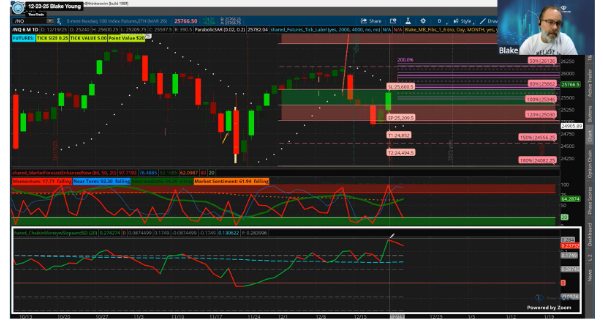
The signal to reverse comes when price trades back inside those deviation bands. When money flow pushes past two standard deviations and then falls back inside, that's your warning. When it then crosses below the average or through the zero line, that's your confirmation to exit or reverse.
I showed this playing out on the Nasdaq recently. We hit two standard deviations on the upside, traded back inside, and dropped 3.5% in a single session. The buyers were exhausted. There was no one left to push prices higher.
Capital Flow Beats Advance/Decline Every Time
Here's another mistake I see constantly.
Traders watch advance/decline numbers and think they understand market breadth. More stocks going up than down means bullish. More stocks going down than up means bearish.
That tells you almost nothing useful.
A $15 stock with a $100 million market cap does not equal a $300 stock with a trillion dollar market cap. The movement of money into one versus the other is completely different.
Capital flow tells the real story.
I pulled up the S&P 100 market watch recently. We had more stocks declining than advancing. The advance/decline ratio looked bearish. But capital flow showed three to four times more money flowing into the advancing stocks than the declining ones.
The indexes were green. The magnificent seven were lifting everything despite broader market weakness.
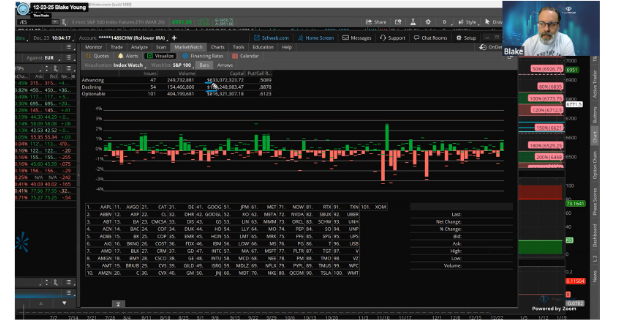
If you traded purely on advance/decline, you would have been bearish while the market rallied. If you followed capital flow, you saw exactly what was happening.
Putting It Together on Individual Stocks
This framework scales down to individual stocks and up to entire sectors.
Take Nvidia as an example. When the market opened, the money flow sat below zero and below its average. Both indicators were in oversold territory. Then at the opening candle, we crossed above the zero line and above the average simultaneously.
That was the buy signal. The position stayed bullish all day. The money flow never crossed back below zero. Every pullback stayed above both key levels. No exit signal triggered.
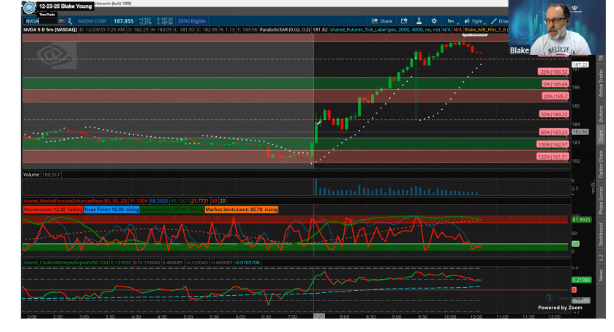
The result was a sustained rally through the entire session with multiple confirmation signals to add on dips.
Contrast that with real estate. The sector crossed below zero, crossed below its average, and pushed to two standard deviations on the downside. The warning came when price bounced but the money flow couldn't get back above the average.
That told us the bounce was weak. Sellers were still in control. The rally attempt was just short covering, not new buyers stepping in.
How to Apply This Now
The S&P 500 sits near fair price on the monthly monkey bars. Money flow hovers around its average, not overextended in either direction. This is neutral territory with a slight bullish lean.
Technology pushed into overbought territory on the money flow and is now fading. That doesn't mean crash. It means protect your longs and don't chase new entries up here.
Energy finally showed accumulation after weeks of selling pressure. We crossed above the zero line on crude oil recently. The volume is now backing the bounce.
Healthcare continues to hold relative strength. That's why the GILD position discussed in previous updates keeps working despite broader market chop.
Position Updates
Speaking of those positions, here's where we stand heading into the holiday week:
GILD: The diagonal spread is now solidly profitable. We bought the January 16, 2026 $120 call and sold the December 26 $126 call for a net debit of $4.22. Current spread value sits around $6.71 with GILD trading at $126. The structure worked exactly as designed. We collected premium on the short call while the long call appreciated. This is what happens when you trade with sector strength.
VLO: This one hurts. The January 16 $175/$140 put credit spread collected $6.25 and currently shows a value of $11.67 with VLO at $165. We're significantly underwater but not at max loss. The thesis on energy holding support at $55 oil remains intact. I'm watching closely but not panicking yet.
XOM: The February $120 calls sit roughly at entry with XOM trading right at $120. Current value around $3.75 versus our $3.77 entry. The $125 calls have lost some value at $1.67 versus our $1.95 entry. Energy's bounce should help these positions recover if the crude oil accumulation signal holds.
What Matters Going Forward
Watch for the money flow to confirm or deny sector rotations. Energy showing accumulation is a significant development after weeks of distribution. If that signal holds, the XOM and VLO positions have room to recover.
Technology fading from overbought territory suggests caution on new tech longs. Let the money flow reset before chasing entries.
Healthcare remains the strongest sector overall. Any dips in quality healthcare names with strong fundamentals deserve attention.
The best part of trading with money flow confirmation is that you never have to guess. The institutional footprint shows up in the data before it shows up in price.
Blake Young
Senior Market Strategist, TheoTrade