


The VIX hit 13.5 last week. Most traders saw calm waters and looked to buy the dip.
Smart money saw a storm building.
Here's why. The spot VIX was pricing 13.5% volatility. But VIX futures were pricing 18.5% for the same 30-day window.
That's not a rounding error. That's a 37% premium telling you institutions are bracing for impact while retail watches CNBC talk about market strength.
The Ghost Print in Plain Sight
The VIX doesn't predict future volatility. It measures the current temperature. That's it.
Think of it like this. You walk outside, it's 70 degrees, and you assume tomorrow will be the same.
Meanwhile, meteorologists are tracking a hurricane 200 miles offshore. The VIX is your thermometer. VIX futures are the radar.
Most traders stop at the thermometer.
Here's what Ghost Prints revealed in December. Spot VIX traded at 15. VIX futures for the next 30 days priced at 19. We calculated the weighted average of the front two contracts—January and February expiration. The math was brutal. A four-point spread. A 26% premium.
That's not volatility pricing. That's a warning siren.
Why This Works When Everything Else Fails
VIX futures are cash-settled. No storage costs. No financing games. No physical delivery headaches like oil or gold.
This matters more than you think.
When oil futures trade above spot, you can't trust it. Storage costs distort everything. But VIX futures operate on pure expectations theory. The price IS the expectation. When institutions pay 37% premiums for volatility protection, they know something.
They're not wrong often.
The Trade Everyone Missed
Last week some thought the market looked stable. But VIX futures showed contango futures pricing higher than spot. This signaled trouble ahead, and it showed up in the days that followed.
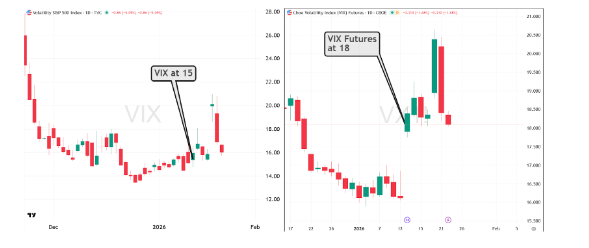
At a time like this, it makes sense to buy calls in volatility products such as VIX options, or even better, a vertical spread using those options.
Since December 24th, even though the S&P kept grinding higher and spot VIX stayed suppressed. The futures premium still had an extra two points added into the price. By mid-January, hedges placed in October and November started rolling off. The market became increasingly exposed.
Then it broke.
The traders watching only spot VIX got torched. They saw low volatility and assumed safety. The futures curve told a different story. It showed institutions positioning for a spike that would catch everyone off guard.
Here's Your System
Stop using spot VIX in isolation. Start doing this instead.
Look at the front two VIX futures contracts. Calculate the 30-day weighted average of the two. Now compare it against spot VIX.
If futures price significantly higher—say 20% or more premium—institutions expect volatility to rise. Period. They're hedging. They're paying up for protection. They're not doing this for entertainment.
You can also use VIX3M as a quick proxy. When VIX3M trades at 19.9 and spot VIX sits at 13.5, that ratio tells you everything. The forward premium reveals institutional positioning that spot VIX completely masks.
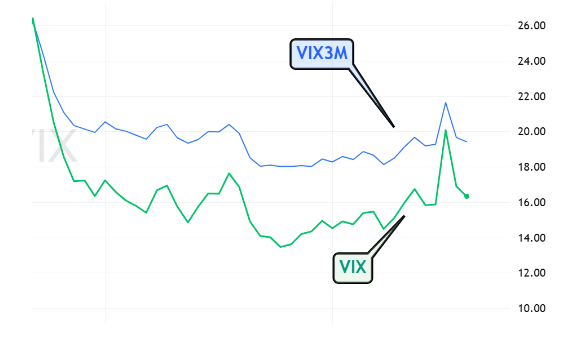
What This Means Right Now
We're seeing elevated forward premiums again. Futures price substantially higher than spot. Hedges from two months ago are rolling off. The market appears calm on the surface.
But underneath, institutions are still positioned for disruption.
The VIX might stay low for weeks. It always does before it doesn't. The futures curve doesn't lie. When you see 25-35% premiums in the forward curve, you don't fade it. You don't ignore it. You position accordingly.
Most traders will wait until spot VIX spikes to 25 before they panic. By then, the move is over. The opportunity is gone. The damage is done.
Smart money positioned months ago when futures diverged from spot. They read the Ghost Prints in the VIX futures curve. They understood that cash-settled products reveal pure expectations.
Your Next Move
Stop trading blind. The VIX alone won't save you. But the VIX futures curve will show you exactly where institutions are positioning and what they're expecting.
Learn to read the curve. Understand the premium. Know when contango signals danger and when backwardation confirms panic.
This is how you trade volatility without getting destroyed by it.
Learn how Ghost Prints Console catches these signals before the rest of the crowd.
Brandon Chapman, CMT
Creator of Ghost Prints