


Every day, thousands of retail traders stare at options flow data and get it completely wrong.
They see large put volumes and assume someone is betting against a stock…
They see call sweeps and assume bullish conviction...
The problem is that open interest numbers tell you nothing about direction.
A put can be bought or sold.
Those two actions create opposite effects on price. And most platforms never show you which one happened.
This blind spot costs traders real money.
A perfect example just played out with VFC.
A popular options commentator told thousands of followers that 30,000 put contracts at the $17 strike meant a squeeze higher was coming.
He presented the data with confidence. He sounded like he knew what he was talking about.
He's dead wrong.
Those puts were sold. Not bought. That single fact changes everything.
When Puts Are Bullish (And Why That Doesn't Help You)
Selling puts is a bullish position. You collect premium betting the stock stays above your strike. If VFC stays above $17 through February expiration, those 30,000 contracts expire worthless. The seller keeps the money.
But here's what the guru missed.

Those puts traded at the bid, meaning they were sold, not bought. When you sell puts, you hand the market makers a long put position. They're now holding puts. As VFC rises, their delta exposure shrinks. They need less downside hedging.
The trade loses its influence on price.
That February $17 print created a gamma wall. Not a squeeze. A wall means gravity. Stickiness. If VFC drifts down toward $17, that level acts like a magnet.
The stock can get pinned there as market makers adjust their hedges. But it doesn't create upward pressure. It creates a floor that might catch a falling stock.
The maximum impact that trade ever had on VFC's price was the day it was placed. When the puts traded at a 19 delta. Now they're at 16 delta. By tomorrow, maybe 14.
The influence fades with every tick higher.
What Actually Creates Downside Pressure
Today's activity tells a completely different story.
The Ghost Prints Console lit up with 30,000 contracts trading at the $17 strike again. But this time, March 20th expiration. And this time, someone bought at least 5,000 contracts in a single block trade.

Bought. Not sold.
When institutional money buys puts ahead of earnings, market makers are forced short. They sold those puts. They're now carrying short put exposure.
If VFC drops, their delta exposure increases. They must short more stock to hedge. That creates structural selling pressure.
VFC reports earnings tomorrow morning. The stock trades at $20. The market maker move prices in about $1.70 of movement.
But that $17 target sits $3 below current price. Someone with serious capital just bet on a move nearly twice as large as the options market expects.
The Signal vs. The Noise
Most platforms show you open interest. They'll tell you 30,000 contracts exist at $17. But they won't tell you whether those contracts were bought or sold.
Without that information, you're trading blind.
The Ghost Prints Console shows both. Color-coded. Time-stamped. With historical data going back weeks. When you see green, that's buying at the ask. That’s aggressive buying. Red means selling. Yellow is at the mid price.
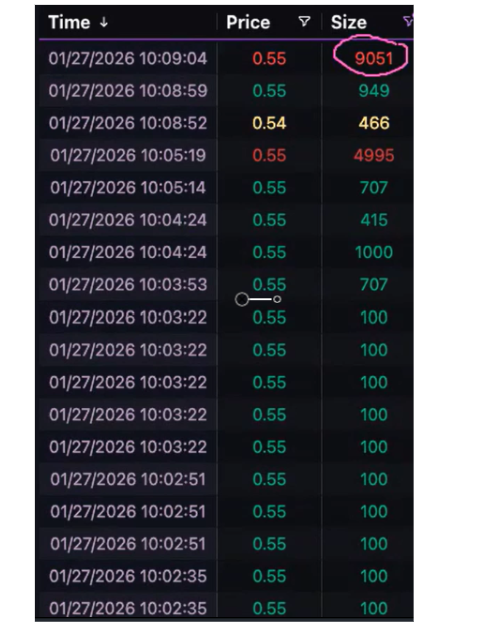
This data matters more than most traders realize.
Two identical open interest numbers can mean opposite things. One creates a wall. One creates a squeeze. One is bullish structure. One is bearish pressure.
For VFC right now, the console shows aggressive put buying today. March expiration. $17 strike. That's a directional bet.
Someone believes earnings disappoint. They're willing to risk capital on puts that only profit if VFC drops 15%.
The gamma dynamics amplify that move if it starts. As VFC falls toward $17, those puts move from out-of-the-money toward at-the-money. Delta increases. Market makers short more stock.
The selling pressure feeds itself.
The Trade Structure
Here's how to position for this setup.
Don't buy the puts outright. Too much capital. Too much theta decay. Use a defined-risk put spread instead.
Buy the $19 put. Sell the $17 put. March 20th expiration.
Maximum risk is the debit you pay. Maximum profit is $2 minus that debit. You're targeting a 1.5-to-1 or better reward-to-risk ratio.
The structure captures the move if earnings disappoint. You don't need VFC to hit $17 exactly. You profit on the way down.
The spread stays ahead of the time decay curve because you're selling premium at the $17 strike.
That $17 level matters. Not because it's a squeeze target. Because it's where the gamma wall sits from February's trade.
If VFC breaks lower on earnings, that level becomes a magnet. The stock can drift there as market makers adjust their hedges. Your spread captures that entire move.
Why This Setup Matters Now
VFC rallied today. That makes the trade better, not worse.
You're getting a higher entry point for the same target. The March put buying tells you institutional money expects weakness. The February gamma wall at $17 tells you where that weakness likely stops.
The earnings catalyst hits tomorrow morning. The market maker move prices in $1.70. But the options activity suggests $3. That's a 75% bigger move than consensus expects.
Most traders will watch VFC tomorrow and react to the news. They'll buy or sell after the move.
Ghost Prints members saw the institutional positioning today. Before the event. That's the difference between following and leading.
The console doesn't predict the future. It shows you where smart money is positioned. When 5,000 puts trade in a single block ahead of earnings, that's signal.
When a so-called guru confuses bullish structure for bearish pressure, that's noise.
The $17 strike holds two opposite trades. One is a gamma wall from sold puts. One is a gamma squeeze from bought puts. Only one of those creates downside pressure.
Only one matters for tomorrow's move.
The Ghost Prints Console shows you which is which.
See exactly how to identify bought vs. sold options in real-time with the Ghost Prints Console.
Brandon Chapman, CMT
Creator of Ghost Prints