
Hey trader,
I watched someone in my mentorship class stack 15 indicators on a single chart.
He still could not tell me whether to buy or sell. That is the problem.
You have been taught that more data means better decisions.
So you add RSI, MACD, Bollinger Bands, stochastics, and a dozen others. Your screen looks like an air traffic control tower and you still freeze when the candle prints.
Meanwhile, algorithms are running trillion-dollar machines against you. They do not care about your 15 indicators.
They care about one thing: flag formations. They curate them, manipulate them, and exploit them every single day.
I use three indicators. Gianni Di Poce uses two.
We both print money because we read the candles inside the flag. That is the entire edge.
The Pattern Algorithms Live On
I said it on Friday's broadcast and I will say it again here. If you can read flag formations, you can become a millionaire in years.
A flag formation has two parts. The flagpole is the initial momentum move, and the flag is the pause that follows.
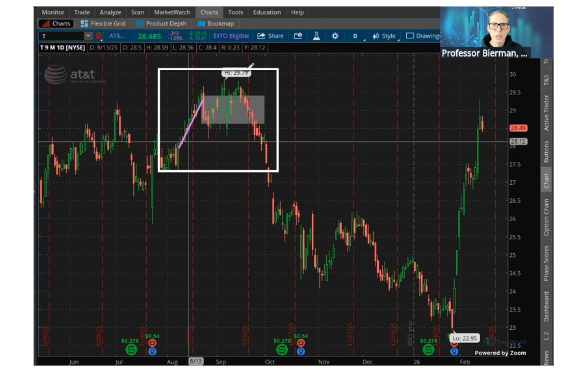
There are three types: bullish, bearish, and neutral. Bullish flags point upward, bearish flags point downward, and neutral flags move sideways.
This chart of AT&T is a neutral flag pattern.
The type determines what you are allowed to do. My rule is absolute.
You cannot short a bullish flag formation. You cannot buy a bearish one.
You wait for the flag to break. Then you let the candle confirm the direction.
The Three Candles That Matter
Once you identify a flag, the candlesticks inside it tell you when to act. I walked through three types on Friday and assigned each one a clear instruction.
- The doji is a pause candle. The stock opens and closes at nearly the same price, so it carries no bias and I say do nothing with it.
- The spinning top throws the same signal as the doji. I call it a "nothing burger" because it means neutral.
- The marubozu is the emotional candle. It opens at the high and closes at the low with no wick, representing full selling pressure for the entire session.
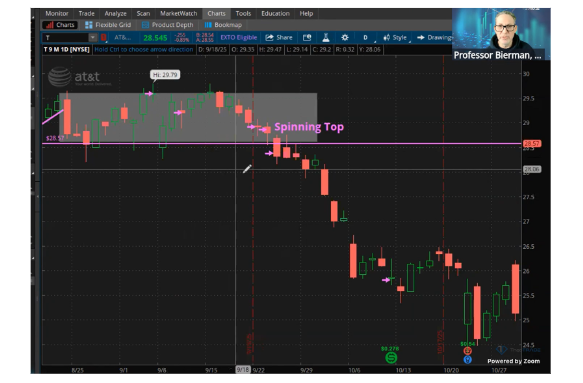
When a marubozu breaks underneath the flag's support level, that is my signal. Everything else is noise.
I am the most patient trader alive. I look for extraordinary candles and flag formations, and I trade off them aggressively.
In Genesis COG, we let the market tell us when to trade.
How AMD Showed the Other Side
I pulled up Advanced Micro Devices on Friday to demonstrate the bearish version of this framework.
AMD bounced off a triple bottom and ran higher. That was the flagpole.
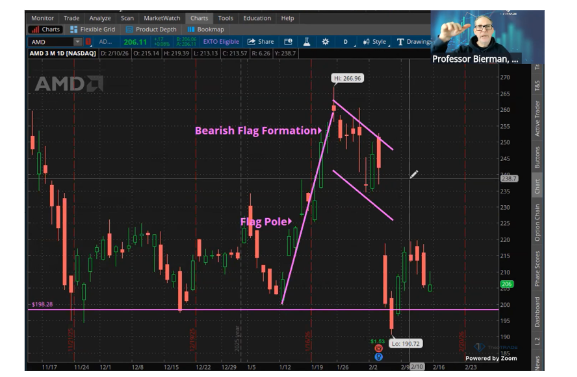
Then a spinning top appeared at the peak. A spinning top is not a sell signal and not a buy signal, so I told my viewers to do nothing.
The stock then formed a bearish flag formation when it began trending lower in channel. Staying in the upward channel would have made this a bullish flag.
So, what did I do?
I told everyone they had only two options: sell the long position or short the stock.
Buying a downward channel will blow your account out. I have watched it happen for decades.
AMD eventually broke underneath the flag's support on a large red candle. That confirmed the momentum shift.
Momentum breaks first. Then trend follows.
Why This Framework Is the Future
I closed Friday's educational segment with a statement I stand behind completely.
Flag formations are the future of the market. Everything is a flag formation now.
Algorithms create them and algorithms exploit them. The traders who learn to read candlesticks inside these patterns will have a lasting edge.
The Genesis COG System automates this framework and identifies when extraordinary candles confirm the break. It caught the AT&T channel shift and the AMD bearish reversal before price confirmed the new trend.
I do not predict. I read and react.
That distinction has kept me profitable for 39 years.
See how the Genesis COG System identifies flag formation breaks before the trend confirms →
Professor Jeffrey Bierman
Creator of the Genesis COG System