


Hey trader,
Procter & Gamble went vertical off a rotation trade this quarter.
Managers panicked out of tech, piled into consumer staples, and ran P&G straight up without a single thought about valuation.
Now, that stock is rolling over. The traders who chased it are watching their gains evaporate because they have no exit plan.
I spent the second half of today's broadcast teaching my TheoTrade audience the one concept that separates traders who protect their capital from traders who give it all back.
It took me twenty years to figure this out. I lost millions learning it the hard way.
The concept is the slope of the moving average. Not the moving average itself. The slope.
I am going to show you exactly how this works and why most traders get it completely wrong.
It Is Not the Trigger. It Is the Slope.
Every video on the internet teaches you that when price breaks below the moving average, you sell. That is incomplete and dangerous.
I showed my audience today that stocks break below the moving average and come right back through all the time. That happens because the slope is still intact.
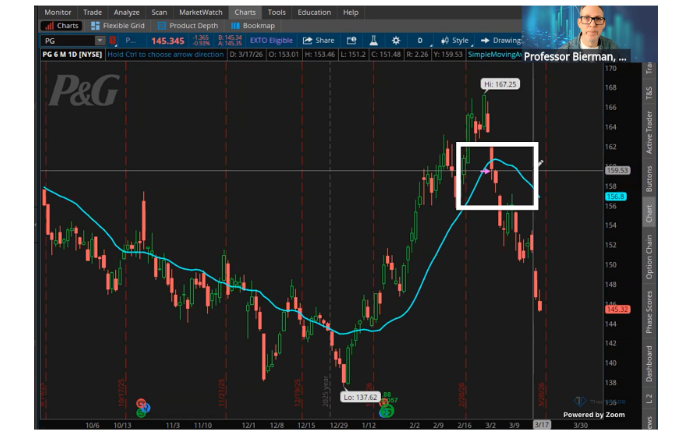
Algorithms trade off slopes. When the slope is still pointing up, they will defend the stock. It drops, they buy it, and they walk it right back up.
The sell signal fires when the price breaks below the moving average and the slope changes direction. That combination is the trigger. One without the other will get you killed.
I told my audience this is the key to the entire market. If the slope is flat, it is a two-sided trade. If the slope breaks down, it becomes one-sided. The algorithms will walk it down to nothing.
The Length Will Make or Break You
The second mistake traders make is choosing the wrong moving average length. I walked through this on P&G today with three different settings.
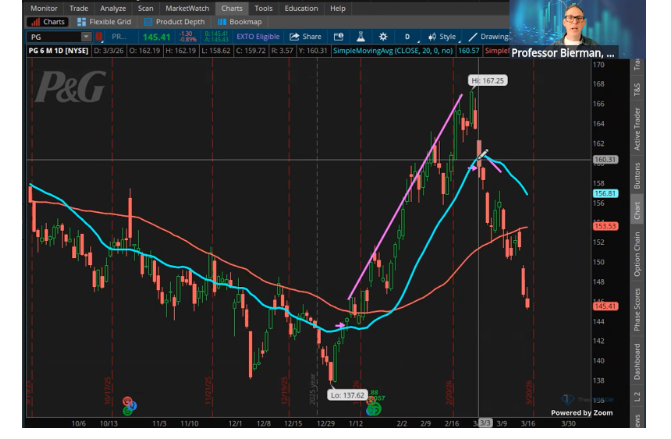
Here is what the math looks like on P&G:
- A nine-day moving average hugs price so tightly that you get whipsawed in and out. I call it asphyxiation. You will make twenty trades and no money.
- A fifty-day moving average gives up thirteen dollars of profit before it triggers. That is far too much leeway for any active trader.
- A twenty or twenty-one day moving average contains the damage. It gives up five to six dollars instead of thirteen. The twenty-one is a Fibonacci number and aligns with Mark Chaikin's work.
My rule is simple. Do not go below thirteen periods. Do not go above twenty-five. Anything shorter whipsaws you to death. Anything longer leaves too much room for destruction.
Qualcomm Proved the Slope Rules Everything
I pulled up Qualcomm to show a bearish chart where the slope tells you everything.
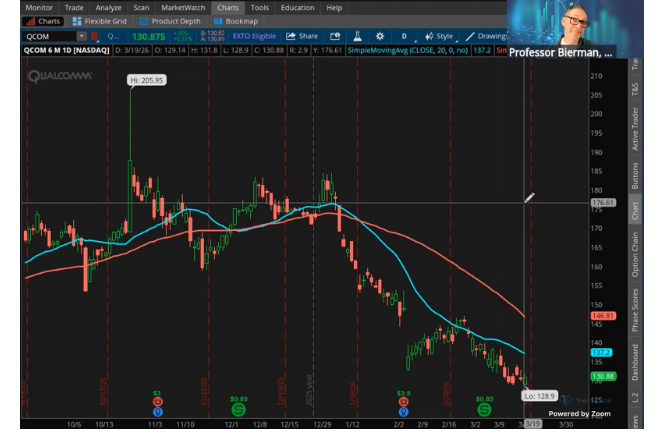
Qualcomm broke below its twenty-day moving average, but the slope was flat. I told my audience not to panic. You still had stationary price support underneath.
Then a Marubozu candle hit. The stock dropped over six dollars in a single session, broke below both the twenty and the fifty, and the slope changed direction. That was the real sell signal.
If you shorted at $138 and it ran seven dollars against you, you would still have made money by following the slope down. The slope told you everything you needed to know.
The S&P 500 Slope Is Parabolic Down
I ended today's session with the S&P 500. The moving average slope is parabolic down right now.
I told my audience I would not cover my shorts even if the index rallied to 6,900. The only thing that changes my position is the slope flattening out. Until that happens, every rally is a reload opportunity on the short side.
Algorithms trade the slope. If the slope is up, they defend price. If the slope is down, they accelerate the selling. You cannot fight that with your fifty shares against their billion dollars.
The Genesis COG System tracks slope direction across daily, weekly, and monthly timeframes. It identifies when the algorithms shift from buying the dip to selling the rip. That is the difference between catching a bounce and catching a falling knife.
See how the Genesis COG System identifies slope reversals before the crowd steps in →
Professor Jeffrey Bierman
Creator of the Genesis COG System