


Every options trade starts with the same fork in the road. You can buy premium or you can sell it.
Get that decision wrong and it does not matter how good your chart read is. You will leave money on the table even when the trade moves in your direction.
I have a single number I check before I look at a strike price, before I pick an expiration, before I decide on a spread.
It takes five seconds to find and it tells me whether I should be buying options or selling them on any given stock.
On Monday I ran three setups across three different sectors. Dollar General had options priced in the 63rd percentile of their yearly range.
AbbVie sat at the 28th percentile. The Healthcare ETF came in at 29%.
Same market day. Completely different pricing environments.
Dollar General demanded a premium-selling strategy. AbbVie called for a long call spread.
The Healthcare ETF was a straight buy.
If you used the same approach on all three, you overpaid on at least two of them. Most traders do exactly that because they never check the number that would have told them otherwise.
The Number You Should Check First
Before I look at a single strike price, I check one number. IV Rank.
IV Rank tells you where current implied volatility sits relative to the past year. If the reading is 80%, options are priced near the top of their 12-month range.
If it reads 20%, they are near the bottom. The number gives you instant context on whether premiums are cheap or expensive.
This is not the same as implied volatility itself. A stock can have 50% implied volatility, but if it spent most of the year at 60%, that 50% is actually on the cheaper end.
My Three Zones
I have a simple framework I use on every trade. It breaks IV Rank into three zones, and each zone tells me exactly how to structure my position.
Below 35%: Be a net buyer of options. The premiums are cheap relative to the last year. You can still use spreads, but make sure you are net long.
Between 35% and 50%: Run the numbers. There is no automatic lean in this range. You have to price out both approaches and see which one gives you a statistical edge.
Above 50%: Be a net seller. Options are expensive compared to their recent history. Buyers are overpaying, and sellers are getting a premium windfall.
Three Stocks, Three Different Answers
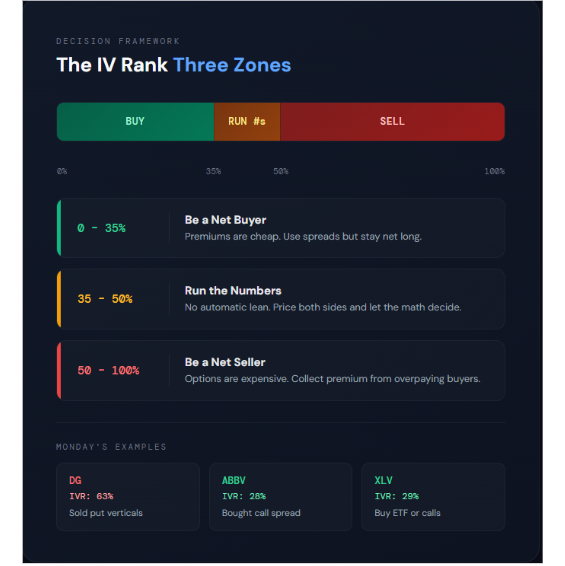
On Monday I walked through three setups. Each one landed in a different zone and demanded a completely different strategy.
Dollar General at 63% IV Rank. The stock has climbed from $95 to $152. Options are expensive right now.
At 63% IV Rank, the premiums are well above the 50% threshold. I shifted entirely to selling premium.
Instead of buying calls to play the bullish trend, I looked at short put verticals to collect income while the stock sits near fair price on the monthly chart.
AbbVie at 28% IV Rank. Healthcare broke out on Monday and AbbVie was flashing buy signals on the daily and intraday charts. With IV Rank at 28%, the options are cheap.
I looked at buying a delta-70 in-the-money call and selling an out-of-the-money call against it to offset time decay. The goal was to pay $2.28 in time decay on the long side and collect $3.18 on the short side.
That created a 90-cent positive theta on a long call vertical. The trade makes money even if the stock sits still.
Healthcare ETF (XLV) at 29% IV Rank. The sector had a huge day, but premium on the ETF is thin. At 29% IV Rank and only 1.5% return on risk for selling puts, there was not enough reward to justify a premium-selling approach.
The better play here is to simply buy the ETF or buy calls outright and let the cheap options work in your favor.
Why This Matters More Than Direction
Here is the part most traders miss. You can be right about direction and still lose money if you structure the trade wrong.
If you buy expensive options on a stock with 63% IV Rank and it moves in your favor, implied volatility often contracts during the move. That contraction eats into your profits.
You called the direction correctly but the options worked against you.
If you sell cheap options on a stock with 28% IV Rank, you collect a tiny premium and take on assignment risk for almost no reward. The edge is not there.
Matching your strategy to the IV environment is what separates consistent traders from ones who win on direction but bleed out on structure.
The Framework in Practice
Most platforms display IV Rank somewhere in the options chain. On thinkorswim, scroll to the bottom left of the trade tab and look for "Current IV Percentile."
If your platform does not display it, you can calculate it yourself. Take the current implied volatility, subtract the 12-month low, and divide by the range between the 12-month high and low.
Multiply by 100 and you have the percentile.
The next time you sit down to trade options, check IV Rank before you do anything else. Let that single number guide your structure.
Below 35%, lean toward buying. Above 50%, lean toward selling.
In between, let the math make the call.
The direction of the trade is only half the equation. The price of the options is the other half.
Get both right and the probabilities start stacking in your favor.
Blake Young
Senior Market Strategist, TheoTrade