


Hey trader,
After I take a loss, I move on…most of the time. That’s what you’re supposed to do.
But sometimes that can leave money on the table.
So, when walking away is discipline and when is it an overreaction to a single loss?
This could be the single most valuable lesson you can learn in your trading career.
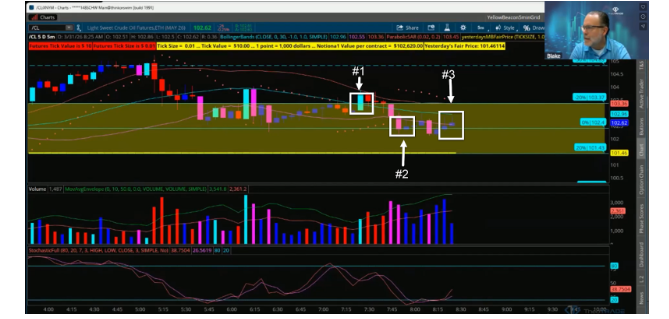
During Monday's 10% Club session, crude oil broke out overnight and pulled back to the zero level on the distribution chart.
I went long two micros at 103.35 with a stop at 103.08. It stopped out for a $54 loss.
The setup was gone. The trade was not.
Crude defended that zero level, and the 104.80 target had already been reached earlier that morning.
The destination was proven. The institutional support was still intact. So I entered again.
That one stopped out too. And I went back a third time.
The third entry risked $112 to make $428.
At nearly 4-to-1, I only needed one winner out of five attempts to come out ahead.
That is not revenge trading.
That is a repeatable edge at a defended level with position sizing that keeps total risk in check.
Here’s how you can tell the difference.
Revenge Trading vs. Re-Entry
Most traders have been told to walk away after a loss. Take a breath. Reset. Come back with a clear head.
That advice exists for a good reason. Emotional re-entries are account killers. You size up, skip the analysis, and try to win back what the market just took from you.
But there is a second mistake that nobody talks about. Walking away from a level that is still working because a single trade did not.
The difference between the two comes down to what is driving your decision. If the loss is driving it, that is revenge. If the level, the structure, and the math are driving it, that is a re-entry.
Here is the checklist I run through before I go back to the same trade:
- Is the level still being defended? If price keeps bouncing off the same support or resistance, larger participants are still active there. The level is alive.
- Has the target been invalidated? If the instrument already reached the target earlier in the session, the destination is proven. You are not guessing where it can go. You already saw it get there.
- Does the reward-to-risk still support the trade at proper size? If you can risk $100 to make $400, the math works even at a 25% win rate. If the stop has widened and the ratio has collapsed, the trade is dead regardless of how good the level looks.
If all three answers are yes, you have a trade. If any one of them is no, walk away and mean it.
How This Played Out on Crude
Crude oil broke out above its distribution levels overnight and pulled back to the breakout zone during the session.
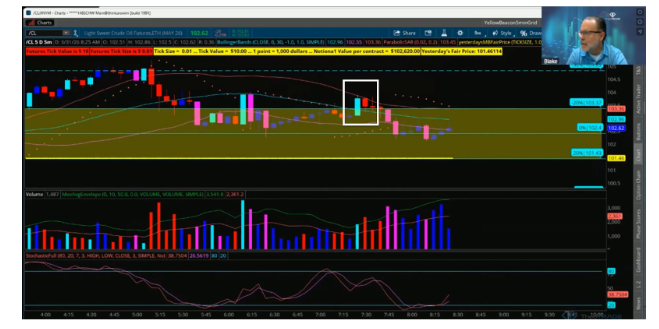
The first entry was a beacon long. Two micros at 103.35 with a stop at 103.08. The risk was $54.
Crude rolled over and hit the stop. Clean loss. No ambiguity.
But watch what happened at the zero level. Price dropped through it, closed back above it, and bounced. The zero was being defended.
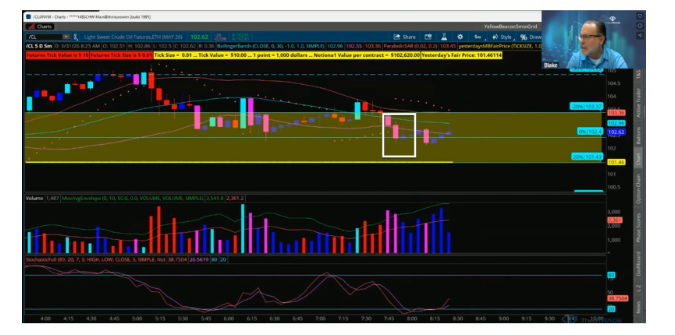
I ran the checklist. The zero was still holding. The 104.80 target had already been hit that morning. The reward-to-risk on a re-entry at 102.60 with a stop at 102.18 was roughly 4-to-1.
All three boxes checked. I went back in.
That one stopped out too. Crude dipped just below the zero and took me out for $86.
So I ran the checklist again. The zero had not broken in any meaningful way. Price snapped right back above it. The target was still valid. The math still worked.
The third entry came at 102.80 with a wider stop at 102.10. This time, I used the full 10% risk allocation. The risk was $112. The reward at 104.80 was $428.
At that ratio, I could lose this trade four more times and still come out ahead if the fifth one hits.
Why the Zero Level Matters
The zero on the distribution chart represents the bottom of the expected range. When price reaches it and institutional buyers step in, you are seeing real demand at that level.
Think of it like a floor that keeps getting tested. Every time someone stomps on it and it holds, you have more evidence that it can support weight.
Crude stomped on that zero three times during the session. Each time, it closed back above. The buyers at that level were not giving up.
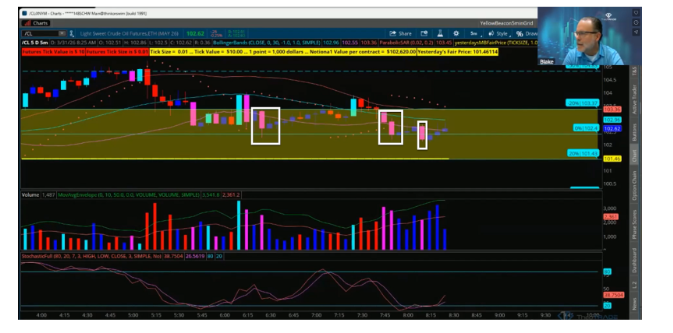
That persistence is what separates a re-entry from a gamble. You are not hoping the level holds. You are watching it hold in real time and positioning accordingly.
The zero-bounce is a low-probability trade by nature. I tell the room that upfront. But at a 4-to-1 reward-to-risk ratio, you only need one out of five to work. That math gives you permission to be wrong repeatedly, as long as your position sizing stays consistent.
Position Sizing Makes It Possible
Here is the part that holds the whole thing together.
All three crude entries used micro contracts. The first risked $54. The second risked $86. The third risked $112.
Total risk across three trades: $252. If the third entry hits its target, the payout is $428. That covers all three losses and leaves $176 of profit.
Now imagine taking those same trades on full-size contracts. The first loss becomes $540. The second becomes $860. The third risks $1,120.
Same setups. Same levels. Completely different impact on your account.
Micro contracts give you the ability to take repeated shots at a high-reward level without putting your week at risk. That flexibility is what turns a low-probability setup into a positive expectancy strategy over time.
If I had been trading full size, I would have taken one shot, lost, and walked away. The math would have forced me out. With micros, the math kept me in.
The Line You Cannot Cross
None of this works if you abandon the checklist.
The moment you stop asking whether the level is still defended and start thinking about getting your money back, you have crossed into revenge territory. The trades might look the same on a chart. The decision-making process behind them is completely different.
A re-entry says the setup is still valid, so I am taking it again at proper size. Revenge says I lost money and I want it back.
You can feel the difference in your body. A re-entry feels clinical. You are checking boxes and executing. Revenge feels urgent. You want to be in the trade right now before it moves without you.
If you feel that urgency, close the platform. The setup will be there tomorrow. Your account might not be if you keep trading from that place.
What This Means for Your Trading
Every session will hand you moments where a good level produces a losing trade. What you do next defines your edge over time.
Build the checklist. Is the level defended? Is the target still valid? Does the math still work at proper size?
Run it every single time. Not just when you feel calm. Especially when you do not.
The traders who learn to distinguish between revenge and re-entry are the ones who capture moves that everyone else watches from the sidelines. The ones who never learn it either blow up their accounts or leave consistent edge on the table.
Both mistakes cost you money. Only one of them is obvious.
Blake Young
Senior Market Strategist, TheoTRADE