

Hey trader,
The S&P 500 dropped 167 points in a single morning this week. Most traders pointed at headlines.
The real cause was a structural options trade that almost nobody outside institutional desks even knows exists.
It is called the dispersion trade. It unwound for exactly one day, and the damage was immediate.
Here is why that matters to you. This trade usually takes two to three weeks to fully unwind.
You have only seen day one of a process that could repeat without warning at any point over the coming weeks.
Today, I am going to show you how this trade works, why it creates a selling vacuum underneath the market, and what it means for every long position you are currently holding.
I have watched these mechanics play out from the inside. I track them in real time through the Genesis COG Scanner.
The Trade That Runs Underneath Everything
The dispersion trade is one of the largest structural positions in the options market right now. Institutional desks sell options on the S&P 500 index while simultaneously buying options on individual stocks within that same index.
The strategy exploits a simple fact. Index volatility runs lower than the average volatility of its individual components because stocks do not move in perfect unison.
It prints money in calm markets. Short index options decay in your favor while long stock options provide the hedge.
The catastrophe arrives when the trade reverses. Unwinding the short index position forces aggressive buying of index volatility and dumping of the underlying, which creates what I described on today's broadcast as an absolute vacuum to the downside.
That vacuum opened for a single session this week. One day produced 167 points of damage.
One Day Out of Weeks
I have watched dispersion trades unwind before. They do not resolve in a single session.
The typical cycle runs two to three weeks as desks rebalance thousands of positions across the index.
You got a preview. Here is what makes the next phase dangerous:
- The structural imbalance that triggered the unwind has not been resolved. The conditions are still present underneath the surface, and the trade will unwind again.
- Every rally from here is being defended by zero-DTE flows and algorithmic support. The day those defenses fail while the dispersion trade is actively unwinding, dip buyers will be caught with no bid beneath them.Retail traders are treating this like a video game. They buy futures, chase opens, and pile into zero-DTE calls with no understanding of the structural trade working against them on the other side.
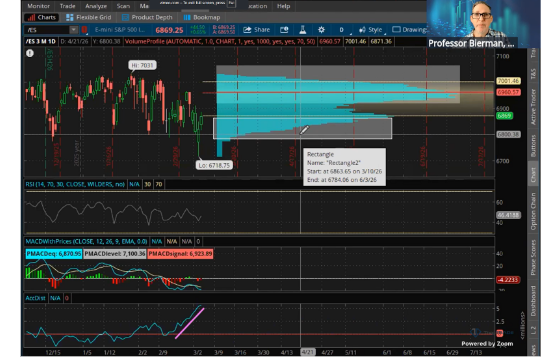
The volume profile confirms the exposure. Two thin layers of liquidity are holding this market together right now.
Below 6,733, the next meaningful support sits at 6,000.
That is an 800-point air pocket with nobody willing to place a bet in between.
No Rescue Is Coming
Kashkari declared this week that the Iran conflict has completely obscured the Fed's monetary policy outlook. They have zero visibility on the path forward.
No visibility means no rate cuts. If this market breaks, the Fed will not step in to catch it.
They cannot act when geopolitical uncertainty has paralyzed their entire decision-making framework.
I am carrying 50% cash across all accounts right now. I am making money on both the long and short side because I sized for exactly this environment.
The dispersion trade will unwind again. When it does, the session will make this week's 167-point drop look like a warm-up.
The Genesis COG System tracks the institutional mechanics that drive these structural unwinds in real time. It identified the momentum deterioration before this week's session confirmed what the options market was already signaling.
You cannot afford to be swimming without protection when the next unwind hits.
See how the Genesis COG System detects structural unwinds before they hit the tape →
Professor Jeffrey Bierman
Creator of the Genesis COG System