


Hey trader,
The semiconductor supply chain has a vulnerability that almost nobody is watching.
Traders are focused on oil prices and airlines when they think about the Persian Gulf conflict.
The second-order effect matters more.
Taiwan manufactures the processors that power Nvidia, Apple, and AMD. Those factories run on liquefied natural gas.
And Taiwan has 11 days of supply!
Would I have realized this without the Block Hunter Console? Probably not.
The Block Hunter Console flagged 10,000 put contracts on Micron in one print today.

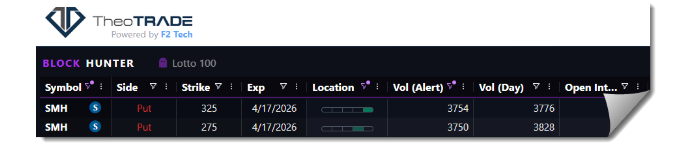
A separate put spread in SMH printed in the same session, buying the $325 puts and selling the $275 puts.
On the other side, nearly 3,000 call contracts landed on Taiwan Semiconductor for this week's expiration.
This tickled my brain enough to dive into the issue.
And what I found could be the hidden trade that no one has seen yet.
Why LNG Matters to Chip Production
20% of the world's liquefied natural gas is currently bottled up in the Persian Gulf.
Taiwan, where TSMC operates the most advanced fabrication facilities on the planet, has 11 days of LNG supply remaining.
TSMC is working to extend that buffer to 15 days. The margin between current reserves and target reserves is four days.
Helium is critical to the manufacturing process for three-nanometer chips.
The smallest, highest-margin processors that Nvidia and Apple depend on require it.
A disruption to Taiwan's energy supply affects which chips get made and which customers get served.
Not a single semiconductor company in the United States actually manufactures its own chips at scale.
The supply chain runs through Taiwan, and Taiwan's energy supply runs through shipping lanes that are currently constrained.
What the Console Caught
The Block Hunter Console flagged three distinct prints across the semiconductor sector in a single session.
Micron saw 10,000 put contracts bought in one print at the $300 strike.
The size of the trade confirms this was not a routine hedge adjustment.
Micron has had significant positive revisions to its earnings estimates and just completed its earnings cycle. The stock gapped higher on the report and has been fading since.
The institutional desk bought those puts into the fade. Positive earnings revisions did not stop them from building downside exposure.
SMH printed a put spread in the same session.
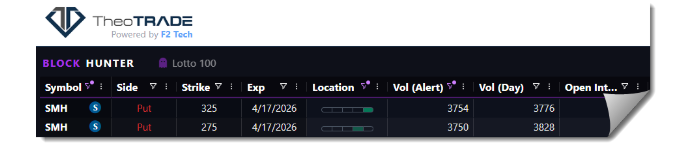
Institutions bought the $325 puts and sold the $275 puts, creating a $50-wide bearish spread on the semiconductor index. The primary weight in that index is Nvidia.
The Opposing Bet
Taiwan Semiconductor saw nearly 3,000 call contracts bought for this week's expiration in one block.
The thesis behind the TSM calls is straightforward. If negotiations in the Persian Gulf produce a resolution, the LNG bottleneck eases. Taiwan's energy supply stabilizes. The existential risk to chip production fades, and TSM rallies.
The thesis behind the MU puts and SMH spread runs in the other direction.
If the conflict persists or escalates, Taiwan's 11-day supply window becomes a real constraint. Production slows, and the stocks most levered to chip output take the hit first.
Both sides committed significant capital. The MU puts represent conviction that the risk is real and near-term. The TSM calls represent conviction that the risk resolves quickly.
When institutions build opposing positions of this size in the same session, the sector is approaching a binary catalyst.
The Console separated the flows and showed you which side carried more weight.
How to Read the Structure
The SMH put spread gives you the institutional framework for a bearish semiconductor position.
- Structure: Put vertical on SMH
- Institutional strikes: Buy $325 put, sell $275 put
- Spread width: $50
- Direction: Bearish on semiconductors
- Catalyst: Continued Persian Gulf disruption, Taiwan LNG depletion, production slowdowns
A $50-wide spread reflects institutional scale. A narrower spread at similar strikes offers the same directional exposure with defined risk suited to smaller accounts.
The downside gamma from the 10,000 MU puts creates mechanical selling pressure as Micron approaches the $300 strike.
Market makers who sold those puts must sell shares to hedge their growing delta exposure. That hedging activity accelerates the move lower if it starts.
The bearish weight in the semiconductor space is larger than the bullish side in today's flow.
The TSM calls are a short-dated bet that needs resolution within days. The MU puts and SMH spread are positioned for the risk to persist.
What the Console Is Tracking Now
The Block Hunter Console caught the full picture across MU, SMH, and TSM in a single session.
Micron's positive earnings cycle did not prevent institutional desks from building downside exposure. The semiconductor index is carrying a $50-wide put spread. Taiwan's LNG supply sits at 11 days.
The institutions are positioning around the supply chain while the rest of the market watches the headlines.
The Console separated the flows, confirmed the directional bias through fill location, and showed you the size on both sides.
See exactly how Block Hunter catches institutional positioning before the crowd catches on.
Brandon Chapman, CMT
Creator of Ghost Prints