


I'm short Las Vegas Sands at 67.
Caesars is down. Wynn has been sliding all month. The entire casino sector is underperforming while the S&P grinds higher.
Nobody's asking why.
The answer isn't in the charts. It's in Washington.
Lobbyists are pushing to regulate and slow down the proliferation of gambling across the United States.
The casino industry generates $54 billion annually. About 30 to 40 percent of that revenue gets moved into tax havens overseas.
That's $15 billion the government never sees.
Congress knows. They don't like it.
The Numbers Behind The Trade
Pull up Las Vegas Sands on any chart.
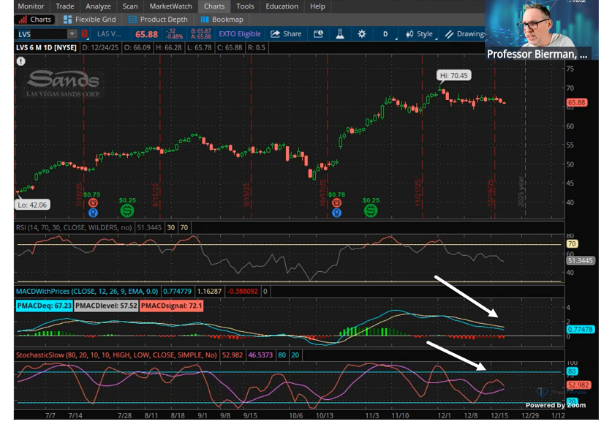
The MACD is heading down. The stochastic is rolling over. Every momentum indicator says this stock wants lower prices.
I shorted at 67. The stock currently trades around 43.
When this breaks through the zero line on the weekly MACD, I don't see how you stop it from hitting the mid-fifties. That's my target. That's where I cover.
Why The Government Is Coming
The social costs of gambling are mounting. Congress is paying attention.
Consider what's happening beneath the surface:
- Gambling addiction rates climbing in newly legalized states
- Local businesses getting crushed by casino over-commercialization
- Communities becoming overdependent on gaming revenue
- $15 billion annually escaping through offshore tax structures
These aren't abstract concerns. They're driving real legislative pressure.
The same lobbyists who pushed for legalization are now facing organized opposition. State attorneys general are asking questions about tax avoidance.
When regulators start circling, stock prices lead the news.
The Chicago Casino Problem
They're building a Caesars Casino about 10 minutes from my house.
I think it goes bankrupt.
The location is terrible. No parking. Chicago isn't Vegas. People don't fly here to gamble.
You want to gamble? Go to Vegas. Go to Macau. Go somewhere sexy.
Chicago is not a sexy gambling destination. The economics don't work.
This is the problem with the entire sector. Operators expanded too aggressively into markets that can't support the infrastructure.
How To Position
If you own casino stocks, sell them.
I'm not telling you to short. That trade is already working for me. But holding long positions here is fighting a regulatory headwind that hasn't fully materialized yet.
The weekly chart shows a clear descending channel. Lower highs. Lower lows. Classic distribution pattern.
When the government comes after an industry's tax structure, the stocks don't recover quickly. This isn't a one-quarter problem.
The Timeline
I'm giving this six months.
By summer, we'll know if Congress moves forward with gambling regulation. We'll see whether states start clawing back tax advantages.
In six weeks, we'll revisit my Las Vegas Sands short. You'll see whether the Genesis Cog got this right.
The casino operators have been dodging taxes for years. The game is ending.
The Genesis COG System identifies exactly when sector weakness signals deeper structural problems. When an entire industry underperforms a bull market, the system flags it before the headlines explain why.
I've been trading for 38 years. When Washington turns against an industry, you don't want to own it.
[See how Genesis COG detects sector breakdowns before regulatory pressure becomes obvious →]
Professor Jeffrey Bierman
Creator of the Genesis COG System