TSLA Has A Terrible Weekend
There are many acronyms to describe the large momentum tech names. One of those is TFAANG. That one includes AMZN and TSLA. While there weren’t any earnings reports during the holiday weekend, there were prominent tweets from Elon Musk and President Trump which affected stocks. Tesla’s CEO jokingly tweeted that Tesla was going bankrupt as an April fools day joke. Normally, this would be odd, but in the current situation, it makes Elon Musk look deeply out of touch with reality. On Sunday, the National Transportation and Safety Board announced Tesla mishandled the investigation into the car crash which was caused by Tesla’s autopilot. The company brushed it aside unlike Uber which took its crash much more seriously and suspended the self-driving tests.
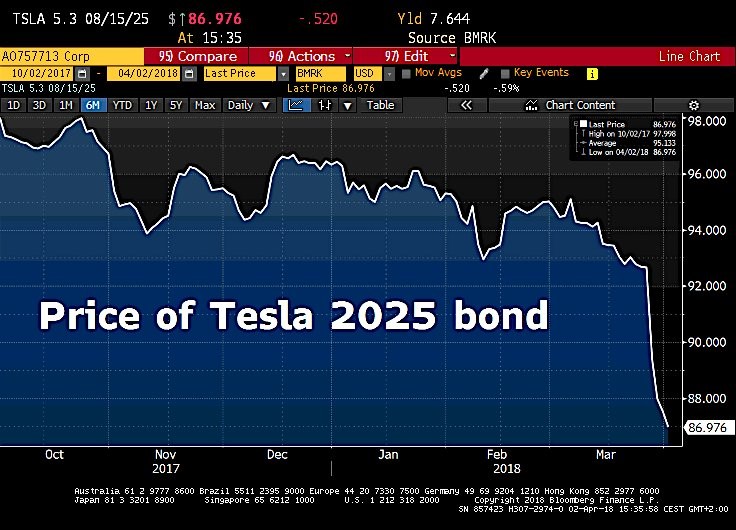
There’s nothing wrong with an April fools joke. In fact, Elon Musk’s ability to maintain a high public approval rating through his use of social media helps Tesla sell cars. His 21 million Twitter followers are a huge asset to the company. The major problem with that asset is it’s difficult to maintain. It’s easy to offend people. Musk’s joke was far too close to reality given Tesla’s recent bond price action. As you can see from the chart above, Tesla’s 2025 bonds are collapsing. This will hinder its ability to issue new debt which is a huge problem because it will likely need money in the next 12 months. Getting shut out of the public market because there’s no investor demand for Tesla’s debt can be a self-fulfilling process which eventually causes the firm to spiral out of control.
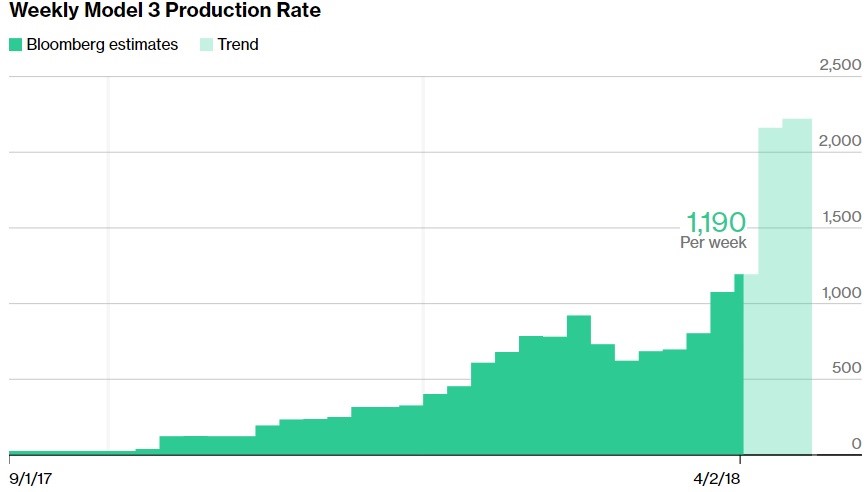
The stock cratered 5% on Monday. It has now dropped 34% from the September high. That makes it more difficult to sell equity. While Elon Musk jokingly tweets about the collapse of his company, the firm is about to report how many Model 3 cars were produced. The weekly run rate is supposed to be 2,500. However, as you can see from Bloomberg’s estimate below, the firm is only producing 1,190 per week which is half the guidance. Tesla is widely held by retail investors. I view it as a sign of sentiment and an indicator for where we’re at in the business cycle. The fundamentals are weak. When Tesla faces trouble, it means financial conditions are probably stressed.
President Trump Continues Negative Tweets About Amazon
If your goal was to stop the equity market rally, the most obvious choice would be to force Amazon stock lower. I’m not saying this is Trump’s goal, but it is the effect of his negative tweets about the company which claim Amazon is a scam because of the lack of state and local taxes it pays and that it costs the Post Office billions of dollars. The interesting part of Trump’s criticism of Amazon is that Amazon would probably be helped if the sales tax laws were change. The main reason Amazon stock fell 5.2% on Monday is because the overall tech sector fell and there was a knee jerk reaction to the negative headlines caused by the tweets.
Amazon already benefitted by not paying state sales tax because it was a remote seller. Now that Amazon has an expanded fulfillment distribution network, it already pays sales tax. Trump’s criticism is a few years too late. The implementation of a sales tax on internet retailers would help Amazon because some of the smaller internet retailers would need to start paying sales tax. Furthermore, Amazon charges 3rd party retailers who sell through its website a 2.9% fee to collect the sales tax for them. This fee will help the firm because 17% of its sales in 2017 were based on fees to 3rd party sellers. Amazon’s fundamentals are much stronger than Tesla’s and the bad news is actually good news.
An Update On The GDP Forecasts
Despite the holiday on Friday, two of the GDP models were updated on Friday, so I didn’t have the opportunity to review them. The NY Fed’s model was revised from 2.85% growth to 2.71% mainly because of the change to real personal consumption expenditures. This estimate is a far cry from the expectation for 3.45% growth on January 5th. This weakness is a great depiction of how the economy swooned in February. There has been a sharp reversal from the optimistic January survey reports to the actual February economic reports. The expectation is for 2.87% growth in Q2. I expect that forecast to fall in the next few months.
I’m not sure if the economy will start to turn up in Q2 or Q3. Ultimately, it’s fine to not know when the upturn will occur because the stock market and bond market still haven’t completely processed that the economy is weakening. I think the economic data will get worse in the next couple of months which will force the Fed to get more dovish. Then after the Fed gets dovish, the economic data will improve. This will provide two catalysts to move stocks higher. The understanding that there will be a mini-rebound in the economy and the expectation that the Fed will move in a dovish direction makes you into a buyer on any weakness that gets out of hand. I acknowledge that’s a somewhat vague depiction, but there can be irrational movements in the short term which cause better buying opportunities than expected.
The St. Louis Fed Nowcast continues to be far above the others as it shows 3.61% growth in Q1. I don’t have any indication that will occur other than some survey data. Predictions are difficult, so I present them all, even the ones I don’t agree with.
Conclusion
The two leaders of the market, Tesla and Amazon had weekends with negative headlines. I think the market will survive if Tesla stock crashes. It would be an indicator of the market sentiment. However, if the weakness mainly comes from missed Model 3 production estimates, I wouldn’t be as worried about a crash. Amazon is probably the most important stock in the S&P 500. Luckily, the negative news won’t hurt the company unless Trump comes up with another policy to hurt Amazon. That’s not out of the realm of possibilities because he thinks the firm has destroyed physical retailers which hurts the economy. The reality is Amazon helps retailers sell products on its website.