Finally, A Small Decline
The stock market finally sold off on Friday, but it was only a modest decline. The S&P 500 fell 35 basis points. It was a very weird day for individual stocks because of quadruple witching and indexing. Index funds needed to make changes to their weighting as well as add and subtract stocks. Plus, options expiration made the market act unnaturally.
Obviously, the biggest name being added to an index was Tesla which was added to the S&P 500. The addition went surprisingly smoothly in my opinion. This was talked about for weeks and there was only a little volatility in the last few minutes of trading. Investors front running the trade seemed to have dumped shares a few minutes before they were bought by the indexes at the close.
From 3:10 PM to 3:45 PM, the stock fell 4.7%. Then in the last 15 minutes of trading it rose 9.2% closing up 6%. It then fell 2.6% after hours which is a likely preview of the coming bloodbath next week. Tesla’s runup to the inclusion was clearly much bigger than the actual addition day.
Shareholders will get a painful reminder of how much of a bubble it is next week and next year. Bloomberg Wealth actually did an interview with a Tesla shareholder who now has $1 million in the stock. They apparently do ring the bell at the top!
The media blamed the lack of a COVID-19 relief deal for the decline in stocks on Friday, but it was so modest, so we can't say there was a specific reason for the drop. Stocks can’t go up every day. This market is overbought and due for a correction larger than this. We might get one in January as the hottest names reverse course.
Extreme Reading In Semiconductors
Obviously, there are a ton of industries that are overbought because the market is on a great run. It’s very difficult to find any oversold stocks. The losers such as coal and community banks have had a good run and the winners have continued to do well. So far, all stocks have been invited to the party.
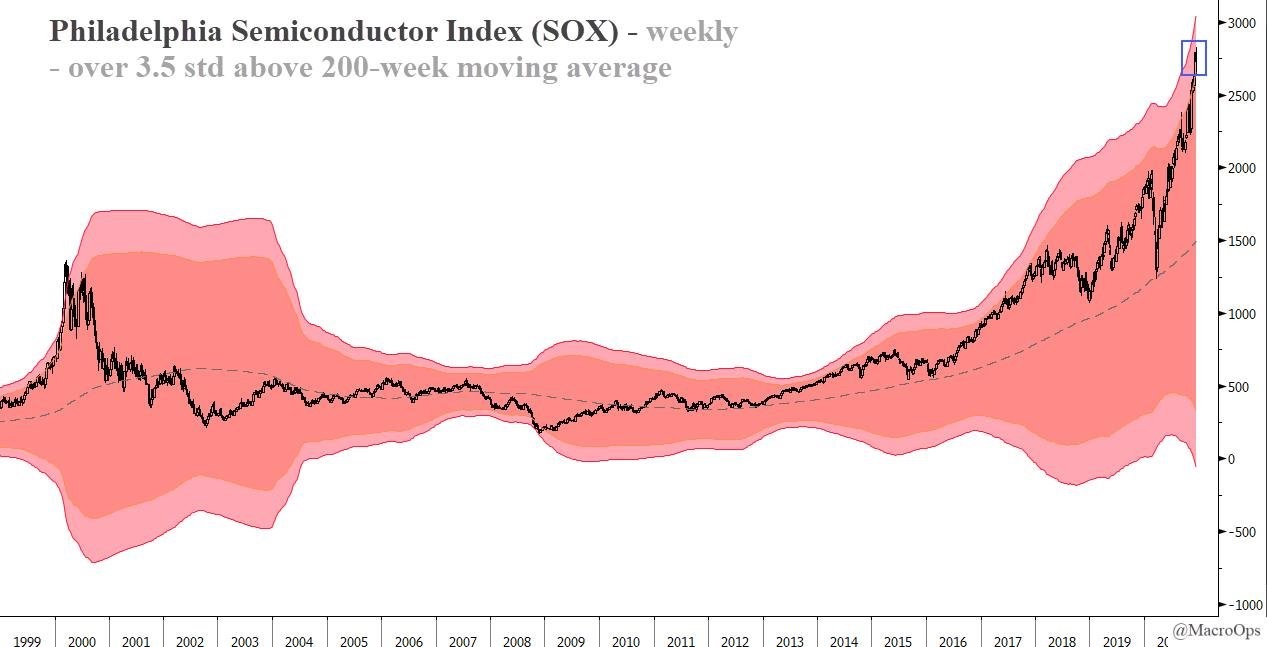
As you can see from the chart above, the semiconductors have gone stratospheric. This can’t end well. These firms did well during the lockdowns because chips are needed for people to work from home. They are also a cyclical play, so maybe investors are buying them in the reopening trade as well. The SOXX semiconductor index is 3.5 standard deviations above its 200 week average.
This is the exact over extension that occurred in the 1990s tech bubble. We all remember a few years ago when semiconductors were thought of as cyclical stocks that were losers. Now, investors love them. This is all recency bias. Look for the crash in semiconductor stocks to be well over 50%.
The one exception is Intel which has been woefully underperforming. It fell 6.3% on Friday on news Microsoft is designing its own chips for servers and Surface PCs. Many investors wouldn’t own Intel either as it is losing its competitive advantage.
Retail Favorites Win Big
The less experience you have in the market, the better. That’s how this year has gone. One theory is that won’t continue. Some say stocks that aren’t ESG friendly simply won’t be bought by millennials. It’s a fun situation when you have people explaining away ridiculous valuations.
Saying millennials love a few stocks isn’t a good investment case. In the end, profits are what matters to investors. You don’t get rich by investing in money losing companies.
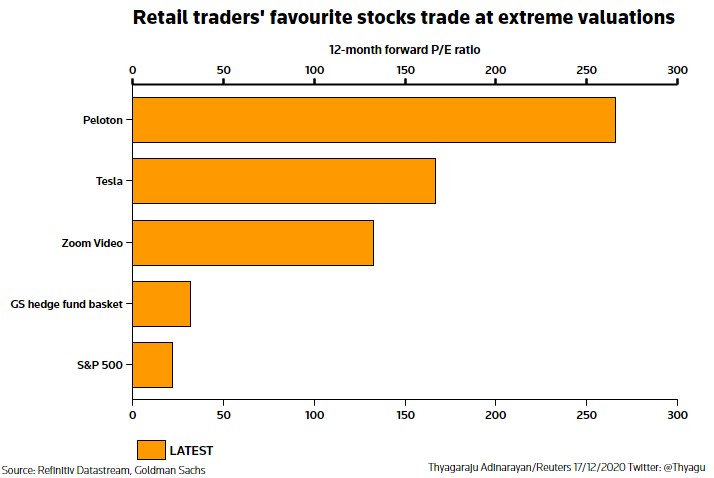
Hedge fund VIPs have actually had a great year as they are up 41.8% year to date. However, a basket of retail’s favorite 58 stocks is up 81.2%. Robinhood traders are on top of the world. As you can see from the chart below, the hedge fund basket is much more expensive than the S&P 500.
However, the favorite stocks among retail traders are in another stratosphere. Triple digit PE ratios are the norm because retail traders don’t look at them. They just buy momentum stocks. It’s fine to buy winners, but this crowd also won’t ever sell which will be a problem when the party ends.
2nd Craziest Year Since Great Depression
If you look at the market’s return for the year, 14.8% looks solid. You wouldn’t know that this was one of the craziest years ever. As you can see from the chart below, the market’s realized volatility was 35.3% in 2020 which is the 2nd highest since the Great Depression. Only 2008 had a higher realized volatility.
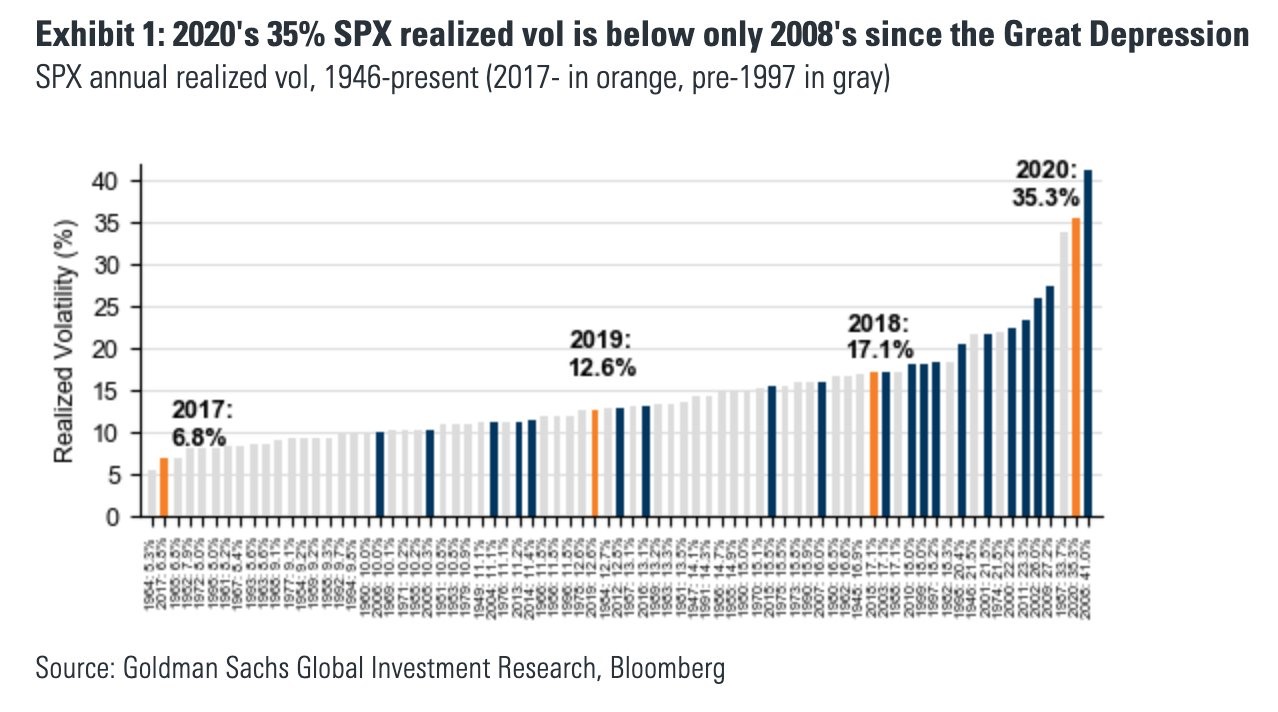
Volatility will likely fall next year unless vaccines don’t get distributed easily and quickly. However, it won’t be a quiet year. It will look a lot like 2000 because the hottest tech stocks, SPACs, and cryptocurrencies are way out of line with reality. The bubble in bitcoin is much larger than it was in late 2017.
Bitcoin is at $23,109. Its market cap is $429 billion. It plus Tesla quals over $1 trillion and that’s not even counting all the expensive software stocks. Investors don’t see any possible scenario where emerging markets and commodity stocks do well and the hottest stocks don’t sell off. They have to! There will be so much new supply with all the IPOs such as Robinhood itself going public.
Conclusion
Tesla being added to the S&P 500 was a momentous day for this bubble market. The actual trade action wasn’t that extreme compared to the rally in the past few months in anticipation of the inclusion. The next big marker will be Robinhood’s IPO.
The semiconductor stocks are in a big bubble. This has been the 2nd most volatile year since the Great Depression. 2021 can’t possibly match this year, but it will be an important one because the bubble stocks will pop. They have to. It’s basic supply and demand.