Very Unusual Day
The stock market had a relatively boring Friday until right before the close. Before getting into that, let’s explain why. Usually, we can only guess why stocks move strangely, but this time we know. It was quadruple witching day and the index funds rebalanced. This rebalancing was different than usual because the indexes skipped their rebalance last quarter because of the extreme market action. Honestly, many didn’t know it was possible to skip a rebalancing and some disagreed with the decision.
People believe they shouldn’t have someone picking their stocks if they go passive. However, index funds are actively managed. That’s why Tesla isn’t in the index yet. It hasn’t had enough quarters of GAAP profitability in a row. We don’t have the data on whether the decision to skip rebalancing was better for returns. Index companies weren’t trying to earn higher returns, but it always calms people down if a decision makes them money.
You can imagine this was a bigger change to the sector weighting than usual because the last quarter was skipped. Plus, sectors have had very different returns recently. We noticed extreme volatility in the utilities at the end of the day. In the last 40 minutes of trading, the utilities sector fell 2.3%. That move would have never happened in a normal market.
There was no news event that caused this decline. If you knew about quadruple witching and the index changes, it made sense to wait for the last 30 minutes of trading to make a move.
High Flyers
As you know, the cloud industry is overheated beyond belief. This is another tech bubble. Some are saying this is like 1998 when the Fed bailed out Long Term Capital Management. If that’s the case, we have 2 more years of gains. Think this rally likely can't last that long. We already have stocks up triple digits in a few months. They are reaching hundreds of billions of dollars in market cap.
Shopify is the face of the tech bubble. Its stock is up 174% since its March bottom. It was up another 1.97% on Friday. It’s up 13.24% in the past month. Its market cap is already $103.27 billion. It’s unlikely to increase that much per month even for the rest of the year. It would be worth over $215 billion. Fact that anyone would even consider such performance shows how much of a bubble it is.
It has slowing revenue growth. In the past few quarters, its revenue growth has been 73%, 59%, 47%, 37%, and 34%. Its revenue growth isn’t slowing because of COVID-19. This is a long term trend lower. Problem is it’s not profitable yet.
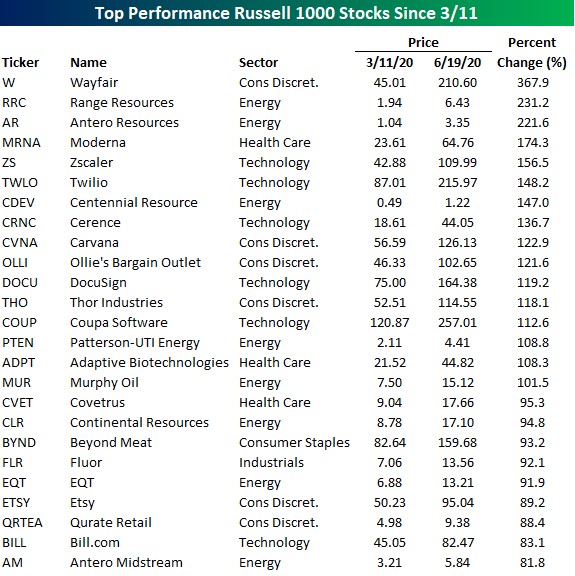
The table above shows the top performers in the Russell 1000 since March 11th. As you can see, only 6 are in technology. However, Wayfair is a dot com stock that sells furniture. You can consider it part of the mania. And you can also consider Carvana to be part of the mania as it is an online used car seller.
Finally, Etsy is another online retailer. It sells handmade products from individual creators. That’s 3 tech adjacent companies not counted as tech. Beyond Meat is in the staples sector, but this is a recent IPO with no profits. Many have been surprised by its rally because the only way it has been helped by this shutdown was the temporary beef shortage. A few weeks of Beyond Meat being the only option won’t necessarily make people convert to it long term.
Growth Wins
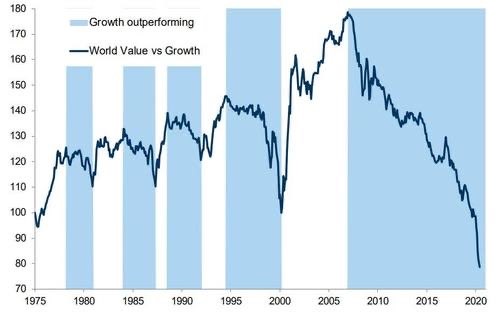
Growth stocks are beating value stocks more than at the peak of the tech bubble. The chart below shows the world value versus world growth index. This is a global phenomenon which was started in America. America has the biggest tech players. They are the famous FANG stocks.
Almost everything tangentially tech related that has high sales growth is being bid up. This will be a painful reversal. Spotify is the latest example as it has rallied 29.44% since June 11th.
Review Of Friday’s Action
Nasdaq was up for the 6th straight day as it is only down 0.74% from its previous high, which is also its record high. It’s up 10.85% year to date and 24.52% in the past year. CLOU cloud ETF fell 33 basis points. Facebook stock rose 1.21% to a new record high. It’s up 63.5% since its March bottom.
Russell 2000 fell 0.59% as the regional banks were weak. KBW regional bank index fell 1.07%. It’s down 13.3% since June 8th. The S&P 500 fell 0.56%. It was down after hours probably because of quadruple witching. It fell 0.82% after hours on no news. In the afternoon, it fell 0.8% in a few minutes because Apple said it was closing stores in 4 stores. We can expect more declines like this as more places close in the South and the West.
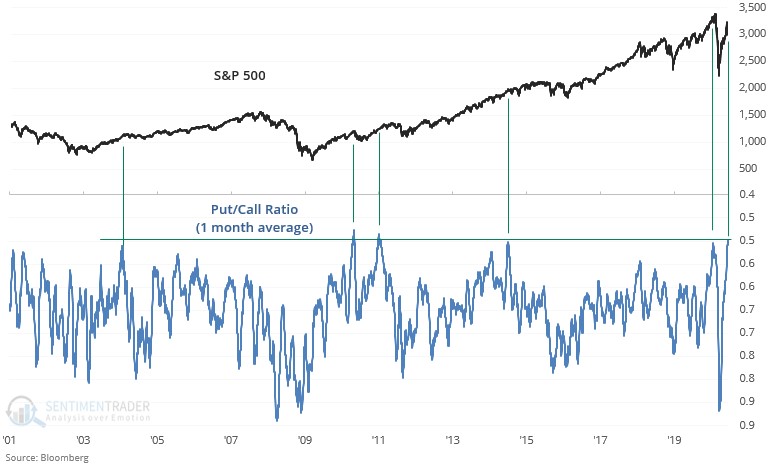
As you can see from the chart below, the 1 month average put to call ratio has only been higher 2 other times in the past 20 years. These high readings haven’t always led to big declines. However, none of them occurred in a recession. That’s because stocks never get this overbought in recessions. You can argue the recession is over, but this recovery is worse than most recessions.
Every sector fell except healthcare which was up 0.87%. The worst sector by far was utilities which fell 2.8%. I mentioned it crashed near the close as there was an index fund rebalancing which changed its weighting.
Case for Bearishness
Many are now very bearish on the high-flying stocks. It’s very difficult to tell how severe the coming decline in these names will be. It could be a 20% decline in the Nasdaq or it could be the start of a multi-year trend in favor of value stocks away from growth names.
Only thing you need to know for performance to be good is that you want to avoid where everyone is investing. Crowded areas all eventually go sour.