

Sometimes really smart people say things that seem really silly in times when rationality has been pushed aside by some powerful force exerting undue pressure on markets.
Allow us to give you an example. The following are excerpts from Friday’s commentary by Bloomberg’s Mark Cudmore, a former FX trader who writes a daily missive:
“Stop the malevolent thoughts. I know you’ve got them. You really want the U.S. stock market to crash so you can enthusiastically buy in. If so, you’re in the vast majority of long-term equity investors. But waiting and wishing for the crash may prove costly (never mind the strange things that wishing for others’ financial demise does to one’s psyche).”
“It’s not that the market can’t crash. It’s that a sell-off won’t sustain. There’s a sizable risk of being too clever for your own good. The concept that U.S. equities are expensive, or priced for perfection, is far from controversial -– it’s consensus.”
“The corollary is that equities are vulnerable to a severe correction, or even a crash. Since the lows in 2009, the S&P 500 Index has more than tripled without a single 25% pullback
That seems crazy but is far from unprecedented. After the 1987 crash, markets septupled by the peak in 2000 without a single 25% drop.”
“One of the major drivers of that bull market was that investors had excess cash relative to viable investments: easier monetary policy, an explosion in new credit products, and a budget surplus that caused a severe drop in government borrowing (freeing up capital).”
“Fast forward to today and investors effectively have infinite cash. Not just in the system generally, but funds themselves. In July, fund managers had the highest percentage of cash in almost 15 years, according to the BofAML survey. That means that in nominal terms, their cash pile dwarfs anything in history.”
Got that? Ok, so the first problem there is the whole comparison with history thing. The period following the 1987 crash was a ludicrous run-up that eventually led to multiples which made so little sense that the absurdity at a certain point didn’t even bear mentioning. If we use that comparison, then the Dow will go to 49,000.
Implicit in Cudmore’s analysis is that investors are just waiting for opportunities to deploy cheap money bestowed upon them by central banks. As Cudmore himself puts it, “it’s cash that desperately needs a dip to buy [and] there’s a whole lot more waiting in the wings – provided by central banks globally and sitting in low interest or negative-yielding assets.”
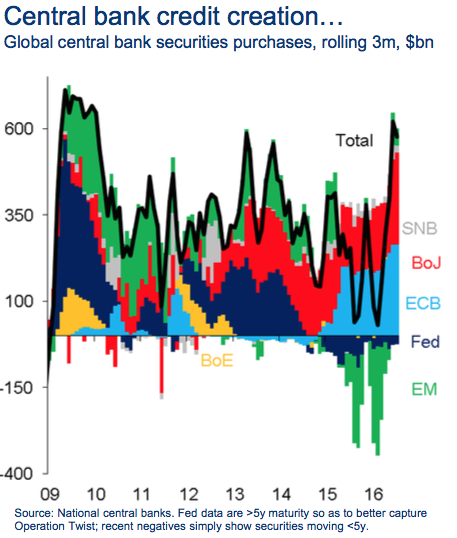
Ok, sure. But this is an argument that stocks will rise to infinity. If investors languishing in IG yielding basically nothing (thanks to programs like the ECB’s corporate bond buying effort) really do have “infinite cash,” then they’ll rotate to stocks on any pullback. So what is the end-game? Clearly central banks aren’t about to cut off the spigots. Just have a look:
(Chart: Citi)
So the cheap money just keeps coming, driving yields ever lower and stocks ever higher on perpetual dip buying by an infinite supply of fiat money provided by central planners?
How can that possibly work in practice? This essentially assumes that eventually, all developed market central banks will be operating from a negative equity position. You can’t just keep building portfolios of trillions in negative yielding bonds and then basically recapitalizing yourself or asking for an injection from the government (as the ECB once put it dryly: “central banks are protected from insolvency due to their ability to create money and can therefore operate with negative equity.”)
Taken to its logical extreme this assumes central banks will eventually own all government and corporate debt which will all at that point carry negative yields - after all, how else can you ensure that the cash investors use to buy stock on dips is truly infinite?
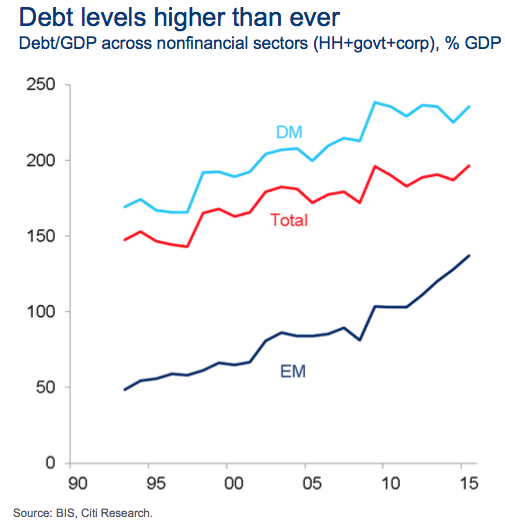
“A sustained crash only comes when the initial price correction forces deleveraging, as seen in 2000 and 2008,” Cudmore continues.
But the world didn’t deleverage. The leverage just shifted:
(Chart: Citi)
Here’s the punchline from Cudmore:
“When the financial system has its next big scare, it’ll most likely come through the sovereign bond or currency channel, and not equities. That’s if markets ever question the value of their fiat money, which doesn’t look imminent.”
Actually it does look imminent. As we’ve argued at length, fiscal stimulus (i.e. helicopter money) may be the point at which markets do question fiat money. But really, it’s not really “markets” that need to question it for this whole thing to go decisively off the rails. It’s the public. For now obfuscation has prevented that from happening. But if you start sending out checks to people in the mail for no reason, people may begin to understand that this is all a farce.