The Major Indexes Rebound
The stock market started to look past the trade war fears on Friday as the S&P 500 was up 0.51% and the Nasdaq was up 1.08%. The Russell 2000 was up 1.71% because smaller firms, who don’t do much international business, could be helped by protectionism. Overall, it will hurt trade and make consumer prices go up. The competition for small firms declines, but their end user is hurt. The Dow was down 0.29% mostly because of the decline in McDonald’s (4.8%), Caterpillar (2.6%), and Boeing (1.4%). Caterpillar and Boeing were down because of the tariffs, while McDonald’s had its worst day since October 2008 because of disappointing sales from the new value menu. I’d like to correct a point I made earlier. I had said GM will be hurt by the steel and aluminum tariffs. While that’s true, the selloff may have been too harsh because GM gets 90% of its steel from American suppliers. Therefore, the 4.88% decline in the stock in the past two days may have been overkill.
Trade War Talks Ratchet Up
The big news was President Trump’s statement in which he said “when a country (USA) is losing many billions of dollars on trade with virtually every country it does business with, trade wars are good, and easy to win.” That’s a scary sign because no one wins a trade war. Regardless of the outcome, while it’s ongoing, trade suffers and prices increase. It’s possible that the market sees the negative response from the Republican Congress and economic advisor Gary Cohn and concludes this tariff won’t get done.
The Congress has the final Constitutional authority on tariffs if it chooses to act. It can threaten to shut down the tariffs, making Trump change his mind. For some context, in 2002 when George W. Bush imposed a 30% steel tariff, exempting Canada and Mexico due to NAFTA, the WTO ruled a year later that the tariffs violated the U.S. obligations under WTO and fined America $2 billion. This caused America to rescind the tariffs.
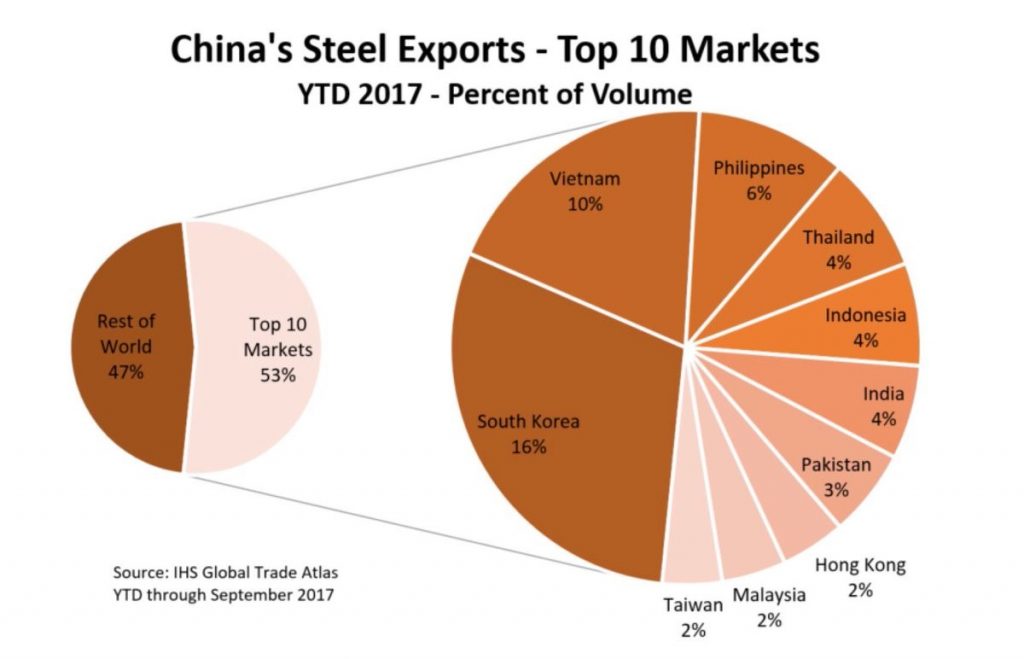
As you can see from the chart below, America isn’t one of the top end markets China exports to. America is number 26 probably because America uses its own steel. The steel and aluminum jobs have been gone for years. Issues of Chinese dumping occurred years ago. It’s surprising to see the issue being brought up this year especially since the President didn’t act on it his first year in office.
Consequences Of A Trade War
Keep in mind, a trade war still isn’t probable. I’m discussing only potential negative consequences. Canada, Mexico, China, Japan, Brazil, and the E.U. are all considering retaliatory measures. It seems like a terrible cost benefit analysis to start a trade war to help a few hundred people in the Mid-West get jobs in the aluminum and steel industries. The E.U. stated it would target U.S. steel, agriculture, and other products for potential tariffs. The European Commission leader Jean-Claude Junker said, "We will put tariffs on Harley-Davidson, on bourbon and on blue jeans - Levi's." As you can see, President Trump’s stance on the issue was matched by other world leaders. It’s reasonable to debate whether these responses are good or bad. On the one hand, they ensure a trade war would be terrible. On the other hand, they increase the likelihood that America won’t go through with the tariffs.
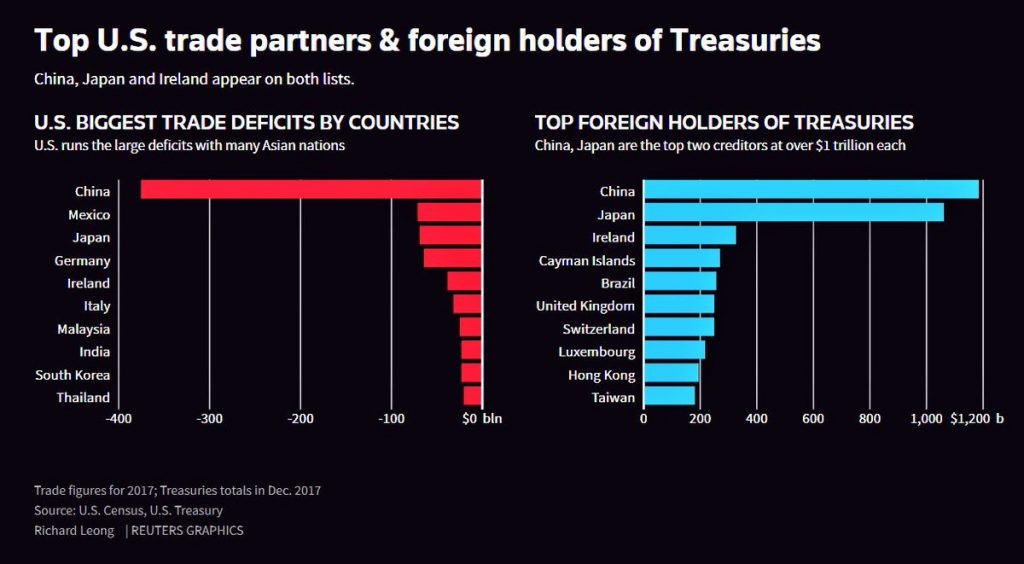
The chart below gives the worst case scenario of what a trade war could do. Not only could China decide to stop buying American treasuries, all of the countries could agree to do so. It’s also worth noting that trade deficits aren’t bad. America gets cheap foreign products and then those countries invest the money they make into America. It’s a great deal for America. America ends up with a low interest rate on its debt, foreign invested capital, and cheap consumer goods. This is why most of Congress and Trump’s economic advisor don’t want to do the tariff. It’s also why I don’t think it will be executed on.
Other Action On Friday
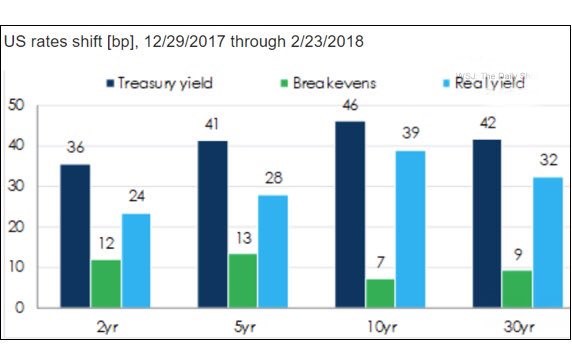
The 10 year bond yield increased 5.65 basis points which reversed the slide lower. It joined the stock market in reversing its recent trend. With all the inflation reports in sync, it makes sense to expect higher yields over the next 6 months. As you can see from the chart below, most of the increase in treasury yields has been caused by an increase in real yields rather than the breakeven inflation rate. Therefore, you can argue the yields should be up more. Since June 21st 2016, the 10 year breakeven yield has increased from 1.66% to 2.12%.
Since the December 29th close, the 10 year breakeven rate is only up 16 basis points. It’s tough to gauge the current expectations for inflation because while that increase is modest, the consensus forecast for inflation is quite high as the core inflation is expected to get to about 2.4% by the end of the year. It’s also worth noting that the regional Fed indexes are showing more inflation than the overall metrics show. This might be caused by the disappointing wage growth. We’ll get more information when the next CPI report is released.
Conclusion
Since the market rallied, it must not think the worst case scenario, which is a trade war, will occur. Sometimes traders don’t want to go into the weekend holding risk assets, but in this case the worst news has already come out, so maybe that’s why they bought stocks. At the pace the government is on, the tariffs will be enacted next week. There’s upside to stocks if the tariffs are neutered, rescinded completely, or delayed. I expect some sort of delay because the administration wasn’t prepared for President Trump’s decision this week.