Italian Situation Resolved
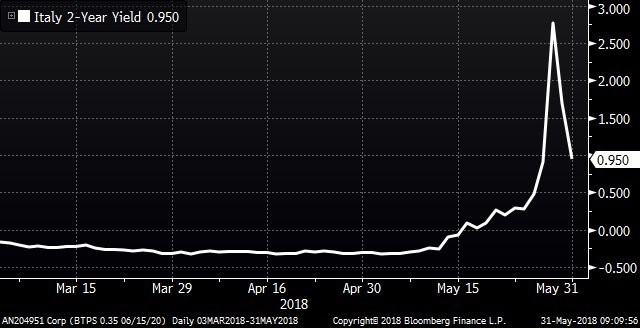
Global market action has been unreal this week. As you can see from the chart below, the Italian 2 year bond had a panic moment where it went from a negative yield to almost 3%. Now it has fallen back to below 1% in just 2 days as traders act as if nothing happened. To be clear, there are justifications for the volatility. The market is merely reflecting an action packed weak with the most geopolitical news since the U.S. Presidential election and Brexit.
The 5 Star Movement and League agreed to a coalition government. Surprisingly, as a compromise the populists proposed to have Giuseppe Conte as finance minister instead of the fire brand Eurosceptic, Paola Savona, who they initially proposed. Savona will be the European affairs minister. The worst possible thing the technocrats could do is try to stop the populists from governing even though they increased their share in government in the March 4th election. The best thing is to allow them to make some changes because if they don’t, ‘Italeave’ will be on the table. For now, another election has been taken off the table which is great news. The economic stagnation in Italy might not end, but a political crisis won’t come in the next few weeks which is enough for the U.S. stock market to go back to mostly ignoring Italy.
Trump Tariffs Cause Stocks To Fall Thursday
Just after investors were able to breathe a sigh of relief knowing that the Italian situation has been temporarily resolved, Trump levied steel and aluminum tariffs on Canada, Mexico, and Europe which caused stocks to sell off. It appears some investors thought that after Trump gave these countries temporary delays to negotiate that there would be deal struck to prevent them from ever occurring. Everyone had an idea of when Trump’s metals tariffs would be levied, but clearly some traders didn’t think the situation would end up this way. The metals tariffs haven’t had a big impact on the economy so far, even in the industrial sector. However, it makes for terrible headlines to see global leaders all condemning America. It makes it look like there will be a trade war.
For example, E.U. Commission President Jean-Claude Junker said the tariffs were “unjustified” and threatened to issue tariffs on Kentucky bourbon, blue jeans, and motorcycles. The E.U.’s ambassador stated the specifics of the retaliation will be announced in late June. That’s another catalyst which can send stocks temporarily lower. The number of geopolitical landmines facing investors seems to be increasing by the day. Mexico stated these tariffs “distort international trade.” The country will react by putting tariffs on U.S. pork, apples, grapes, cheeses, and flat steel. Finally, Canadian Prime Minister Trudeau stated “these tariffs are totally unacceptable.” Canada will put tariffs on $12.8 billion worth of U.S. products ranging from steel, to yogurt and toilet paper.
Now that both sides (America and its international trading partners) are issuing tariffs, it doesn’t look like compromise will be achieved; it also doesn’t look like a new NAFTA deal will be struck. Everything is uncertain and the direction is clearly towards protectionism. That’s the worst possible combination for investors.
Thursday Market Recap
The stock market sold off sharply on Thursday as the S&P 500 was down 0.69% and the Russell 2000 was down 0.87%. The selloff was across the board as only technology and utilities were up (0.02% and 0.29% respectively). This geopolitical situation is obviously closer to home than the Italian one and it seems like it won’t be resolved as easily. It’s tough to handicap these tensions, but neither side looks like it will be giving in.
For the first time in a while, the bond market didn’t have much action. The 10 year yield was flat and the 2 year yield was up 1.6 basis points. The latest difference between the yields is now 44 basis points. The dollar index was also flat. As you can see, the main action in response to the tariffs was in stocks. The S&P 500 is in a very tight range, technically speaking, as the market remains stuck ever since it broke out from the trend of lower highs. There has been more volatility this week than last week, but the end result is a similar price. The increased volatility could be a sign we are about to break out of this range. We’d simply need to see a few days of action in one direction to end it.
Personal Consumption Up
In a previous article, I discussed the inflation results from the PCE report. Now let’s look at the income and spending section of the report. Personal income was up 0.3% month over month which met expectations. Last month was revised lower from 0.3% growth to 0.2% growth. Consumer spending was up 0.6% month over month. This beat estimates for 0.4% growth. Last month was revised higher from 0.4% growth to 0.5%. This report makes me think GDP growth will be above 3% in Q2 because industrial production and the consumer look strong in April and soft data reports signal May will be a great month as well. Merrill Lynch raised its Q2 growth estimate from 3.3% to 3.5%. I haven’t seen any estimates that expect less than 3% growth.
The headline reports I just went over go directly into Q2 GDP without any context, but it’s still important to understand the details of this report. The personal income growth was better than the headline because wages and salaries were up 0.4%. The spending growth was worse than the headline shows because there was a 0.9% gain in nondurable consumption which reflects the increase in gas prices.
Conclusion
Geopolitics has caused the market to be more volatile, but there’s still no trend as the S&P 500 has hit a plateau. The geopolitical woes are dragging stocks lower, but the domestic economic growth suggests stocks should move higher. American GDP is driven by consumer spending, so a great PCE report signals economic growth will rebound from the weak Q1 reading.