Stocks Fall - Bank Stocks Fall Along With Treasury Yields
The action on Wednesday was interesting. Both the sectors that like rate hikes and the sectors that don’t like rate hikes did poorly. The financials like rate hikes. However, they fell 0.99%, possibly because the Fed removed the term ‘accommodative’ from the statement.
This pushes the end of the hike cycle closer. However, the utilities and real estate sectors don’t like hawkishness. They fell 1.04% and 1.15%. It’s tough to explain how hawkishness hurt the utilities and real estate. Yet, dovishness hurt the financials. Obviously the Fed can’t be both.
The best sectors were communication services and consumer discretionary. They increased 0.35% and 0.19%.
In reaction to the Fed rate hike, the 10 year yield fell 5 basis points to 3.05%. The 2 year yield fell 1 basis point to 2.83%. That means the difference between the two rates is only 22 basis points.
I expected the 2 year yield to fall slightly because the rate hike was already priced in. There was a small chance two rate hikes would occur. The 10 year yield might have fallen because the risk off trade dominated. Optimism waned because the Fed is hawkish.
It’s tough to say if rates fell because of stocks or stocks fell because of rates. The financials don’t like lower rates and a flattening curve. It’s weird to discuss falling rates when the Fed just raised them. But that’s what happens when the Fed funds futures market considers a 50 basis hike a small possibility.
Stocks Fall - Rate Hike Causes Volatility
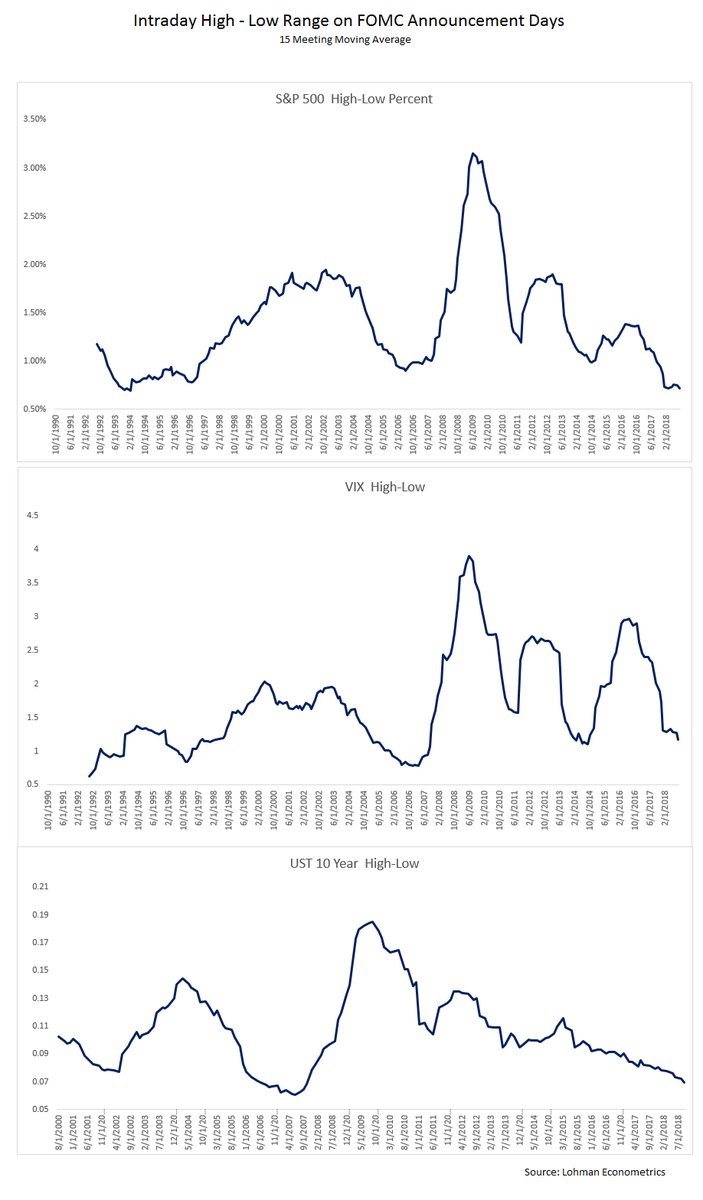
The charts below show the recent Fed decisions haven’t caused volatility in stocks or bonds. There was a bit of volatility after the Wednesday announcement.
Even though this decision was already priced in, the market shifted lower after a brief blip higher. I expected the blip higher, but not the subsequent decline.
The S&P 500 was down 0.33% on the day, increasing the negative streak to 3. The CNN Fear and Greed index has fallen to 53 which is neutral. This means I’m no longer bearish in the short term.
From the peak at 2:20 PM, the S&P 500 fell 0.82%. The Nasdaq fell 0.33% and the Russell 2000 was down 1.01%. The VIX increased 3.78%.
Stocks Fall - Powell Doesn’t See An Inflation Spike Coming
Even though Powell raised rates 3 times this year and is about to go for a 4th hike, he doesn’t fear inflation increasing.
When asked about inflation surprising to the upside, he said “it’s not in our forecasts.” I had previously expected inflation to fall in the next few months because of tough comps. Then would increase later in 2019 because of the tight labor market. However, the spike in oil prices pushes up my estimates.
Oil fell 1% to $71.57 on Wednesday. Inventories rose 1.9 million barrels when they were expected to fall 1.3 million barrels.
However, oil is still in an uptrend. This is partly because America’s sanctions on Iran will cut supply by 1.7 million barrels per day.
President Trump is feeling the political heat from rising prices which is causing him to criticize OPEC for not increasing supply.
The White Houses stated, "We will ensure prior to the re-imposition of our sanctions that we have a well supplied oil market."
These are just meaningless statements to the oil market. It’s worth pointing them out because Trump could get rid of the sanctions if he feels enough pressure from rising oil prices.
Stocks Fall - Update On Fed Funds Futures Market
There is a 100% chance the Fed doesn’t raise rates at the November meeting because there is no press conference. At the December meeting there is a 79.2% chance of a hike.
The chance of at least 2 hikes fell from 6.4% to 0% which goes along with the 2 year yield falling slightly.
Personally, I’m not surprised this occurred. Even though the Fed increased its economic growth projections because as we get closer to meetings, the unlikely outlier scenarios lose potential.
When the event is far away anything can happen, which gives credence to unusual situations possibly occurring.
Another point worth noting is that we can’t make much of small moves in the futures market.
Maybe some expected a hawkish hike to push up expectations for more rate hikes this year. However, the Fed is already going with the most hikes in any year in this expansion while inflation recently decelerated according to the CPI and PPI reports.
You can argue the Fed is too hawkish even though real rates are still low.
Stocks Fall - Estimated Fed Bias
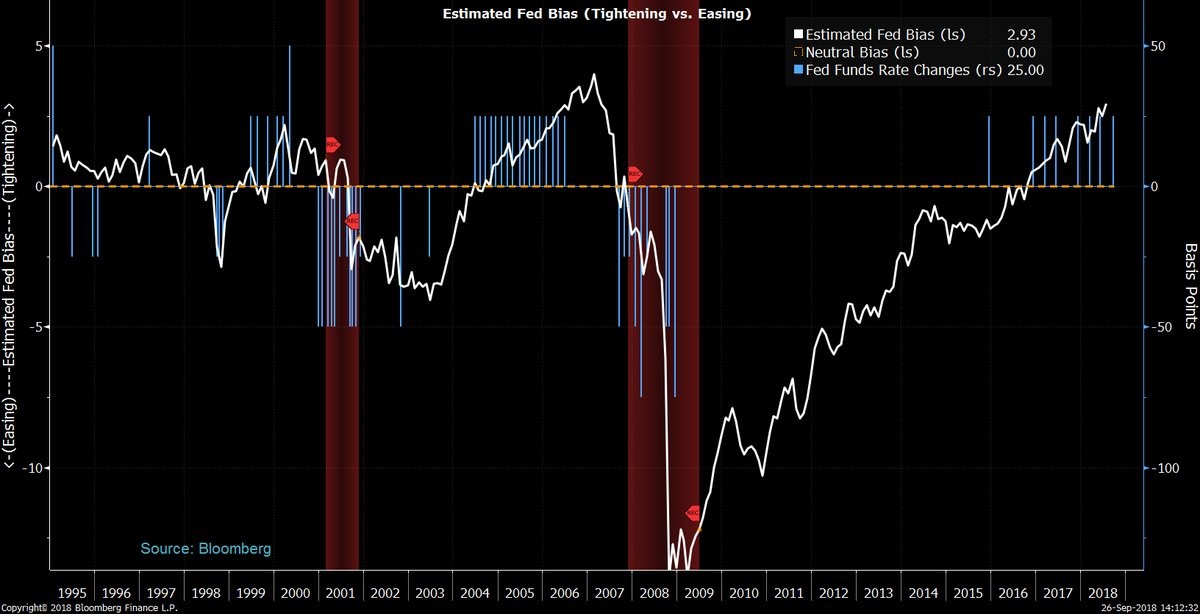
The chart below is interesting because it gives you an idea of how close the Fed is to ending its hike cycle. It shows the Fed bias is tighter than at any point in the 1990s, but is looser than the peak in the mid 2000s.
It’s amazing to see how hawkish the Fed was right before the financial crisis because raising rates effected people with variable rate mortgages who were already paying for a house they couldn’t afford.
Rate hikes helped topple the housing bubble. However, I think more blame goes to the creation of the bubble than how it started.
Keep in mind, in this chart, the bias isn’t perfectly correlated with rate hikes as the bias was high in 2007 even though there weren’t any hikes. The current bias is high even as rate hikes have come slower than last cycle.
Stocks Fall - Conclusion
The action in the next few days will be more important than this knee jerk reaction. If stocks rebound, this 3 day sell off will be forgotten just like the 4 day sell off in the first week of the month.
I’m not a huge bull in the intermediate term, but I don’t see why something which was expected should catalyze a correction. It’s very reasonable to say stocks were way overbought heading into the week. This mini correction needed to happen to settle things down.
The most interesting aspect of the action is that the 10 year yield fell short of breaking the cycle high of 3.11%. If it can’t continue it’s march higher, the yield curve will invert.