Stocks Choppy - Present Day Has Nice Monday Rally
Stocks Choppy might be the case before the 2020 election. For now stocks are enjoying a nice rally. There wasn’t much news on Monday as most earnings reports are later in the week.
Chicago Fed index was the only macroeconomic report that came out. Stocks still found a reason to rally though. S&P 500 was up 0.28%, Nasdaq was up 0.71%, and Russell 2000 fell 0.2%.
Amazon and Alphabet will be reporting on Thursday and Facebook reports on Wednesday. Regional bank index fell again as it was down 0.64%. Small banks are dragging down the Russell 2000. Financial sector has the highest weighting in that index.
Maybe a sentiment reversal helped stocks on Monday. CNN fear and greed index entered the day at 44 which is greed. It rose 1 point on Monday to neutral.
Earnings Season Looks Solid
Stocks Choppy - Sector by sector performance was a mixed bag. Consumer staples and materials fell 0.53% and 0.26%. While tech and energy rose 1.22% and 0.44%.
Obviously, tech will be impacted by Apple’s earnings report which comes out next Tuesday. Q2 earnings season has been solid so far as 85 firms have reported results. 76% have beaten EPS estimates with 5.49% non-GAAP growth. 65% have beaten sales estimates with 2.78% growth.
GAAP growth is 1.13%. Q2 EPS growth is low. But that’s not news as estimates coming into the quarter were weak. Ignore the doom and gloom articles which suggest this is a disastrous earnings season; it’s not.
Stocks Choppy - Reality is stocks are trading on Q3’s estimates anyway.
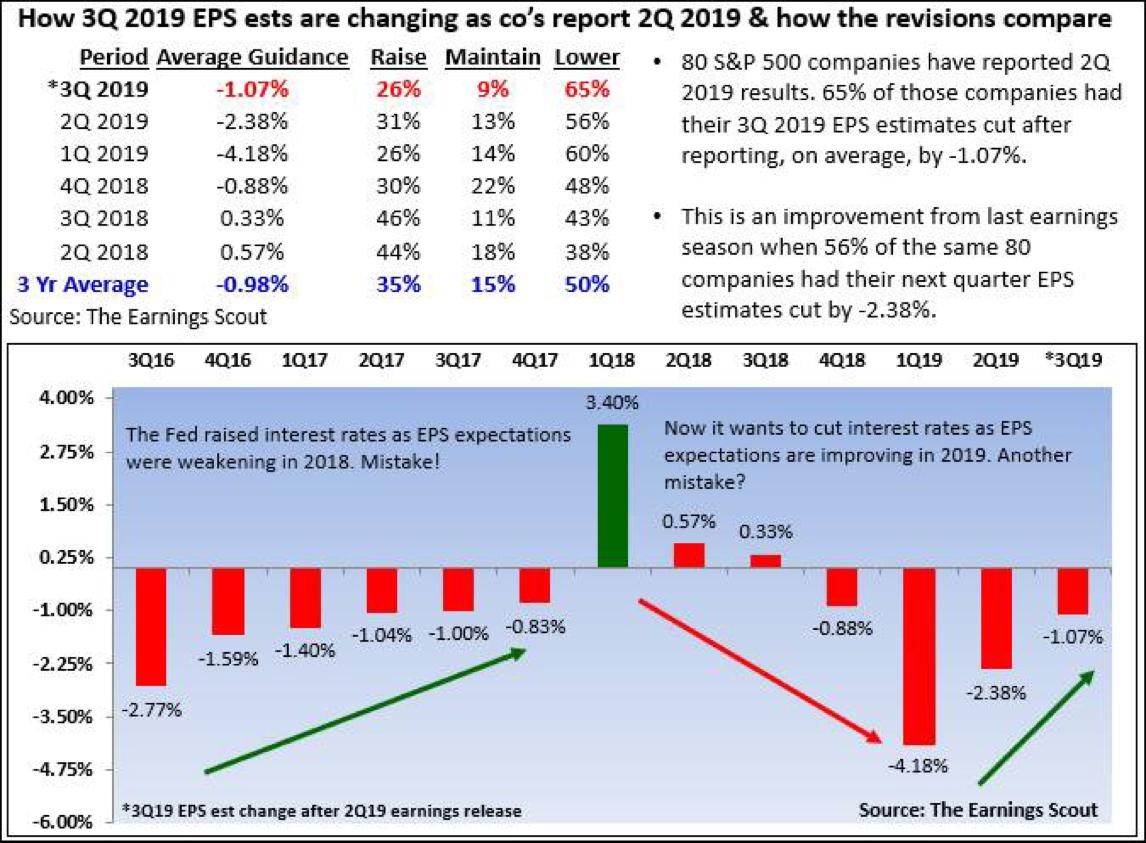
As you can see from the chart below, estimate cuts are lower than the last 2 quarters so far as Q3 EPS estimates fell 1.07%.
Estimates fell 4.18% in Q1 and 2.38% in Q2. This is now a 2 quarter trend of smaller estimate declines. On the negative side, 65% of firms have lower estimates which is much worse than the 3 year average of 50%.
Investors don’t expect estimate changes to get much better than they are now. Key for future quarters, meaning Q4 2019 and beyond is that estimates are starting much higher than the recent few quarters.
With similarly small estimate declines, we can see 7% to 10% EPS growth in 2020 which justifies modestly higher stock prices. It’s no surprise the bears think Q4 estimates are too high. So far, they are wrong. To find out more, we must follow the macroeconomic picture.
Update On Democratic Primary
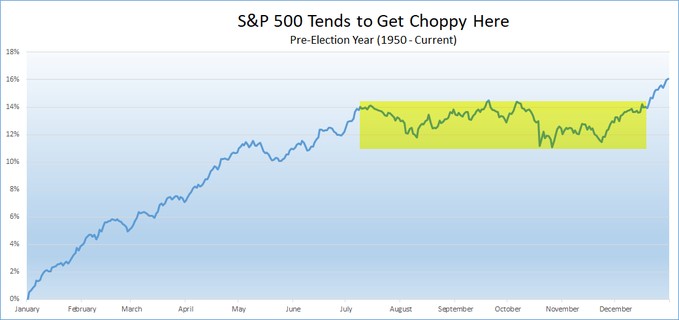
Stocks Choppy - As you can see from the chart below, this part of the election cycle is choppy for stocks. We often see economic weakness heading into election seasons and then a stimulus after a new President is elected.
2016 election cycle was very unusual. The economy had already started to recover in mid-2016 before the election. On top of that momentum there was a fiscal stimulus which helped growth in 2018. That stimulus was priced into stocks in 2017.
Obviously, this cycle doesn’t need to follow the average. I don’t think most investors are actively projecting potential policy in 2021 because it’s too far in advance. There are still 20 Democratic candidates in the primary.
While most of those candidates are long shots, we don’t know how each candidate dropping out will affect the landscape. For example, who will the 1.8% of voters who support Cory Booker support after he drops out?
Stocks Choppy - Primary season is heating up
The second set of debates will be on July 30th and the 31st. Yes, there are still 20 candidates debating. With the advent of the internet and social media, it’s easier for more people to run.
Candidates don’t only rely on the mainstream media to increase their notoriety. Even so, the front runner establishment candidate that is Joe Biden continues to lead in all the polls. His decline in the polls appears to have ended in early July. His average has creeped up from 26% on July 5th to 28.4% today.
The top tier of candidates appears to be Biden, Sanders, Warren, Harris, and Buttigieg. However, it’s still possible one bottom tier candidate has a great debate and increases in the polls.
Many stated Harris did the best in the first set of debates. Polls in the early states, which are Iowa and New Hampshire, show similar results. Except Biden’s lead is smaller.
Looking forward to the general election, the economy will probably play a pivotal role in whether Trump or a Democratic challenger wins.
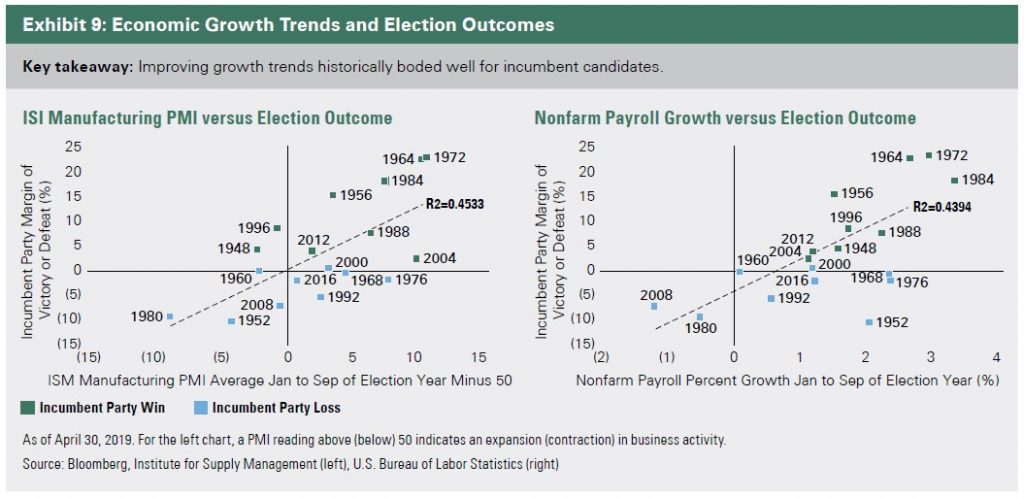
As you can see from the chart below, the manufacturing ISM and non-farm payroll growth have an effect on (or at least predict) who wins elections.
If the ISM manufacturing PMI starts the year low, it has a good chance of showing positive growth. Manufacturing isn’t a huge part of the economy like it once was. But it does a great job of sensing changes in the growth rate of the overall economy.
Labor market is going to have a tough time showing improvement though because it’s already almost full. I would think if the unemployment rate stays low, it will still be a positive for Trump. Even if job creation growth is weak.
If the election was held this November, I’d say the economic backdrop is very favorable to Trump.
On the other hand, in the average of recent polls where the match up is Trump versus Biden, Biden has an 8.5% lead. It’s a big negative for Trump to be behind with a relatively solid economy according to consumer confidence polls. It’s tough to imagine consumer confidence being much higher in November 2020 than it is now.
Stocks Choppy - Conclusion
The stock market’s performance this week will depend on how earnings season goes. First 85 firms to report have done solidly. But we have a long way to go to see if this ends up being an ok quarter.
The election will gradually become more important to the stock market in the next few months. It won’t only affect the healthcare sector soon. It will impact the whole market.