COVID-19 Seems to Get Worse
COVID-19 is looking even worse in the south and the west. For example, 54 Florida hospitals in 25 counties are at full intensive care unit capacity. Furthermore, on July 7th in Orange County California hospitalizations were up 35 in 2 days to 659 which is a record high. In the same period, ICU patients increased 27 to 224 which also is a record high. COVID-19 cases in Texas rose 10,028 to 210,585 in total on Tuesday.
That’s the biggest daily increase since the pandemic started. This negative news means the slowdown will likely continue for the next few weeks at least. The impact on the economy will last a couple weeks after the peak in new cases.
The stock market prices in an improvement before the economy improves because it uses COVID-19 as a leading indicator. However, in the recent spike in June and July, the stock market has completely ignored COVID-19, treating it as a normal flu. Obviously, you don’t want to get your health advice from the stock market. Furthermore, it’s a bad sign for the stock market to ignore bad news.
At a certain point, the news will break the rally if it gets worse. It seems like investors buy tech and electric vehicle stocks every time bad news on COVID-19 comes out. This is creating a bubble in those pockets of the market. Those pockets have gotten so big, they control the entire market. Software ate the world in 2020.
Same Store Sales Growth Falls
It’s clear the economy has been starting to fall backwards for the past 3 weeks. I expect much of the July economic data to be weaker than the June data which might scare some investors. On the one hand, it’s obvious we’ve seen a slowdown. That implies investors shouldn’t be shocked. On the other hand, since they have been buying stocks relentlessly, maybe they will be surprised.
Redbook same store sales growth reading had been improving in prior weeks. Because we’ve seen weakness in consumer confidence, we expected it to reverse its recent trend. Same store sales growth fell from -5.7% to -6.9% in the week of July 4th. It’s important to the weakening thesis that data points that had disagreed with it suddenly come in line. There’s little evidence on the positive side now.
Old JOLTS Data
JOLTS report from May came out on Tuesday. With the economy changing so rapidly in the past few weeks, May data is ancient. Job openings in May increased from 4.996 million to 5.397 million which beat estimates for 4.9 million. We are taking a time machine with this data back to May when the reports almost always beat estimates. It’s surprising economists still managed to be too negative.
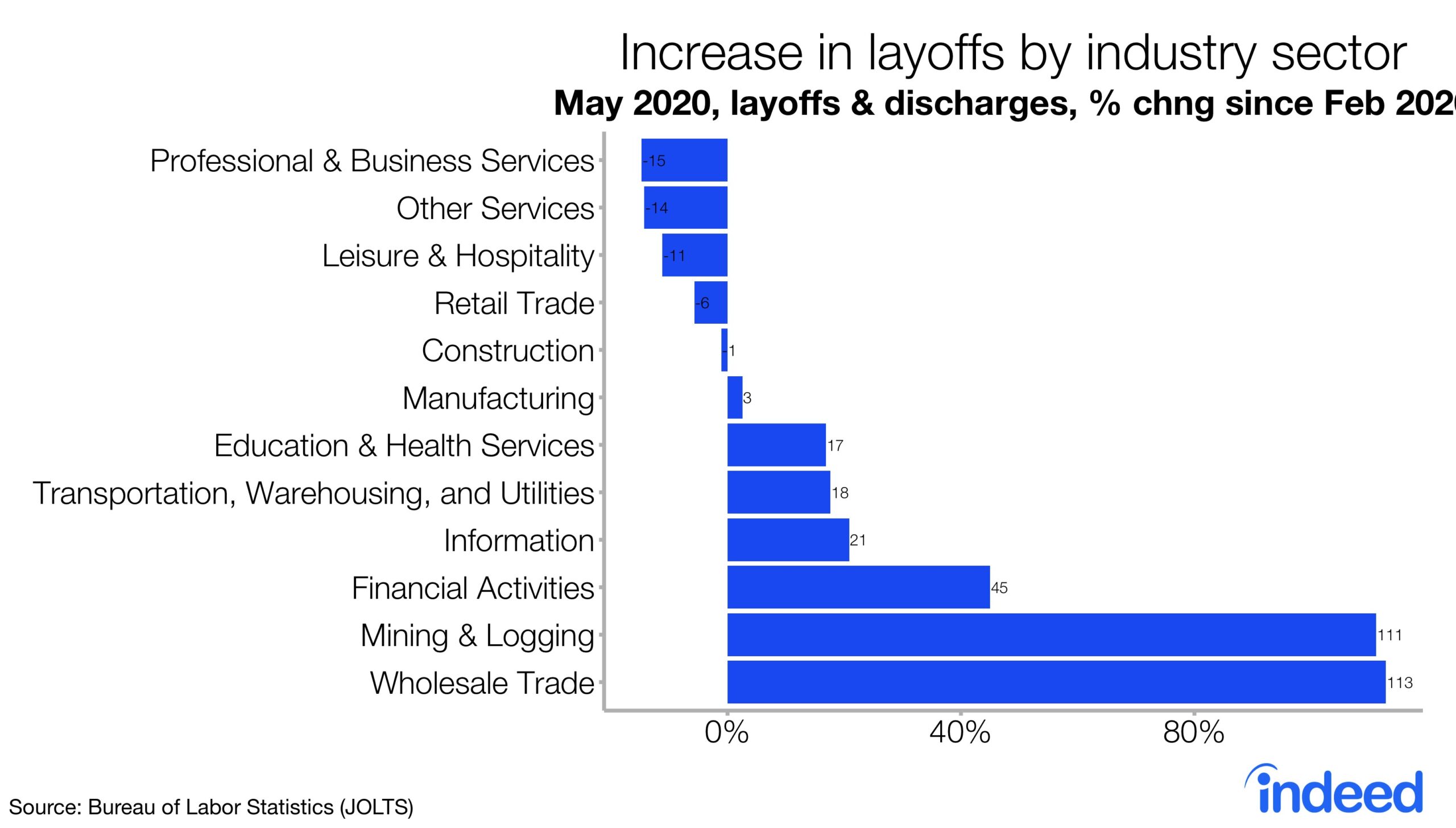
The chart below shows the change in layoffs since February. The results aren’t that bad. Professional and business services layoffs were down 15%. On the other hand, wholesale trade layoffs were up 113% and mining and logging layoffs were up 111%. Clearly, these industries don’t employ that many workers because in February and May there were 1.8 million layoffs. The spike in between was to 11.5 million in March and 7.7 million in April. Considering the great June BLS report, the JOLTS data will be very impressive next month.
Bad News For Potential August Job Creation
A mistaken theory some politicians have is that once the $600 in federal unemployment benefits are taken away, people will be motivated to get a job. Therefore, they say the benefits shouldn’t be extended past July 25th. This will be a huge mistake. The few people who get a job will be dramatically outweighed by the millions of people who suddenly have less money.
It wouldn’t be surprising if spending starts to dry up in the 2nd half of July in anticipation of this loss of income. Obviously, it’s possible the government works out another stimulus. Stock market rallies are bad for the economy in the short term because they encourage lawmakers to ignore potential negative factors. If the stock market fell 15% on economic fears, a stimulus would be passed quickly.
We have a strong idea millions of people won’t suddenly go back to work because these benefits are going away. Firstly, we saw very strong job growth in May and June. If people were holding back on going back to work, we would have seen it in the BLS numbers. We’d also see wage hikes to entice people to come back to work.
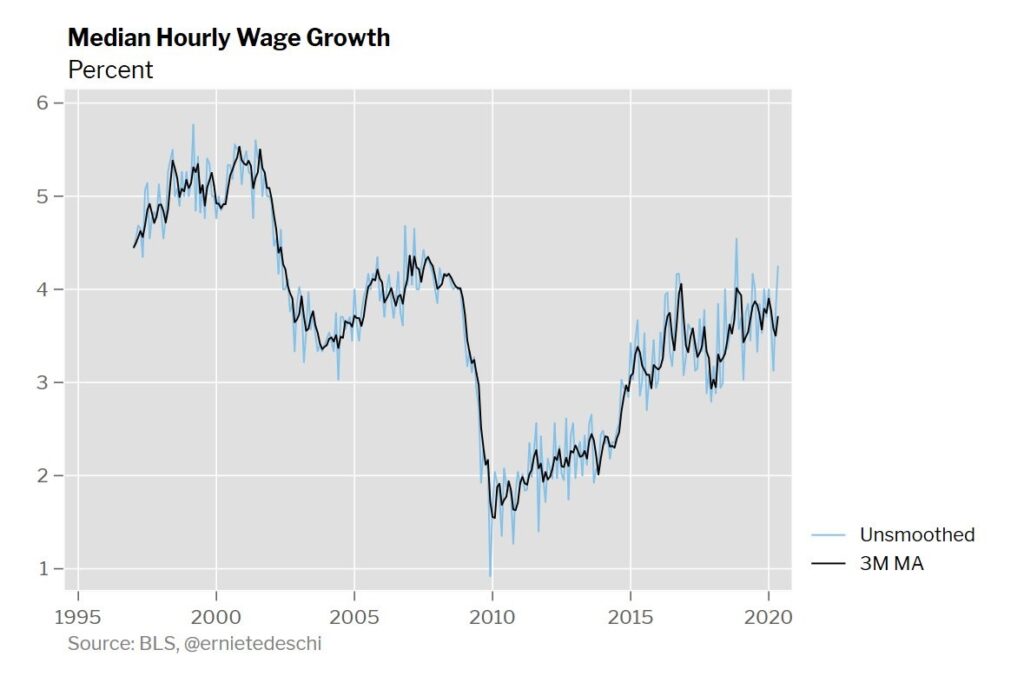
As you can see from the chart above, median hourly wage growth has been stagnant. The average hourly growth readings have shifted because of composition effects. It’s mainly because leisure and hospitality had wild swings (it pays workers the least).
A final explanation, using the data, is job openings aren’t close to back to normal in relation to the number of unemployed people. There would be a spike in openings in relation to unemployed people if there were many people who refused to go back to work when they were offered their jobs back.
Using common sense, people aren’t going to not take their jobs back just for a temporary $600 per week. They will either only go back to work when it is safe or they will want their jobs back because pay will be consistent. There’s no point in risking your long term job to get extra money for a few weeks. People don’t want to rely on the government to get paid especially since the unemployment insurance situation was a debacle in March and April.
Conclusion
COVID-19 is getting worse. Some bulls claim that the low number of deaths is the reason stocks are up. However, that makes no sense because hospitalizations need to increase for a few weeks before deaths increase. There was a spike in deaths to 994 on Tuesday (data dump from the holiday weekend).
Keep in mind, people just need to stay home for economic activity to slow. They don’t need to perish. Redbook same store sales growth weakened because the economy is in a new slowdown.