Small Businesses Optimistic
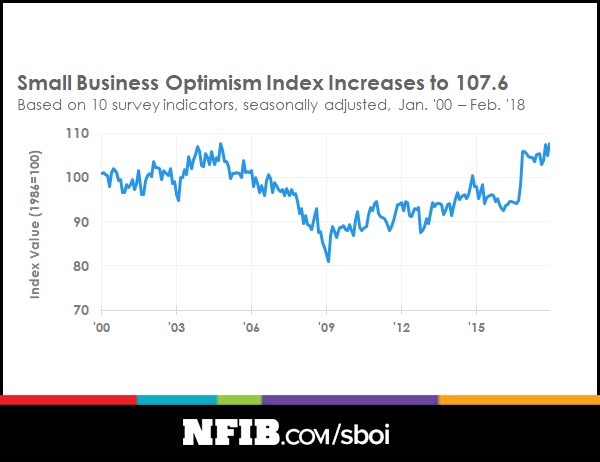
Even though it seems impossible, the small business optimism increased even more in the most recent report. As you can see from the chart below, the index was up 0.7 points to 107.6. The improvements came because of the tax cuts and the improvement to the regulatory situation. We often hear about how optimism is bad, but that’s really only the case for stock investors getting euphoric. If stock investors are euphoric, they push stock valuations too high, making it a bad time to invest. If small businesses are euphoric, then they hire more workers and invest more in their businesses. I fail to see why that’s a bad signal. Furthermore, the stock returns after previous NFIB peaks bear that out as the S&P 500 is up 9.7% in the following year on average after its peak.
It’s interesting to see how much more press coverage the tariffs get compared to deregulation. Trump issued the fewest significant regulations since 1982. The reason it’s easy to cover the tariffs is because it’s simpler policy than individual regulations. Obviously, negative stories sell better. Few people understand the importance of limiting Dodd-Frank, but there’s bipartisan momentum in Congress to go through with it. This will help small banks. It looks like the 86% rally in the KBW small bank ETF in the past 13 months was justified. It would be easier to buy stocks if the headlines about this new deregulation were positive. The good news is the headlines make others sell, giving you a better price to buy.
Labor Force Participation Rate
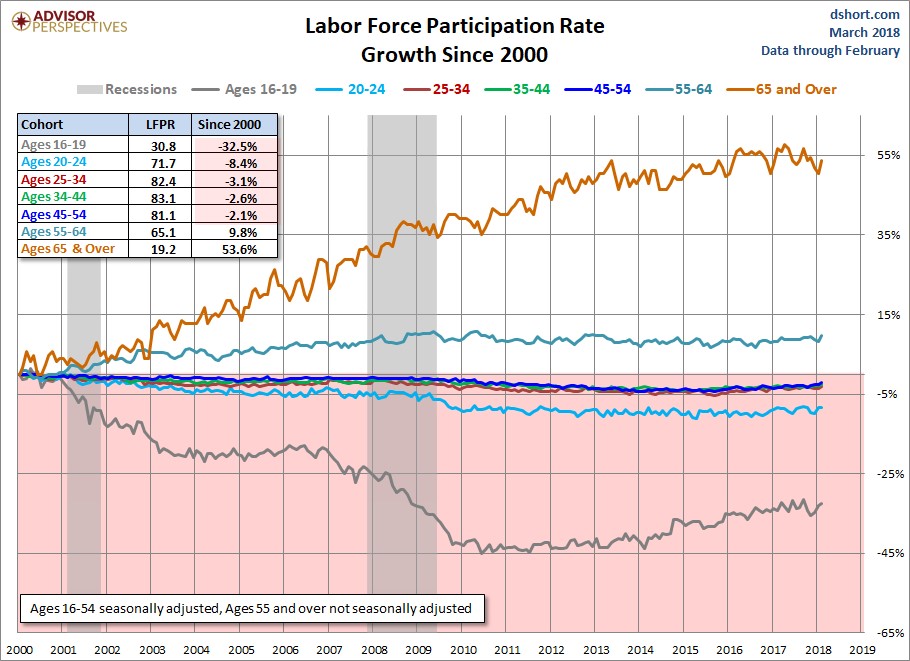
The most important stat in the labor market is the labor force participation rate because the workers who have gotten out of the labor market will be getting back into it. If they don’t come back, then there’s no question wage growth will accelerate this year because the unemployment rate is low. The chart below shows the labor force participation rate for each age group. As you can see, the percentage of teenagers working has fallen by 32.5% since 2000. Even since the recession, the participation rate has barely increased. In the past 20 years, it has become more necessary to get a college degree. This is a generational problem because teenagers have less savings to pay for college. Tuition and book prices have increased astronomically and starting wages are similar to what they were in previous generations. Even those who are 20-24 only have a participation rate of 71.7% which is down 8.4% from 2000. Some of the young workers have been replaced by older workers as the participation rate for those over 65 has increased 53.6%.
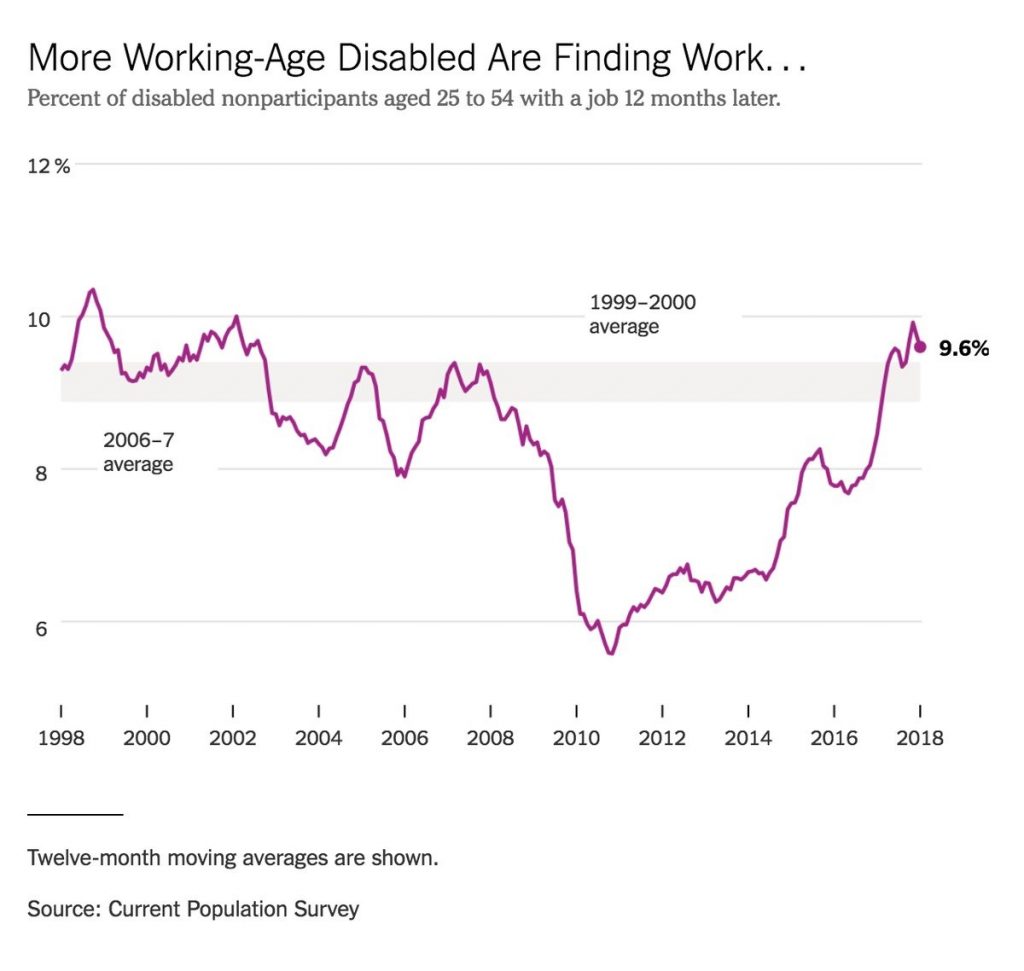
The debate on the labor force participation rate is whether the millions of workers who have been unemployed for years will be able to find a job. Some assert that their skills have diminished. On the other hand, we saw manufacturing companies who were surveyed in the Philly Fed report claim that they are more than willing to train workers to get the employees they need. Companies would rather train unskilled workers than pay higher wages to qualified ones. Furthermore, as you can see from the chart below, more working age disabled people are finding work. The percentage is above the 2006-2007 average, but below the 1999-2000 average. Either workers who are disabled actually aren’t disabled or companies are lowering their standards because they need workers. The fact that disabled people are finding work at this rate signals the labor market might be full. However, this is only one subset of the population, so it could easily be slightly off. My forecast is for the labor force to be full in 2019, so it’s a small difference in timing from what this indicates.
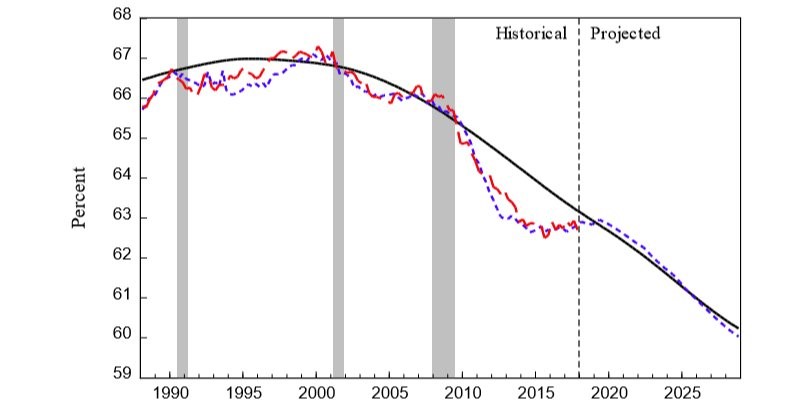
Because of the aging population, the CBO forecasts the labor participation rate will fall further. As you can see from the chart below, the projection is for the percentage to fall below 60% by 2025. Obviously, this chart is just based on demographics, not cyclicality. I think the participation rate will increase this year and next year. In the next recession, it will fall below the long term trend line. This chart explains why the CBO expects the deficits to be high. The most obvious solution would be to raise the retirement age few years. If the government did that, the participation rate would increase. It could be higher than this forecast.
European Labor Market
Clearly there are differences in the labor market in Europe and America, but both countries have similar demographics and inflation patterns. The biggest difference is probably the dispersion among European nations compared to the American states. Alaska has the highest unemployment rate (7.3%), but it only has a population of 739,000, which is smaller than many cities. Outside of Alaska, the highest unemployment rate is 5.8% (West Virginia), signaling most states have relatively low unemployment. However, Europe has a very wide dispersion as Spain’s unemployment rate is 16.4% and Italy’s unemployment rate is 10.8%. That compares to Germany’s 3.8% rate.
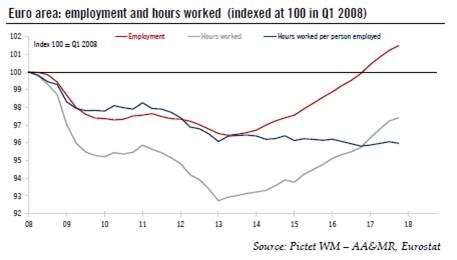
With that information understood, the chart below is an interesting because it shows how employment has improved since 2008, but the hours worked are still down about 3% and the hours worked per employee are down about 4%. This seems to me like the labor market has room to add more employees. Ultimately, it’s tough to paint a broad brush of the whole European economy which is why the ECB has such difficulty meeting its inflation target. It’s quite something to see the ECB at a negative interest rate while Germany has such a low unemployment rate. I think it would make sense to split up monetary policy without splitting up the E.U.
Conclusion
The small business optimism is extreme. That’s a good thing because it means more hiring and business formation will take place. Stocks won’t necessarily crash in the next year if this is the peak euphoria. I think the labor force isn’t full yet, but the percentage of disabled workers getting jobs seems to say that it is full. We’ll see if that indicator is a warming sign or if the prime aged participation rate is a better tell.